

The Russian Empire depends on more than its army and repression. It needs oil, money, transport, control over the periphery — and the belief that nothing can function without Moscow.
Today, all of these foundations are under pressure.
Moscow has cut its forecast for 2026 oil production to 494.2 million tonnes — the lowest level since 2009. Sanctions, export bottlenecks and damage to infrastructure caused by Ukrainian strikes are putting pressure on the sector. Russia has also been forced to restrict fuel exports because of shortages on its domestic market.
But the weakening of the imperial centre matters for more than the battlefield.
The second process is political
As Moscow spends resources on war, representatives of Russia’s subjugated peoples are increasingly discussing their own future. Ukrainian activists and representatives of ethnic minorities in Russia are already developing contacts around a shared opposition to Russian imperialism.
What the Kremlin portrays as Russia’s “internal affair” is increasingly becoming a question of the right of peoples to self-determination.
The third process is geographic
The former Russian periphery is searching for alternatives.
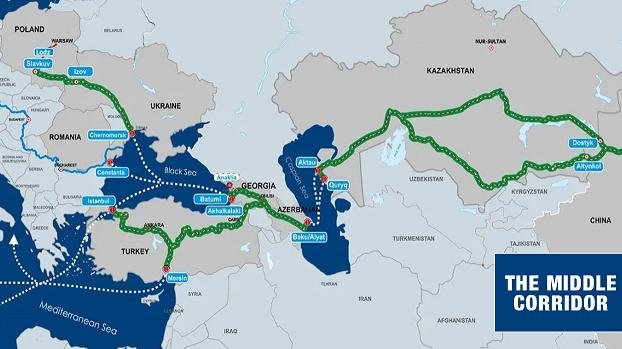
Central Asian states are diversifying their trade, transport and foreign relations. China is rapidly expanding its economic presence, while regional governments seek to avoid dependence on a single centre of power. The development of routes bypassing Russia, particularly the Trans-Caspian Middle Corridor, is especially significant.
The logic is changing.
The question used to be: “How will Moscow influence its neighbours?”
Increasingly, it is becoming: “How can its neighbours build their future without Moscow?”
The fourth process is security
The Baltic states have already gone through this transformation. The former Soviet republics did not merely declare independence — they built their own states, armed forces and alliances, making a return to Russian control far more difficult.
That is the central lesson.
Decolonisation is not the moment when an imperial capital falls. It is the process by which the periphery gradually ceases to be a periphery.
When Moscow weakens economically, its peoples gain more room for political struggle. When neighbouring states build alternative trade routes, they reduce their dependence on the imperial centre. When the former periphery provides its own security, the empire loses the ability to bring it back under control.
The end of the Russian Empire may therefore look very different from the version found in textbooks.
Moscow does not necessarily have to fall first and the peoples become free afterwards.
It may happen the other way around: peoples gradually stop depending on Moscow — economically, politically, militarily and psychologically. And one day the empire discovers that it is no longer the centre of a vast space, but merely one of its fragments.
That is what genuine decolonisation looks like.






