

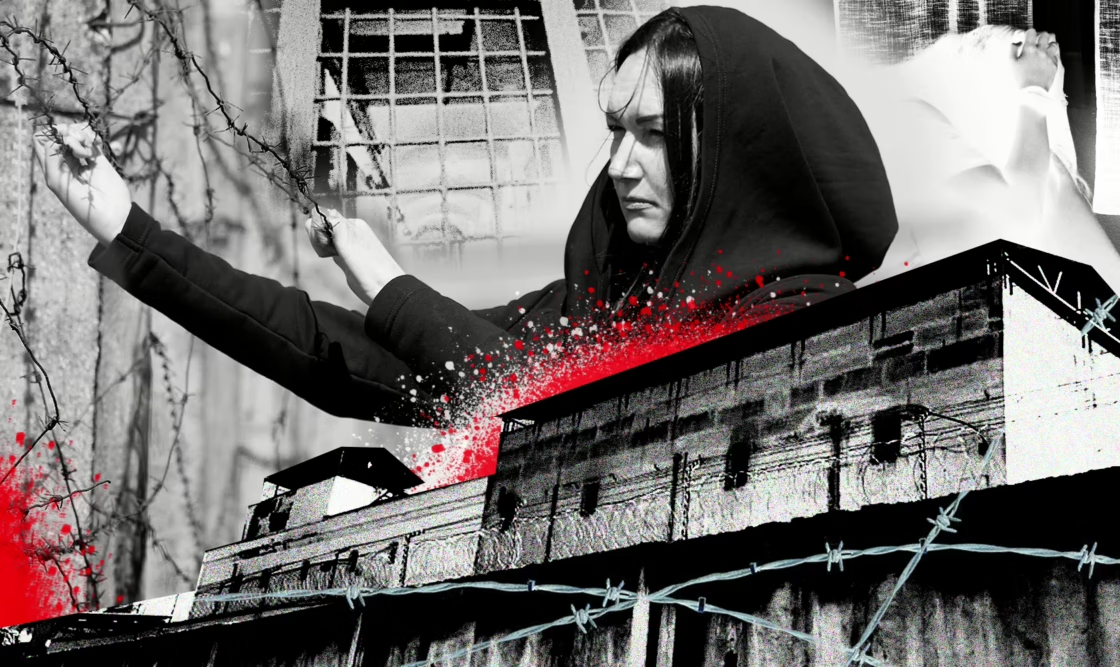
Russia is officially withdrawing from the European Convention against Torture. Over the weekend, Mishustin signed a resolution that triggers the mechanism for refusing the document, and then it’s up to Putin and the pocket State Duma. It would seem that this is another “legal procedure”, but in fact, this is one of the blackest signals in modern history. After all, it is about abandoning the basic rules of the civilized world, including state guarantees of human protection from violence.
The convention, which Russia signed back in the 1990s, allowed international inspectors to visit places of detention without warning and check for torture or inhumane treatment. It was a tool that was supposed to curb prison arbitrariness, and that is why Moscow is now eliminating it. The Kremlin has long demonstrated that it is alien to human rights standards, but now it is finally refusing to even pretend.
What does this mean in practice? Now, no international committee will be able to unexpectedly enter a colony or pre-trial detention centre and record beatings, torture, or humiliation. Now the Russian authorities can hide any crimes against humanity with impunity, and those who dare to testify about torture will be left without protection. This is not just a withdrawal from the agreement – it is a public recognition that torture and repression are becoming an “internal affair” of the state.
It is important to understand: when the Kremlin abandons international norms, it does not only concern Russians. In Siberia, the Caucasus, the Volga region or the Far East – wherever indigenous peoples live, repressions were already harsher than in the centre. For Buryats, Sakha, Ingush, Chechens or Azerbaijanis, this means even greater defenselessness before a system that has long treated them as second-class citizens. Suffice it to recall how Russian security forces conduct raids on Azerbaijanis in Yekaterinburg or Chechens in Moscow – without any guarantees, without lawyers, only based on “operational data”. Now, such practices are officially becoming the norm.
It is worth remembering that Russia has long since embarked on a course towards complete isolation: first, it withdrew from the Council of Europe, then refused to implement the decisions of the ECHR, and now it is cutting the last threads that somehow connected it to the international system of human rights protection. Under the slogans of “protecting sovereignty,” the Kremlin actually defends only the right to torture its own citizens. And it is here that the true nature of Russian imperialism is revealed: a state that seeks to dominate considers torture and intimidation not as an aberration, but as the main mechanism of governance.
This issue is particularly painful for Ukraine. Thousands of Ukrainians are currently held in Russian prisons and pre-trial detention centres – prisoners of war, ethnic Ukrainians who are citizens of the Russian Federation and civilian hostages deported from the occupied territories. Moscow’s rejection of the convention effectively removes any external barriers to torture over them. International organisations will lose the ability to check the conditions of detention, and every Ukrainian in captivity will be left alone with the executioners. This is not only a crime against the law, but is a crime against humanity.
But it is not only about Ukraine. The rejection of the convention is also a signal to the Russians themselves. They are clearly shown: you are completely in the power of the system, and no one else will protect you. Those who today silently swallow propaganda about “external threats” may find themselves in a cell tomorrow, where any beating or humiliation will remain unwitnessed. This is a return to the dark times, when the state was the master of a person’s life and death.
The Kremlin explains these steps as “protection from foreign interference,” but in reality, it is a matter of banal fear. Because independent inspections could show the world what Moscow is so carefully hiding: the scale of torture, deaths in prisons and inhumane conditions of detention. The Kremlin decided: it is better to break the rules than to allow the truth to break out.
This step further intensifies the feeling of hostility between the Kremlin and neighbouring peoples and countries. Azerbaijan has already publicly expressed its protests against the arbitrariness of Russian special services, which treat citizens of other states as if they were their own slaves. For the Anti-Imperial Bloc of Nations, this is confirmation: we are dealing with a regime that will stop neither at the torture of its own nor at the humiliation of strangers.
It is solidarity between the nations suffering from Russian tyranny that becomes the key to combating this barbaric relic of the past.
Russia is trying to sell this step to its citizens as a “victory,” but in reality, it is a capitulation to its own fear and its own criminal past and future. It has failed to resist the temptation to once again become an empire of torture chambers and dungeons, where torture is not a crime but part of the system. And this choice means only one thing: Russia is sinking even deeper into isolation, degradation, and barbarism.
For us, Ukrainians, this signal is extremely important. We see that we are dealing not just with an aggressor, but with a regime that has abandoned any rules of the civilized world. And the longer it exists, the more torture, deaths and crimes there will be. Russia has withdrawn from the convention, but the world has no right to withdraw from the fight against this empire.
Daniel Kozachok






