

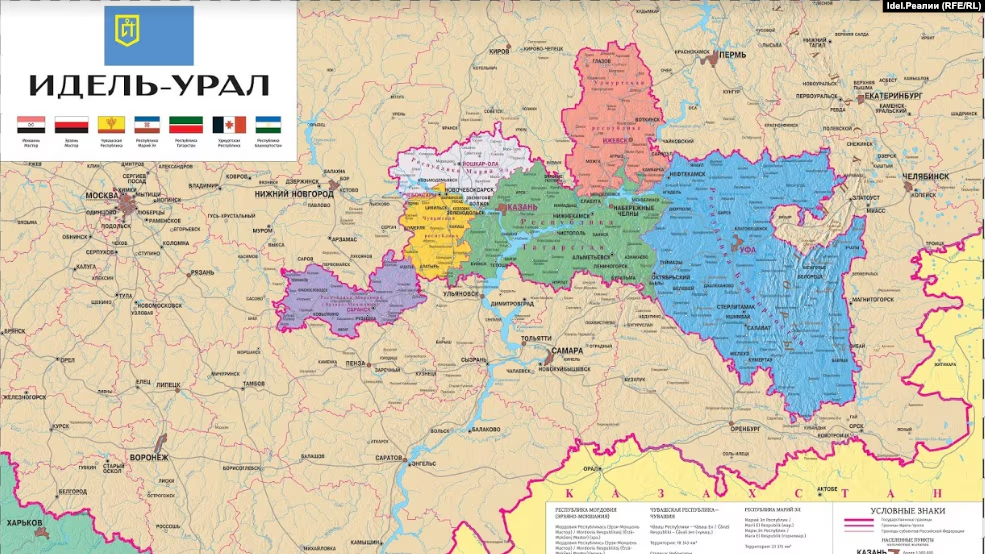
US President Joe Biden has declared the period from 21-27 July 2024, Captive Nations Week. Against this backdrop, the public association League of Free Nations is holding events worldwide, demanding the right to freedom for the people of Russia. Idel.Realii interviewed activists of the Volga region people and an expert on the Finno-Ugric people about whether the measure taken annually by Washington is morally outdated.
Captive Nations Week is an annual series of mass events originally aimed at drawing public attention to the problem of “captive nations under the control of communist regimes.” According to this law (adopted in 1959), the President of the United States is authorized to proclaim “Captive Nations Week” annually – until all of them gain freedom and independence.
The text of the Congressional resolution, which became law in 1959, listed the following countries and territories: Idel-Ural, Tibet, Kazakia, Turkestan, North Vietnam, Poland, Hungary, Lithuania, Ukraine, Czechoslovakia, Latvia, Estonia, Belarus, Romania, East Germany, Bulgaria, mainland China, Armenia, Azerbaijan, Georgia, North Korea, Albania.
“THE PRICE OF GASOLINE IS MORE OF A CONCERN”
Artem Medvedev, a representative of Free Udmurtia who lives in the USA, believes the measure is still relevant.
– Obviously, one “week” is not enough. But American politics is based on the voter. And his internal matters – for example, the price of gasoline – worry him more than the situation of the nations of Idel-Ural. So, thanks for what we have, – he says.
Medvedev believes that many nations within Russia are in an unequal position relative to the ethnic majority.
— Therefore, the simplest parallel for the West is that Udmurts, Kalmyks, and Buryats within Russia occupy a place slightly higher than, say, Mexicans in the USA in the 1990s or the black population in the 1960s. Equality of opportunity is declared, but try to find a state kindergarten in Russia, a school, a university with education and communication in the native language [we are talking about the languages of the nations of Russia, other than Russian], — Medvedev notes.
The activist clarifies that decolonization is a very important process.
— Russians do not realize it, because they do not have any particular problems with ethnic self-realization — in any movie theatre the films are shown in Russian, 99% of textbooks are in Russian, and government services are in Russian. It is important for us — the representatives of small nations — to convey to the Russian majority that the desire to be a Kalmyk, Mari, Chuvash or Udmurt is as natural and normal a desire as, for example, going to Turkey for the summer. Not a whim, not a foolishness, not a fashion, — he says.
AMERICA HAS NO TIME FOR IDEL-URAL
The author of the project “Angry Chuvashia” and the former head of Navalny’s headquarters in Cheboksary, Semyon Kochkin, believes that in 2024, American society and American politicians are interested not in the nations of Idel-Ural, but in the US presidential elections.
— Promoting your agenda there during such high-profile events seems like an impossible task. It seems to me that the issues on which it would be possible to work with the States are sanctions [against Russia]. There are specific people because of whom our republic is turning into a military factory, where new funeral notices arrive every day. The Chuvash identity is being replaced by Great Russian pseudo-patriotism. Some specific people are pursuing this policy. At the same time, only 8 people from the ruling elite of Chuvashia are under American sanctions, — he complains.
Kochkin also hints that the measure of declaring Captive Nations Week is outdated.
“The Week of Captive Nations appeared at a completely different time. Then the only opportunity to tell fellow tribesmen about the real situation was Radio Liberty,” the activist believes.
Kochkin claims that for him and his associates, work within the republic is more important than steps at the international level.
— And even though over the past 70 years there have been many unfree nations, there are those who have managed to become not only free but also truly successful and rich. We, despite emigration, still have the opportunity to speak directly with people in Russia. They listen to us, people inside participate in our projects. For us, work inside Chuvashia is a higher priority than work in the international direction, — he shares.
At the same time, as the Chuvash activist notes, his team lacks the resources and experience for international activities.
— But despite this, if international organizations want to know what is happening in the republic, then [they] turn to us. The problem is that it is really difficult to hear people in Cheboksary, Tsivilsk and Batyrevo because of censorship and pressure. But we make these voices as loud as possible. I hope that soon we will hear these voices not on the streets of Washington, but on the streets of the republic’s capital, — Kochkin concludes.
“OUR DESIRE TO FREE OURSELVES FROM ‘GUARDIANSHIP’ HAS NOT GONE ANYWHERE”
Erzya elder Syres Bolyaen is more optimistic about international activity. This year, according to him, actions are being held in the USA, Germany and Lithuania. In the USA, they will be held in several states at once. He also maintains the position that the American president’s measure has not lost its relevance.
— <…> Of course, the Captive Nations Weeks are more relevant than ever! It is a reminder to dictatorial regimes that our desire to free ourselves from their “guardianship” has not gone away! We have fought, are fighting and will fight until we achieve our goal. In addition, it is a signal to that part of our people that is directly under occupation. This is what it is called! A signal showing that there is still hope, that there are people who have not given up and, being outside the concentration camps, have not forgotten about their compatriots, — he shares.
According to Bolyaen, the situation of the Erzya is not much different from that of other “enslaved nations.”
— The civilized world should understand that adherence to Moscow-centrism, and attempts to preserve the familiar structure of the world is not just concern for one’s relative comfort, it is not just non-interference, not just maintaining neutrality, it is participation in the destruction of our nations. The collapse of the Russian Federation cannot be prevented, just as it was impossible to save the USSR, but preparation for this collapse, assisting our peoples in creating their own states can significantly minimize both the economic losses of the world community and the number of human victims. The Erzya national movement is a co-founder of the League of Free Nations, — he concludes.
Last year, the Russian Prosecutor General’s Office declared the League of Free Nations and the Forum of Free People of Post-Russia movements “undesirable.” The agency noted that these associations advocate separatist slogans and pose a threat to the foundations of the constitutional order and security of Russia.
THE POOR SITUATION OF THE MOKSHANS
The head of the Moksha National Committee, Donisi Chovganon, also spoke about the relevance of the Week of Captive Nations.
— A very timely measure, I would say. Many in the West, especially in the United States, believe that empires are a thing of the past with the collapse of the socialist camp, but this is not so. Moscow and even Beijing, which looms behind it, have managed to not only restore, but also strengthen the assimilation of enslaved nations on the fragments of the bygone era of bipolar confrontation: Turkic (Uyghurs, Bashkirs, Kyrymly), Samoyed, Altai and, of course, Finno-Ugric. It is the latter that is in a desperate situation, practically on the verge of extinction, so the annual Captive Nations Week is one of the ways to show that we exist, that we are fighting for our freedom, just as the Estonians fought the Hungarians 40 years ago, — he notes.
According to Chovganon, people living outside Russia are practically unaware of the situation of the Finno-Ugric people of this country.
— Even in Estonia, Hungary and Finland, not to mention Poland, Germany or France, our people are still considered one with the Erzya, using the word “Mordvin/Mordvin”, which has become an insult based on nationality, both in everyday life and in academic circulation. The dire situation in which the Mokshas have found themselves together with other Finno-Ugric neighbours of the Volga region depends solely on the will of the Moscow Kremlin: if they decide to make all Mokshas Russian, then so be it, the people will not particularly resist because of their mentality and character to adapt to everything, even the worst, — he believes.
Between the last three censuses of the Russian population — from 2002 to 2020 — the number of people counted as “Mordvins” has decreased by almost half. However, the decline is not the only problem of this group. There is a big difference between the approaches of the Russian authorities and activists to the identity of the ethnic group. The former believe that there is a people called “Mordvins”, while the latter claim that “Mordvins” do not exist — there are “Erzyans” and “Mokshas”. In the census results, the ethnic group is called “Mordvins”, while “Erzyans” and “Mokshas” are presented as sub-ethnic groups.
After the start of Russia’s full-scale invasion of Ukraine, Moksha and Erzya, along with representatives of other nations, were actively recruited to participate in the war on Russia’s side.
— The mobilization of Moksha men to the Ukrainian front since the fall of 2022 is separate proof of this. The West should understand that the root of all evil in Northern Eurasia is Moscow (more broadly: Russia), so it is necessary to help all those movements aimed at its disintegration following the example of the USSR. Yes, there will be no catastrophe, especially a nuclear or civil war, because Moscow is a vassal of Beijing, and Beijing (more broadly: the Communist Party of China led by Xi Jinping) does not need a wasteland from Pskov to Vladivostok, it needs a controlled territory for the export of resources. Fortunately, Mordovia and the neighbouring lands where the Moksha live (Penza, Tambov, Ryazan, Saratov) are of no interest to the Chinese, and therefore the European part of the Russian Federation can be bloodlessly transformed into new independent, sovereign states with a non-nuclear status. This is what the Moksha National Committee is striving for, he concludes.
Olivier Loode, director of the Uralic Centre for Indigenous Studies and former member of the UN Permanent Forum on Indigenous Issues (PFII), agrees with activists who believe that Captive Nations Week is an appropriate measure even after the fall of the communist Soviet Union.
— Any political initiative of the United States and the Western world that draws attention to the oppressed situation of indigenous peoples living in the territory of the Russian Federation should be welcomed and supported, including the Week of Captive Nations. This is truly timely and relevant, because many of these enslaved indigenous peoples themselves are making new efforts to defend their rights in the form of independent national movements, as well as networks that unite them, such as the League of Free Nations and the Forum of Free Nations of Post-Russia, — he believes.
Loode calls for the measure to regain its former political content. To do this, he proposes taking concrete steps.
— Captive Nations Week, which still formally exists, does not have the same political weight as it did during the Cold War. It seems to me that national activists take this much more seriously than the government or the US Congress. Much more needs to be done to make this Week relevant: for example, hearings in Congress of leaders of independent national movements, and official meetings with US presidents and other high-ranking officials. I know that there are people in Washington (DC), including in the community of analysts and think tanks, who support this, but so far I have not seen any concrete steps or serious political will in the US to move in this direction, — he says.
Asked what the US should understand about the state of affairs of the Finno-Ugric peoples of Idel-Ural, Loode says that he “does not expect that the West, except for the Finno-Ugric states – such as Estonia and Finland (Hungary is effectively out of the picture) – will show special interest or attention to the Finno-Ugric peoples of Russia.”
— It should consider all indigenous peoples of Russia as a whole and equally important. At present, Western centres of power seriously lack knowledge about the indigenous peoples of Russia as a whole, and the mainstream Russian opposition has done little to educate them on the issue. However, the power that some Finno-Ugric peoples of Russia can bring to the broader discourse and movement to decolonize Russia is linked to their knowledge and contacts in Estonia and Finland, as well as the EU as a whole. Many representatives of the Finno-Ugric intelligentsia of these peoples were educated in these countries, work and live there. The problem is that most of them are politically passive. But collectively they could form a powerful force for the decolonization of their peoples if only they wanted to and were able to overcome their fears, — the interviewee believes.
Loode believes that activists, in turn, should be more visible in the political arena.
— The most important thing is that such activists exist. For me, the main problem in this broader issue is not even the lack of political support from the West, but the lack of serious political activity among the majority of Finno-Ugric peoples of Russia. Sometimes it seems that Russian colonial and assimilationist policy has already fulfilled its mission of neutralizing these peoples, reducing them to folklore figures. For a people to be able to count on support from outside, they must be able to self-organize, formulate their goals and clearly convey them to the outside world. So far, among the Finno-Ugric peoples of Russia, I see this only in the Erzya movement, but this is clearly not enough. Only those people who want to decolonize themselves have a chance to decolonize. Unfortunately, I do not see such a desire at the collective level among these countries. However, many smart and talented people could lead such movements and, ultimately, receive serious support from the West, — Loode summarizes.
- Not only the Russian authorities but also representatives of the Russian opposition disagree with the separatist rhetoric of the regionalists. Thus, with the beginning of Russia’s full-scale invasion of Ukraine, Mikhail Khodorkovsky repeatedly said that he was against separatism, and representatives of the Anti-Corruption Foundation (FBK) made a forecast about the unlikelihood of Russia’s disintegration. Leonid Volkov spoke about this in July 2022, and Vladimir Milov in February 2023. In mid-July 2023, Georgy Alburov also wrote about this, calling the idea of the separation of Bashkortostan and Tatarstan marginal.
- In recent years, Russia has been criticized for its pressure on activists advocating for federalism in the Russian Federation and its “assimilationist” policy towards its indigenous peoples and national minorities. At the same time, experts and activists point to dismantling the state’s federal foundations.
- The Russian authorities are stepping up persecution – now criminal – of activists who speak out in defence of federalism, regional powers, and the rights of indigenous peoples inhabiting the Russian Federation, criminalizing even political speech (guaranteed by the country’s Constitution). This has led to activists increasingly speaking out about their desire to separate from Russia.
- Last year, the Russian Prosecutor General’s Office declared the League of Free Nations and the Forum of Free Peoples of Post-Russia movements “undesirable.” The agency noted that these associations advocate separatist slogans and pose a threat to the foundations of the constitutional order and security of Russia.
- On 7 June 2024, the non-existent organization “Anti-Russian Separatist Movement” was recognized as “extremist” in Russia. The court hearing at which the decision to ban it was held behind closed doors. According to the Russian Ministry of Justice, which initiated the lawsuit to ban the non-existent organization, this movement is aimed at “destroying the multinational unity and territorial integrity of Russia.” No distinctive features of the movement or its symbols have been reported. No official organizations, parties or movements with this name have been previously known to be registered in Russia or the world.






