
Since February 2014, many publications have appeared, the authors of which prove that the war during which Russia occupied Crimea and part of Donbass is a completely new type of conflict, which humanity has faced almost for the first time in its history.
Let’s try to figure it out, and to begin with, let’s ask ourselves a few questions. Why is this war with Russia? Why is Russia constantly at war with its neighbors and not only with them? Why does Moscow give unconditional priority to external problems, practically ignoring internal ones? Why is she herself in most cases the source and generator of all these problems?
Not finding answers to these and similar questions, foreigners attribute everything to the “mysterious Russian soul”, which, according to the classics of Russian literature, is seemingly impossible to comprehend with the mind.
Meanwhile, the answer on the surface lies in the fact that Russia belongs to a really different civilization, which, despite apparent changes, at its core – namely the mentality of the people and the system of state administration – remains unchanged for centuries . The history of Muscovy, its “military expeditions”, “liberation campaigns”, “international” and “peacekeeping” operations in relation to Novgorod, Kazan, Crimea, the Caucasus, Siberia, Lithuania, Afghanistan, Iran, Finland, Poland, Ukraine and all others on the perimeter of Russia show the practical immutability of the methods and tactics of Russia’s war.
“To talk about the fact that Russian policy changes over the years is unwise, neither it, nor the credulity of Russians, nor the methods by which Russia hopes to achieve the longed-for dream of all its rulers – world domination … The peculiarity of Russian policy that catches the eye is the amazing constancy not only of its goals, but also of its means, which are completely independent of what the government stands for at the moment in power. In the crisis that we are observing now, there is no feature, no process, no document that we would not find in all previous international crises unleashed by Russia. And if the success of this hereditary policy speaks of the weakness of Western states, then the longing uniformity of its principles is an indicator of Russia’s internal barbarism.” This quote by K.
No matter how the name of the state between Europe and the Pacific Ocean changes – the Horde, the Muscovite Empire, the Russian Empire, the USSR, the Russian Federation – its goals have always been and remain external expansion and suppression of freedom.
At the same time, Moscow did not officially attack anyone, but “defended itself against an attack being prepared against it.” Russian propaganda, which has served the khan-tsar-general secretary-president for centuries, has achieved virtuosity in intimidating and fooling its own population, including using a technique called “projection” in psychology – accusing the enemy of something that he does not even think to plan or the more to carry out, but in what Moscow itself is doing or is going to do: in aggressive intentions, violation of national rights, interference in internal affairs.
Since January 2014, the Kremlin has conducted a powerful information campaign that “thousands of Bandera residents are going to capture government bodies in the east and south of Ukraine” – as a result, these bodies were captured, but by Russian servicemen without chevrons and epaulettes. In parallel, there was a wave of disinformation about the plans of the new Kyiv authorities to shut down Russian TV and radio channels. In fact, the first thing the occupiers did in Crimea and Donbas was to turn off Ukrainian programs.
The same can be said about the lie about the “oppression of the Russian language” in Ukraine – with its hundreds of Russian schools, dozens of Russian-language TV and radio channels, hundreds of Russian-language periodicals – despite the fact that there are practically no Ukrainian newspapers, TV or radio programs, and the only Ukrainian library was closed 4 years ago, its director – a Muscovite and an ethnic Russian woman – was imprisoned “for Ukrainian nationalism”.
Verbally speaking against the recently still mythical “Russophobia”, the Kremlin has in fact become its generator and in recent years has proved that it is the most important Russophobe in the world, because with its arrogance and lies about Crimea and Donbass, murders of political opponents, total planting on ” doping needle” of Russian athletes, cyber interference in elections in the West lowered Russia’s image to a level not seen since the Cold War, and made millions of ethnic Russians outside the Russian Federation suddenly feel the danger of further communication in Russian – “and suddenly we, as Russian speakers, Putin will come to defend?!”.
Constant confrontation with the whole surrounding world over many centuries has developed in the Kremlin and its subjects their own understanding of justice and morality – deliberate lies have become “commonplace” for them. Anyone who had the opportunity to communicate with Russians in recent years – from politicians and political science doctors to ordinary citizens – could not help but pay attention to the blatant objectivity of their assessments of the behavior of the Russian leadership, their total disregard of facts that contradict their statements, the complete identity of these statements with what the authorities say. Moreover, such “assessments” are made absolutely sincerely, even earnestly and without the slightest doubts about their correctness. Because from their point of view “there is a war going on with the whole surrounding world, and during the war a lie to the enemy is not a lie, but misleading him.”
At the same time, in addition to the leadership of the Russian Federation, its apologists among the political class and the broad masses, one cannot help but see hundreds of thousands and millions of citizens whose goals, morals and actions are incompatible with official propaganda and the “position” of their subjects.
Those who call themselves “Russians” in Russia are actually two antagonistic nations that speak the same language, but have completely different mentalities and values - a relatively small number of actual Russians and a mass of Hordeans.Russians, who love their homeland and want it to become a normal democratic country, see no prospects in the “pipeline economy”, are sick of militarization and external expansion, who do not perceive the limitations of their freedom and for all this are subject to the authorities and the Kremlin media of ostracism, are declared the “fifth column” and are actually an enslaved people in their own country. Hordy people, who do not care about the quality of life and who have one goal – to make Russia “feared, which means respected.” Who are not frightened by sanctions, nor a reduction in the quality of life, nor restrictions on their rights, nor the death of their compatriots on foreign land – on the contrary, it unites them even more closely around the leader. Those about whom N. Nekrasov once said: “People of the serf rank are real dogs sometimes; the heavier the punishment, the more kind to them, Lord.”
If the revolutions in other countries were and are the result of the unlawful strengthening of the pressure of the power of the monarch or usurper and were directed against the strengthening of oppression and injustice, against the suppression of the rights of the lower classes, in Russia, on the contrary, revolutionary explosions took place and are taking place in periods of weakening of the pressure of the government on the people, due to the fear of the latter before the impending freedom. In Russia, uprisings and revolutions – no matter how democratic the formulations and slogans of their leaders – were always aimed at strengthening the central government at the level of the mass subconscious. At the same time, the degree of popularity of this or that politician or military leader, the scale of bowing to him depended not on the success of his management of the country or the command of the army, but on the degree of his tyranny and the number of lives he lost. The masses did not condemn either the oligarchs or the generals for anything,
One of the reasons why Russia has never had and still does not have “good neighbors” – the horde is always looking for confrontation and war. It was created for war and cannot exist without war. According to Ukrainian blogger Dmytro Chekalkin, Russia has become “a unique concentration camp where prisoners protect themselves, hate everyone who is free and are ready to die for the expansion of the “zone”.
The Horde has always practiced and practices “hybrid war” as a war without rules: ignoring the laws and customs of war established by international conventions, mixing the military with civilians, using the latter as “human shields”, bombing residential buildings, brutalizing prisoners, etc.
The Horde never made anything of quality for life – it always took it all away from others. Qualitatively, she made and makes only weapons – as a tool for taking away what is needed and what brings death.
The cult of death is a separate topic for the state, in the center of which there is a pyramidal tomb and a cemetery.
And what about the West? He either remained shyly silent or “expressed concern”, for years and centuries vainly hoping that Russia would become civilized anyway without a fundamental change in its basic “values”.
And here, again, it is worth quoting the words of K. Marx from his aforementioned work: “The Russian bear is capable of anything, if he thinks that the other animals in the forest are incapable of anything … The West does not dare to adopt a single policy that simultaneously would achieve two goals: ensuring peace and preserving one’s own dignity … The West responds to the arrogance of the autocrat with signs that are interpreted as cowardice. If the Western powers would from the very beginning speak a masculine language that corresponds to their real military and economic power and their responsibility to the world, if they would immediately show that they are not impressed by bragging and gestures of imposing, then the king would not only leave all his aggressive intentions right there , and would experience a different feeling towards these states than the contempt that now smoulders in his heart.”
The modern reminiscence of the ex-prime minister of Lithuania Andryus Kubilius resonates with this opinion: “In the Western capitals they say that if you send them (Ukraine) lethal weapons, you will thereby provoke the Russian army. I am saying that if we do not provide Ukraine with sufficient military support, it will further provoke the Russian military. I call it gangster mentality: back in 2010, as prime minister, I had an informal conversation with Putin for an hour, and after that I had the impression that I had known this man for a long time. He reminded me of a young gopnik from the suburbs of Vilnius, where Russian speakers live. If such a person understands that you want to negotiate, he primitively interprets this as your weakness and strikes.”
Therefore, the so-called “peace parties” are essentially “war parties”, since their calls for peace and compromises with the aggressor only convince him of the correctness of ignoring the existing rules and stimulate the deepening and expansion of aggression.
Therefore, both Ukraine and Europe should change their attitude towards Russia and their behavior towards it. Since it is constantly and systematically at war with the civilized world, this world must finally create and oppose Moscow with a clear, consistent and extremely understandable system for it. The main elements, the core of this system for both Ukraine and the West should be the analysis and elimination of errors, as well as the replacement of the current passive response with an active and offensive strategy.
As an example of the mistakes of the West, we can cite the wrong emphasis in the policy of good neighborliness. For many years, in the field of administrative reform, local self-government, and the promotion of small and medium-sized businesses, European funds had as their priority the financing of local projects almost exclusively in regions adjacent to their western neighbors. The joint border programs did not involve regions from the east, south or center of Ukraine. Therefore, the gap in the speed of reforms, efficiency of local authorities, economic and social development between the western and eastern regions of Ukraine only grew.
Some of the public messages of Western politicians regarding the expansion policy cannot be called otherwise than false. It is no coincidence that in recent years we have observed new conflict zones in post-Soviet countries that had or have a pro-NATO orientation. Because Moscow understood and understands the direct informational message that came from NATO – “the North Atlantic Alliance does not accept states on whose territory conflicts are taking place” as a direct and clear appeal to itself “We will immediately accept into NATO the countries in which you do not organize riots and enclaves not under the control of the central government.”
As for the need to change the policy of waiting and passive response to an active strategy, the West already has a successful experience here – the Soviet Empire collapsed precisely after the USA developed and implemented a strategy of rejecting communism instead of a doctrine of containment of communism. The goal of the new – namely active – strategy should be to convert Russia to civilized behavior, to a policy that is responsible for its citizens and neighboring countries.
In other words, the strategic goal for Russia should be its de-ordinization. “Bolshevism” and “scoop” are only masks and make-up of what has existed for centuries and is a horde. Therefore, “decommunization” or “de-Sovietization” of Russia did not and will not give any practical results until the “devastation in the heads” is overcome, until Russia and Russians are freed from the Horde mentality and the nomadic matrix. The Horde will disappear by itself “like dew on the sun” as soon as it is placed within strict territorial limits, as soon as it clearly understands that expansion in any direction is impossible. Only in this case will Russia forget about expansion and will finally deal with arranging itself. History – including and the last century – shows that the previously aggressive nations, placed in such conditions by the international community, became peaceful and good-neighborly. A political predator can be quickly turned into a vegetarian – by the way, to his benefit! – cutting off his fangs, as was done, for example, through the denazification of Germany or the demilitarization of Japan.
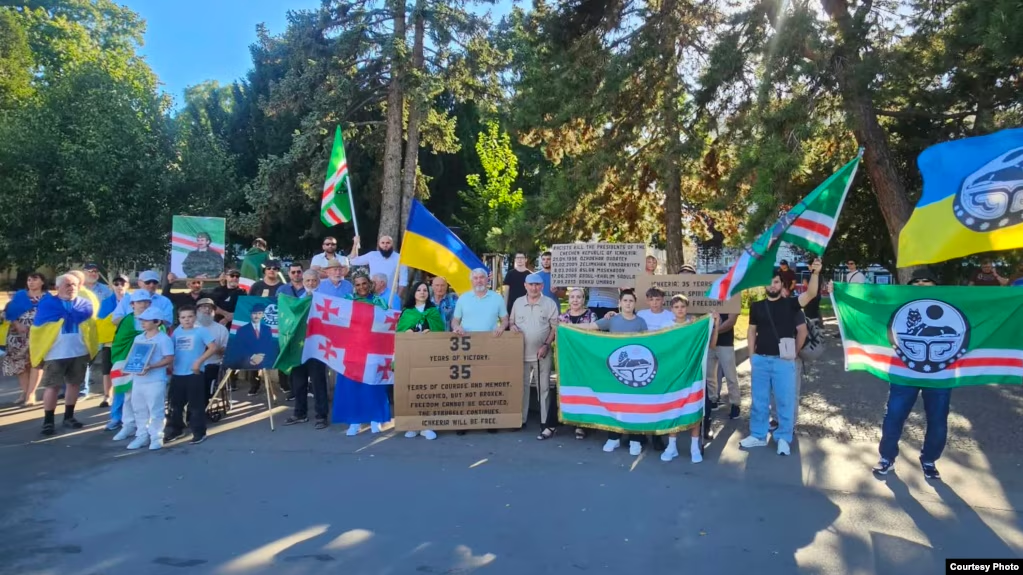
The most optimal deordization step would be the accession of Ukraine and other countries to NATO, whose non-alignment – and therefore, from Moscow’s point of view, neutrality – as already mentioned above simply provokes the Kremlin to aggressive actions. But in the conditions of Ukraine’s so far “non-membership” in NATO, its place in the de-Ordization of its northeastern neighbor could be manifested in the role of initiator and co-founder of a new, but long overdue, union of nations that are the object of Horde expansionism. The model of such a union can be a modernized version of the Mediterranean, proposed by the German political scientist Andreas Umland: a military-political union of countries that are the objects of current pressure from Moscow and potential targets of its aggression. Such a bloc, which would include both members and non-members of NATO, could “gently” use the capabilities of the North Atlantic Alliance to resist Russia, without involving NATO itself in a direct confrontation. I would like to add that in the case of Moscow’s intransigence, this association could grow into something like the ABN (“Anti-Bolshevik Bloc of Peoples”) created by Yaroslav Stetsk – let’s say “Anti-Imperial Bloc of Peoples”, where, in addition to countries neighboring the Horde, nations could also join, until now enslaved by it – Volga Tatars, Chechens, Ingush, Dagestanis, Circassians and others, including Russians themselves.
If the implementation of both options is delayed due to reasons beyond Ukraine’s control, Ukraine can prevent large-scale aggression against itself very quickly and without significant financial costs. The Kremlin will not plan to attack us until we become strong enough to repel not only the attack, but the very desire for it. For this, it is necessary to reconstruct the state, freeing it from the oligarchy, to carry out, of course, economic, legal and administrative reforms and, most importantly, to strengthen the defense.
But strengthening the defense is not only new and effective weapons, a powerful army, but also the development and implementation of a program of a complex of active military, economic, informational and other measures with the following possible components:
– the creation on a permanent basis in every settlement of the country of territorial defense units, organized from the local population within the framework of a nationwide system of the Swiss model or the Estonian “Kaitseliit” type,
– creation of the Headquarters of the partisan movement and organization of this movement in the occupied territories,
– unification of ethnic Russians and Russian-speaking citizens of Ukraine in a public initiative in support of Ukraine’s accession to NATO, for example, with the telling abbreviation URA – “Ukrainian Russian-speaking people for the Alliance”,
– the appeal of the state leadership to Ukrainians and sympathizers in Russia about unadvertised assistance to Ukraine in the protection of sovereignty and territorial integrity, collection of evidence base regarding military and official crimes of Russian politicians and officials in relation to Ukraine,
– not the closure of Russian business in Ukraine, but the imposition of an additional tax of 10% on the Defense Fund of Ukraine,
– Ukraine’s withdrawal of its signature under the decision of the heads of some post-Soviet states dated December 21, 1991 regarding Russia’s occupation of the USSR’s place in the UN and thus the beginning of the international legal process of recognition of the illegality of Russia’s membership in the UN.
I cite these measures as an example, just to understand the direction of the necessary vector, their list is far from exhaustive and should include actions on deordization in Ukraine itself. Here we still have an almost unplowed field, taking into account, for example, the fact that the Soviet numbering of military units is still used in the Armed Forces, and the “southernmost” city of Ukraine is Kharkiv, because it is the administrative center of the “Southern Railway”…
Returning to Moscow’s relations with the West, I would like to point out that the Kremlin’s “cheek puffing” and “muscle play” are just a bluff. It is quite simple to compare the GDP levels of Russia and the EU and the USA to understand that the Kremlin will not go to a big war. At least as long as he is retarded and weak. And for the economic growth of Russia, its large-scale economic and technological modernization is critically needed. But history clearly shows – whether it was under Peter I, or in the later times of tsarist Russia, or during Stalin’s industrialization – not a single civilizational step forward, not a single economic and technological reconstruction took place in Russia without the help and deep participation of the West. (I will note in passing as an answer to a possible objection: “But now the latest technologies are not only the West?!”,
Therefore, the victory of the civilized world over Moscow’s expansionism seems inevitable.
But under four conditions:
First, if the West is serious about strengthening its solidarity and defense capabilities, strengthening the military capabilities of NATO, its members and allies to a level where aggression from Russia will be guaranteed to be impossible and perceiving the war in eastern Ukraine as a war against itself.
Secondly, when he seriously and comprehensively confronts Russia with his main non-lethal weapon – economic, technological and financial superiority and thereby “explains” to the Kremlin that there will be no cooperation, let alone technological assistance, until Moscow returns to its territorial boundaries and in the international legal field.
Thirdly, if the West does not allow to destroy the existing system of international security and makes it clear to Russia. that if this system is replaced by a new one, there will not be, as now, a key place for Moscow.
And – most importantly – when the West will finally wake up and be guided by the words of John Paul II from the title of his encyclical “Do not be afraid!”.
Only in this case can one count on the fact that Russia, with the help of the civilized world, will free itself from age-old slavery, and its neighbors from constant anxiety. Only under such conditions can a new, civilized, developed Russia emerge in place of the Horde, of which its citizens will be justly proud, and the space between the Atlantic and Pacific oceans will become a territory of peace and good neighborliness.
Pavlo Zhovnirenko