

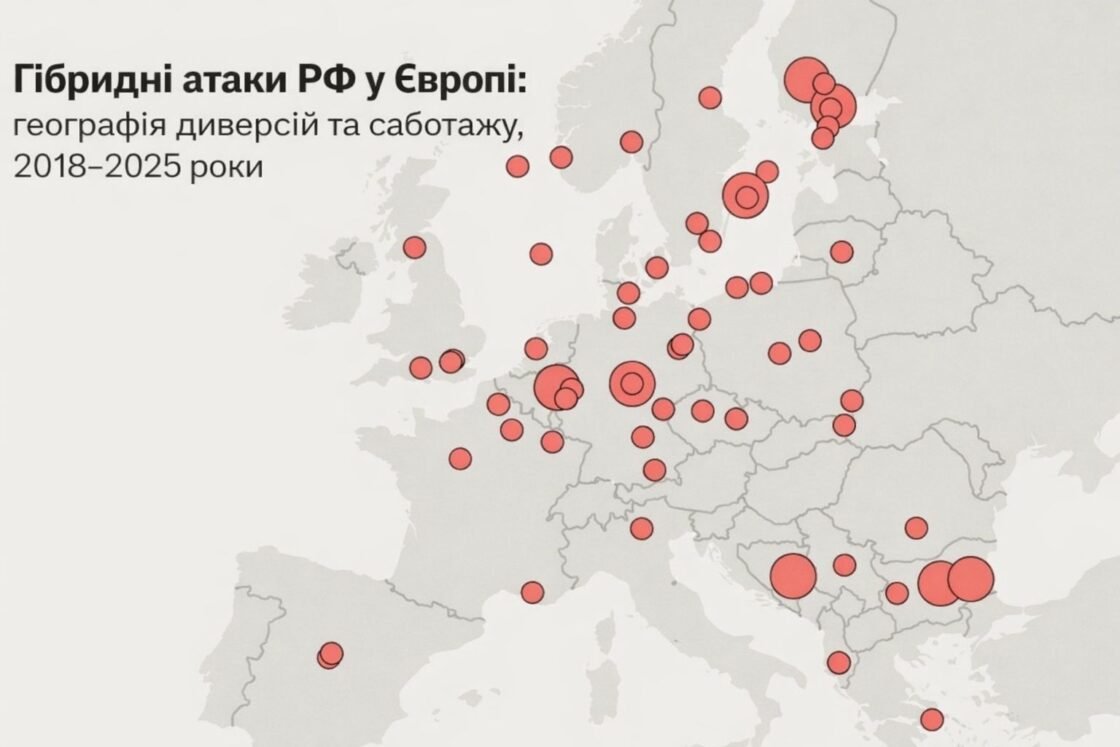
The European discussion about whether it is worth talking to Putin is increasingly disconnected from the reality, in which Russia itself is already waging an active hybrid war against Europe. Arson, sabotage, sabotage of critical infrastructure, and GRU operations on the territory of EU countries are not episodes or “excessive suspicions”, but part of a systemic pressure campaign that accompanies the war against Ukraine.
Lithuanian special services directly linked the arson in 2024 of a factory that supplied military products to the Armed Forces of Ukraine to the activities of the Russian GRU: Russian and Belarusian citizens are involved in the case. This is no longer a “grey zone” – this is terrorism on the territory of the EU with a clear military-political goal: to disrupt support for Ukraine and intimidate European societies. Similar cases are increasingly appearing in the Baltic countries, Central and Northern Europe, forming a common contour of the threat.
Against this background, Ursula von der Leyen’s position that Ukraine is closely linked to Europe’s security ceases to be a political slogan and acquires practical meaning. Supporting Ukraine is not “helping a partner”, but an investment in the EU’s own resilience. A similar signal was conveyed on a symbolic level by King Charles III, who, in his address to Ukraine, clearly situated its struggle within the broader European historical context.
At the same time, London has taken a principled position against resuming any “dialogue” with Putin, based on a simple fact: negotiations cannot be conducted with an actor who simultaneously organises sabotage and prepares force scenarios against the negotiators themselves. This logic is increasingly resonating in other capitals, where declarations are no longer limited. Germany is allocating funds for energy support for Ukraine, Finland is announcing a new package of military assistance, and the Baltic countries are openly lobbying for Ukraine’s membership in NATO as an element of collective security.
At the same time, the military dimension of Europe’s preparations for direct confrontation is growing. British marines are practising war scenarios with Russia in the Arctic conditions of Norway; the Czech Republic is declaring its readiness to transfer anti-drone aircraft platforms to Ukraine; Ukraine and Britain are launching joint production of interceptors, scaling up defence industrial cooperation. This is no longer a “crisis response,” but a structural adaptation of Europe to a long-term threat.
The European integration track is no less revealing. Reuters materials on the new model of Ukraine’s accession to the EU reflect the understanding in Brussels: security, defence and economic integration can no longer exist separately. Ukraine is gradually being viewed as an element of the European security architecture even before formal membership – and this is a direct consequence of Russia’s escalation strategy.
In total, all these signals add up to one picture. While some European elites theorise about the “possibility of dialogue,” Russia is acting practically – through sabotage, arson, and pressure on critical supply chains. The answer is not only support for Ukraine, but also a gradual realisation: the war has already gone beyond Ukrainian territory, and Europe is its immediate field. Ukraine, in this reality, is not a buffer or an “object of assistance,” but a front line on which the stability of the entire European security space depends.
Viktor Yahun
Facebook 





