

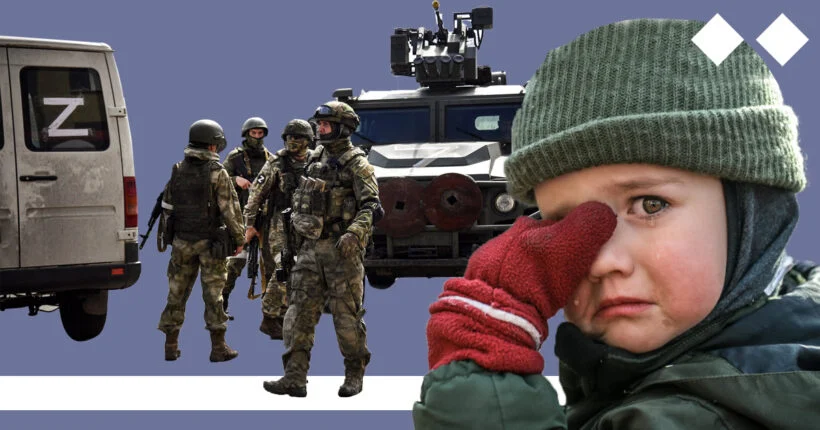
The ongoing Russian invasion of Ukraine has brought devastation across generations, but among its most disturbing consequences is a pattern that echoes centuries of imperial violence: the abduction of children. While the forced deportation of Ukrainian children by Russian forces has captured headlines in recent years, it is not an isolated incident. It is the latest chapter in a centuries-old imperial strategy to erase Ukrainian identity by severing generational continuity (Magocsi, 2010).
From the slave raids of the Crimean Khanate to Soviet-era reeducation, Nazi Germanization, and now modern reprogramming camps in Russian-occupied territories, Ukrainian children have repeatedly been targets of war and empire. This essay explores five historical moments of child abduction—from the Crimean Khanate to Putin’s Russia—revealing a disturbing continuity in the use of children as tools of conquest.
The Slave Markets of Empire: Ottoman Raids and the Crimean Khanate
In the shadow of the Ottoman Empire, between the 15th and 18th centuries, the Crimean Khanate waged terror on the steppes of Ukraine. Slave raids, known as “harvests of the steppe,” resulted in the abduction of an estimated two million people—many of them children. Captured by Tatar raiders, Ukrainian boys and girls were sold in Ottoman markets or assimilated into Islamic households, where they were cut off from their language, faith, and kin (Fisher, 1978).
These raids left deep scars on Ukrainian society, depopulating entire regions and turning families into commodities. Resistance movements, like the rise of the Cossacks, were born in part as a response to this systematic kidnapping. But the trauma endured.
Tsarist Russia and the Quiet Abduction of Identity
When Ukrainian lands fell under Russian imperial rule, child abduction took a more bureaucratic form. The tsars did not steal bodies—they stole minds. Through the suppression of the Ukrainian language, censorship of native literature, and the imposition of Russian Orthodox doctrine, the Empire implemented a system of forced cultural assimilation (Subtelny, 2009).
By the late 19th century, over 90 percent of schools in Ukraine used Russian as the language of instruction. Children from Cossack and noble families were often placed in Russian military schools, where loyalty to the Empire was valued above all. The aim was to create a generation of Ukrainians who would no longer recognize their origins.
The Soviet Machine: Orphanages, Ideology, and the Holodomor
Under Stalin, the state’s control over Ukrainian children deepened. The Holodomor, the man-made famine of 1932–33 that killed an estimated 3.9 to 7 million Ukrainians, left countless children orphaned. The state swiftly absorbed them into a vast network of Soviet orphanages, where Ukrainian identity was not only discouraged—it was punishable (Applebaum, 2017).
Children were raised to worship Lenin and Stalin, to reject religion, and to see their parents—if they remembered them—as enemies of the state. Families of political dissidents and kulaks were split apart; their children sent to institutions that doubled as ideological reeducation centers. By the end of World War II, tens of thousands more children in Western Ukraine were relocated under suspicion of Ukrainian sympathies (Subtelny, 2009).
Nazi Germanization: A Racialized Theft
During World War II, Ukraine again became a site of child abduction, this time under the ideology of racial purity. Nazi Germany, through the Lebensborn program, sought to “reclaim” children from Eastern Europe who appeared racially suitable. Between 20,000 and 50,000 Ukrainian children were forcibly taken to Germany, renamed, and placed with German families (USHMM, 2022).
The Lebensborn program was not just about family—it was about breeding loyalty. These children were taught to think of themselves as German, part of a master race, with no memory of the nation or families from which they had been stolen. Similar practices of identity erasure can be seen historically in other imperial contexts, such as Indigenous children in North American residential schools and the Stolen Generations in Australia.
The Return of the Pattern: Russia’s Modern Campaign (2014–2025)
Today, the echoes of this grim past are unmistakable. Since the annexation of Crimea in 2014 and Russia’s full-scale invasion in 2022, over 20,000 Ukrainian children have been officially documented as forcibly transferred to Russia or occupied territories (UNHRC, 2023). Some Ukrainian officials estimate the number could exceed 700,000, though these higher figures are subject to dispute due to the fog of war and lack of access to Russian-controlled areas (Ukrainian Parliamentary Report, 2023).
These children have been taken from orphanages, hospitals, schools—and often through deceit. Under the guise of humanitarian evacuations or “summer camps,” children are separated from their families and communities. Many are then subjected to Russification: their names changed, Ukrainian banned, and state-sanctioned ideology injected into every facet of their lives (The Guardian, 2023).
Estimates indicate that approximately 60,000 children are being held in Russian indoctrination or re-education camps, where they face psychological manipulation designed to reshape their sense of identity and allegiance (Human Rights Watch, 2024). They are granted Russian citizenship, placed with Russian families, and, in many cases, prevented from returning to Ukraine.
“They told me I was Russian now. I had to forget everything I knew,” said 12-year-old Mykola, one of the few children successfully repatriated in 2024. “But I knew my mother was waiting for me” (Save Ukraine, 2025).
The International Criminal Court has responded with arrest warrants for Russian President Vladimir Putin and Maria Lvova-Belova, the Commissioner for Children’s Rights, for their involvement in these forced transfers—actions the UN and human rights groups have declared war crimes (ICC, 2023).
Despite rescue efforts, including Ukraine’s Save Ukraine and Bring Kids Back UA campaigns, the road to reunification is long. As of early 2025, only about 1,200 children have been returned (Save Ukraine, 2025).
The Cost of Indifference
On March 19, 2024, the U.S. House of Representatives overwhelmingly passed a resolution “condemning the illegal abduction and forcible transfer of children from Ukraine to the Russian Federation” by a 390–9 margin. This bipartisan act marked a pivotal shift in U.S. policy, aligning Washington with its European allies in recognizing the systematic deportation and adoption of Ukrainian children as a form of genocide (U.S. House, 2024).
The resolution asserts that Russia’s actions are “contrary to Russia’s obligations under the Genocide Convention and amount to genocide” (U.S. House, 2024). It echoes the conclusions of international bodies such as the United Nations and the International Criminal Court, both of which have denounced these child transfers as war crimes (UNHRC, 2023; ICC, 2023).
In tandem, the U.S. Senate passed S.Res.236, a resolution specifically calling for the return of abducted Ukrainian children before finalizing any peace agreement to end the war against Ukraine (U.S. Senate, 2024). This measure underscores a growing recognition that
no just resolution can be achieved while thousands of children remain in the hands of their abductors.
Yet resolutions alone do not halt atrocities. As survivors and Ukrainian officials repeatedly affirm, no genocide has ever been stopped in a courtroom. Legal accountability is crucial—but international trials often take decades and lack enforcement mechanisms. The moral and strategic imperative lies elsewhere: in equipping Ukraine with the tools to defend itself.
Ukrainian military leaders are issuing dire warnings. With ammunition shortages mounting and foreign aid under strain, their ability to repel further incursions—and prevent additional child abductions—is increasingly precarious. Testimonies from repatriated families and humanitarian workers underscore that the best genocide prevention mechanism in Ukraine today is a fully supported Ukrainian army.
While the U.S. resolutions rightly call out Russia’s genocidal conduct and demand the return of abducted children, they must be followed by decisive policy. The protection of Ukraine’s children requires more than statements—it demands sustained, coordinated action. Congress, and the international community at large, must match their moral clarity with the material support Ukraine needs to fight for its future.
Policy Recommendations
To effectively respond to the abduction and forced assimilation of Ukrainian children, the international community must take bold, tangible steps. These include increasing funding and logistical support for child repatriation NGOs; imposing targeted sanctions on individuals and organizations facilitating illegal adoptions; making the return of abducted children a mandatory condition in any negotiated peace settlement with the Russian Federation; establishing an international database to track and monitor abducted children; and supporting trauma-informed care and reunification services for repatriated children and their families.
Weapon of Empire
The theft of Ukrainian children is not just a tragedy for their families—it is an existential threat to a nation. Each child removed from their home, their language, and their heritage is a wound in the cultural fabric of Ukraine. These are not isolated war crimes; they are a strategy, deployed over centuries, to fracture a people by cutting off its future.
And yet, history also tells of resistance. From the Cossacks who fought off the raiders of the Crimean Khanate to today’s volunteers smuggling children out of occupied zones, Ukrainians have never ceased in their efforts to reclaim their own.
“The opposite of love is not hate, it’s indifference.” — Elie Wiesel
This truth compels us to act—not only to condemn the abduction and indoctrination of Ukrainian children but to support justice, accountability, and the right of every child to live free from fear, coercion, and cultural erasure.
If the theft of children has been a weapon of empire, then the recovery of their stories—and their safe return—must become a mission of our time.
Bohdan Cherniawski, USA
References
1. Applebaum, A. (2017). Red famine: Stalin’s war on Ukraine. Penguin.
2. Fisher, A. W. (1978). The Crimean Tatars. Hoover Institution Press.
3. Human Rights Watch. (2024). Russia: War crimes against children in Ukraine. https://www.hrw.org
4. International Criminal Court. (2023). Warrants of arrest for Vladimir Putin and Maria Lvova-Belova. https://www.icc-cpi.int
5. Magocsi, P. R. (2010). A history of Ukraine: The land and its peoples. University of Toronto Press.
6. Save Ukraine. (2025). Children repatriation report. https://saveukraine.org
7. Subtelny, O. (2009). Ukraine: A history. University of Toronto Press.
8. The Guardian. (2023). Russian indoctrination camps for Ukrainian children. https://www.theguardian.com
9. Ukrainian Parliamentary Report. (2023). Report on deportations.
10. United Nations Human Rights Council. (2023). Report on the situation of children in Ukraine. https://www.ohchr.org
11. United Nations Human Rights Council. (2025). Report of the Independent International Commission of Inquiry on Ukraine.
12. United States Holocaust Memorial Museum. (2022). The Lebensborn program. https://www.ushmm.org
13. U.S. House of Representatives. (2024). Resolution condemning the abduction of Ukrainian children. https://www.congress.gov
14. U.S. Senate. (2024). S.Res.236 – A resolution calling for the return of abducted Ukrainian children. https://www.congress.gov






