The Kremlin has likely opted to declare a counterterrorism operation (CTO) regime instead of martial law to downplay the scale of the incursion into Kursk Oblast and to avoid causing panic or backlash domestically.
Source: Institute for the Study of War (ISW)
Details: The Russian authorities are also reluctant to take more radical measures in response to the situation.
Russian military bloggers suggested that the Kremlin should formally declare war on Ukraine and have criticised the decision to impose a CTO regime instead of declaring martial law.
The declaration of martial law would have enabled the Russian authorities to implement more stringent measures, such as banning rallies and demonstrations, imposing curfews, and organising the production of war-related products for the military. However, Russian leader Vladimir Putin has avoided officially declaring a state of war, demonstrating a reluctance to fully put Russian society on a military footing. He has also refrained from declaring general mobilisation to avoid potential internal discontent that could destabilise his regime.
Putin likely appointed Alexander Bortnikov, Head of Russia’s Federal Security Service (FSB) and Chairman of the National Antiterrorism Committee, to lead the counterterrorism operation due to Bortnikov’s track record of effectively managing crises that have threatened Russia’s internal stability and the Kremlin regime.
ISW analysts believe that the complex command and control system of the FSB-led CTO under Bortnikov’s leadership could reduce the effectiveness of Russia’s response to the Ukrainian operation.
The analysts also stressed that Russian forces have been more adequately defending themselves in Kursk Oblast after the arrival of additional conscripts and more experienced personnel from the war zone in Ukraine.

To quote the ISW’s Key Takeaways on 10 August:
- The Russian National Antiterrorism Committee announced a counterterrorism operation in Belgorod, Bryansk, and Kursk oblasts on 9 August in response to the Ukrainian incursion into Kursk Oblast.
- The Kremlin likely decided to declare a counterterrorism operation – as opposed to a state of war or martial law – to downplay the scale of the Ukrainian incursion into Kursk Oblast and prevent domestic panic or backlash – demonstrating the Kremlin’s reluctance to take more drastic measures to respond to the situation.
- Putin likely appointed Bortnikov as the head of the counterterrorist operation because Bortnikov had previously proven himself to be an effective manager during crises that threatened Russian domestic stability and the Kremlin regime.
- A complicated command and control (C2) arrangement for the FSB-led counterterrorism operation under Bortnikov may degrade the effectiveness of the Russian response to Ukraine’s operation.
- The Russian Ministry of Defence (MoD) appears to be relying on a combination of Russian conscripts already operating in Kursk Oblast, elements of the Northern Grouping of Forces, and elements redeployed from lower-priority frontline areas in Ukraine to defend against the Ukrainian operation in Kursk Oblast, likely exacerbating the disorganisation of Russia’s chosen response.
- Russian forces’ usage of conscripts and forces already in Kursk Oblast, nearby forces fighting in northern Kharkiv Oblast, and lateral redeployments across the theatre to defend against the Ukrainian incursion is consistent with a number of likely Russian courses of action (COAs) that ISW forecasted.
- The Russian MoD appears to be relying on select, battle-hardened units to conduct offensive and defensive operations in its most critical sectors of the front.
- Russian forces appear to be more adequately defending against Ukrainian assaults following the arrival of additional conscripts and more combat-effective personnel from frontline areas in Ukraine.
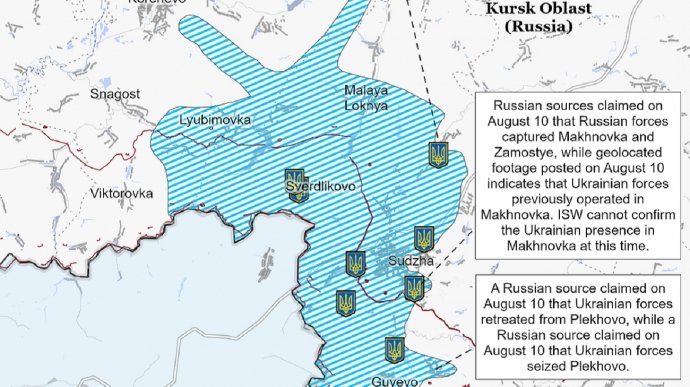
- Geolocated footage and Russian reporting from 10 August indicate that Ukrainian forces largely maintain previously reported positions in Kursk Oblast and have advanced slightly further than their previously confirmed positions.
- Ukraine’s cross-border operation into Kursk Oblast threatens the Kremlin with a potential political crisis regarding casualties among Russian conscripts, whom the Kremlin has increasingly relied upon to defend the Russian state border with Ukraine.
- Ukrainian forces recently struck a Russian ship and a gas platform in the western Black Sea.
- Iran will reportedly deliver “hundreds” of ballistic missiles to Russia in the near future.
- Russian forces recently advanced near Kreminna, Toretsk, Pokrovsk, and Donetsk City.
- A Russian mil blogger claimed that the Russian Ministry of Defence (MoD) has begun to form the “Black Raven” strike drone volunteer unit and asked readers to donate to the 16-million-ruble (about US$184,324) goal to supply the unit with drones and equipment.