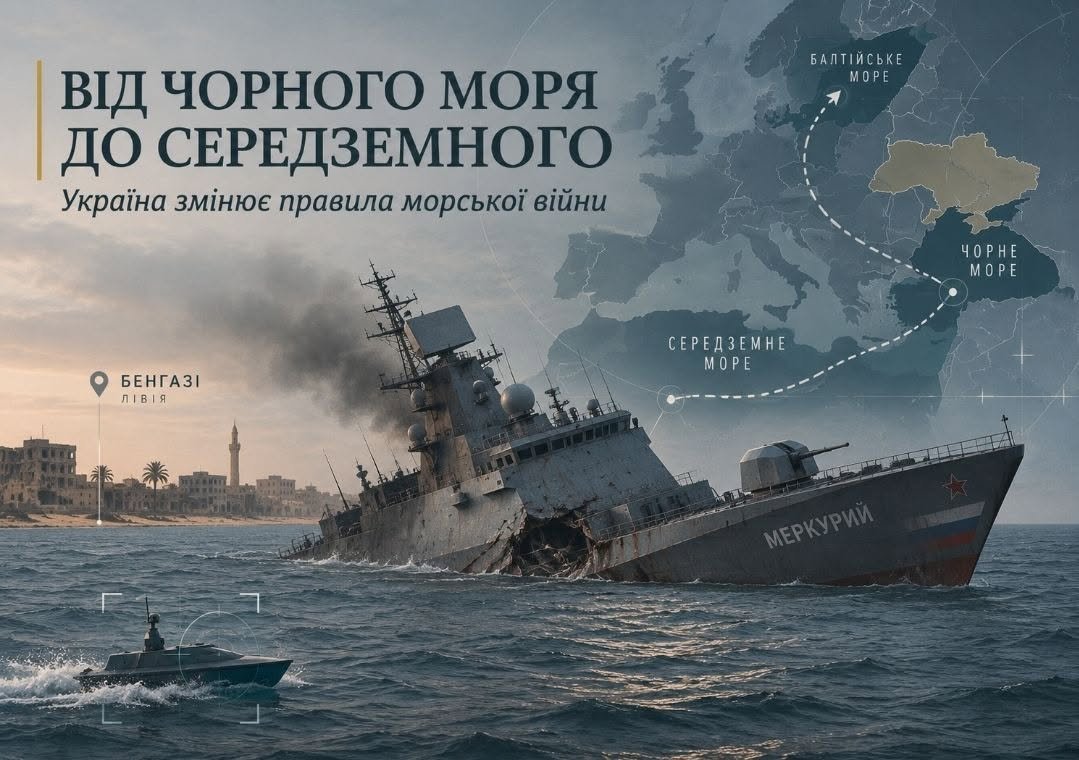
The destruction of the Russian corvette “Mercury” in Benghazi, Libya is an event whose strategic significance goes far beyond the loss of another warship by Russia.
On November 22, 2026, the Ukrainian Defense Forces, together with the Security Service of Ukraine, conducted a special operation near the coast of Libya. The next day, its results were officially confirmed by the President of Ukraine. The modern Russian multi-purpose corvette “Mercury” was sunk along with a Ka-27 ship-based helicopter, and the sanctioned dry cargo ship MV ANGARA was hit, which, according to the SBU, was used to transport Russian weapons.
Published satellite images confirm that the corvette capsized and was almost completely underwater. The final extent of the damage to the dry cargo ship is still being determined. Al Jazeera, citing its own sources, reports on the deaths among Russian and Libyan citizens, but there is currently no reliable information about their number and status.
The Project 20380 Mercury entered the Russian Navy in May 2023, during a full-scale war against Ukraine. The ship was intended for the Black Sea Fleet, but due to restrictions imposed by Turkey in accordance with the Montreux Convention on the passage of warships of states at war, it never reached the Black Sea.
This is not a Soviet legacy, but one of the results of the modern Russian military shipbuilding program, designed to demonstrate the revival of the Russian Federation’s maritime power.
It is worth emphasizing the symbolic and political significance of this ship for Putin personally.
On March 18, 2019, on the fifth anniversary of the illegal annexation of Crimea, while in occupied Sevastopol, Putin supported the initiative to recreate the historical brig Mercury. It was a ship of the Russian Imperial Navy, which in 1829 distinguished itself in a battle with two Ottoman battleships.
The revival of the historical name in the modern Russian fleet was part of the Kremlin’s broader policy aimed at popularizing the imperial military heritage.
On July 23, 2021, Putin signed Decree No. 428, which provided for the awarding of the St. George Naval Flag to ships with the historical names “Azov” and “Mercury”. In October of the same year, the Project 20380 corvette, previously called “Retivy”, was given the name “Mercury”.
And already on July 30, 2023, during the main naval parade in St. Petersburg, Putin separately mentioned the new corvette “Mercury” in the context of increasing the power of the Russian fleet, emphasizing the historical continuity and symbolic meaning of the St. George flag raised above the ship.
Таким чином, “Меркурій” був не просто сучасною бойовою одиницею. Він став складовою політичного наративу путіна про відродження росії як великої морської держави, спадкоємність імперських традицій та історичне обґрунтування російських претензій на Крим і Чорне море.
Показово, що корабель, відродження історичної назви якого путін перетворив на елемент державної політики, так і не зміг потрапити до Чорного моря, для служби в якому призначався, а зрештою був знищений Україною біля берегів Африки.
У цьому контексті втрата “Меркурія”, як свого часу й ракетного крейсера “Москва”, має виразний репутаційний вимір особисто для путіна. Вона ставить під сумнів пропагандистський образ відродженої військово-морської могутності, який російський президент роками вибудовував навколо власної політики.
Однак найважливіше в цій історії — не лише доля конкретного корабля, а трансформація української морської стратегії.
Україна не намагається створити дзеркальну копію російського військово-морського флоту. Вона не змагається з росією кількістю фрегатів, корветів чи підводних човнів. Натомість Україна формує власну модель асиметричної морської війни, в основі якої — технології, безпілотні системи, якісна розвідка, швидкість ухвалення рішень та ефективне використання обмежених ресурсів.
Свого часу Україна продемонструвала здатність суттєво обмежити діяльність російського флоту в західній частині Чорного моря. Тепер ми спостерігаємо поширення наслідків російсько-українського військового протистояння на Середземноморський та Балтійський регіони.
Напередодні операції в Лівії, 21 листопада, у міжнародних водах Фінської затоки було уражено російське підсанкційне судно Sparta II, пов’язане з військовою логістикою рф. У 2025 році воно використовувалося для вивезення російської військової техніки із Сирії. Фінські військові вважають імовірною причетність України до цієї атаки, хоча офіційного підтвердження з боку Києва наразі немає. 23 листопада пошкоджене судно відбуксирували до Санкт-Петербурга.
Ці події дають підстави говорити про значно ширшу тенденцію — зростання вразливості російської військово-морської логістики та закордонної військової присутності.
Окреме питання — чому саме Лівія?
Після падіння режиму Башара Асада в грудні 2024 року російська військова присутність у Лівії набула додаткового стратегічного значення. Кремль тривалий час підтримує сили Халіфи Хафтара, використовуючи східну частину країни для зміцнення свого впливу в Північній Африці, Середземномор’ї та регіоні Сахелю.
Російська військова експансія в Африці потребує постійного матеріально-технічного забезпечення. Морські перевезення є важливою складовою функціонування цієї системи. Втрата бойових кораблів і транспортних суден, залучених до її забезпечення, створює додаткові економічні, військові та політичні ризики для кремля.
An equally important question that interests many today is: where does Ukraine get the intelligence information necessary to conduct such operations?
Modern intelligence has long been not only classic intelligence work. It is an integrated system that combines the capabilities of technical, space, electronic and intelligence intelligence, analysis of open sources of information (OSINT) and international intelligence cooperation.
Not only the receipt of information is of decisive importance, but also the ability to professionally process it, verify it, assess its reliability and use it in a timely manner.
During the years of war, Ukraine has significantly increased its own intelligence capabilities and acquired unique practical experience.
At the same time, the specific sources of intelligence information and the circumstances of the preparation of the operation in Libya have not been officially disclosed. Professional analysis should not be replaced by unconfirmed assumptions about the participation of foreign special services or the existence of Ukrainian operational bases in Africa.
The diplomatic and international legal dimensions of the situation cannot be ignored.
Both political centers of Libya — in Tripoli and Benghazi — condemned the military operations on the territory of the country and in its territorial waters. The internationally recognized government in Tripoli demanded official explanations from Ukraine. The Eastern Libyan administration reported an appeal to the UN, and the UN Support Mission in Libya called for an independent and transparent investigation of the incidents.
Ukraine’s right to self-defense, enshrined in Article 51 of the UN Charter, does not cancel the need to comply with international humanitarian law and respect for the sovereignty of third states. The legality of a particular operation requires a separate international legal assessment, taking into account all its circumstances.
Special attention is required by reports of possible civilian casualties. This aspect cannot be ignored, as it can directly affect the international perception of Ukrainian operations.
What could be the strategic consequences of recent events?
The Russian leadership will most likely be forced to reconsider the system of protecting its warships, military transports and foreign military infrastructure. This will require additional financial costs, military resources and diplomatic efforts.
It is also possible that Russian information and psychological operations aimed at discrediting Ukraine and forming the perception of it as a source of threats to international shipping will intensify.
That is why military effectiveness must be accompanied by proper international legal reasoning, diplomatic work and professional strategic communication.
The main conclusion is that Ukraine is no longer simply adapting to the conditions of war imposed by Russia. It is demonstrating the ability to change these conditions themselves.
Sea power in the 21st century is determined not only by the number of ships, their displacement, cost or total firepower. It increasingly depends on technological capabilities, the quality of intelligence, intellectual potential and the ability to quickly adapt to new threats.
For decades, Russia has been building an ocean fleet as an instrument of global military-political influence. Ukraine, after several years of full-scale war, has questioned the effectiveness of the traditional model of its use.
Trying to turn the history of the imperial fleet into a political resource for modern Russia, Putin has relied on the revival of imperial symbols. However, the historical names of ships, St. George’s flags and large-scale naval parades cannot compensate for the real vulnerability of warships in the conditions of modern technological warfare.
Ukraine, without a classic ocean fleet, demonstrates the ability to influence the security situation far beyond the Black Sea region.
And it is this, and not just the Mercury corvette sunk in Benghazi, that is a strategic challenge for the Kremlin.
Viktor Yahun, Major General of the Reserve of the Security Service of Ukraine, former Deputy Head of the SBU, national security expert
Facebook