

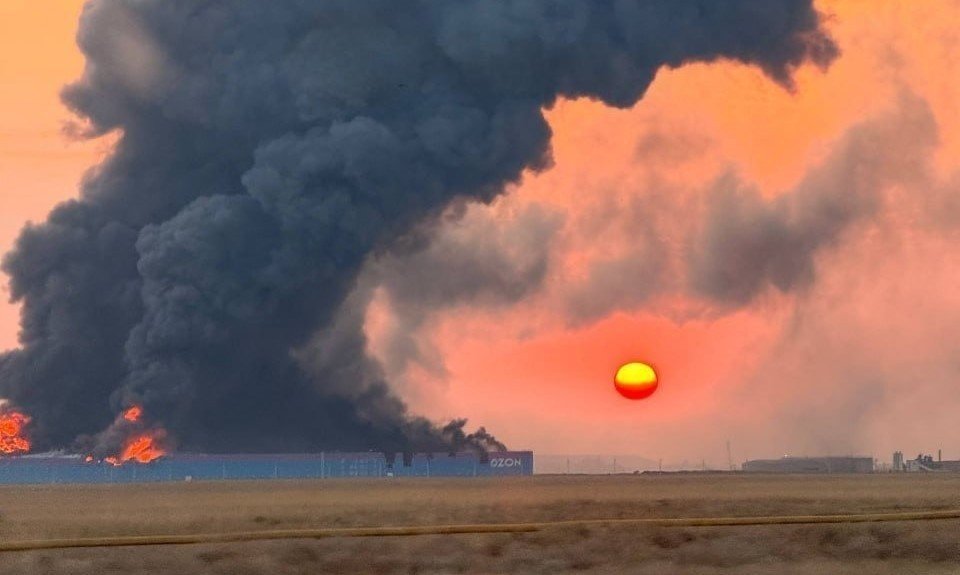
With Russian infrastructure being pummelled by Ukrainian drones, the Kremlin is hoping to sustain its war effort in Ukraine by strengthening defence cooperation with Kazakhstan and Uzbekistan. It is uncertain, however, whether Astana and Tashkent will go along with Moscow’s wishes.
Russia appears to be primarily interested in outsourcing the manufacture of arms, establishing assembly lines and maintenance facilities in the Central Asian nations, thus putting them beyond the reach of Ukrainian drones, according to a report published by RFE/RL.
“Ukraine has certainly become bolder in its actions, but it will not want to launch drone strikes on Kazakhstani territory,” defence analyst Derek Bisaccio told RFE/RL’s Central Asian service. “That would be seen there as a serious escalation.”
Any move to shift arms production from Russia to Central Asia would mark a sharp change in regional dynamics. For most of the post-Soviet era, Russia was the main supplier of weapons to Central Asian states. Moscow’s near monopoly on the regional arms market started eroding in 2022, when the Kremlin launched its unprovoked invasion of Ukraine. Now, Kyiv’s successful drone campaign appears to be forcing Russia to consider becoming an arms importer rather than exporter.
Kazakhstan and Uzbekistan are already home to facilities capable of keeping Russian equipment in the field, including the Semey Engineering plant and Almaty’s Aircraft Repair Plant in Kazakhstan, as well as the Chirchik Aircraft Repair Plant in Uzbekistan.
For Kazakh and Uzbek leaders, the hassles of expanding defence cooperation with Russia may well outweigh the advantages. For one, doing so could expose both countries to expansive secondary sanctions from the United States and European Union.
Responding to a query by RFE/RL, a Kazakh Defence Ministry official was equivocal, saying the matter was still under review. Uzbek authorities offered no comment. Meanwhile, Pavel Baev, a regional expert at the Peace Research Institute Oslo (PRIO), told RFE/RL he saw little incentive for Astana and Tashkent to embrace what he termed Moscow’s “less-than-smart plan.”
Lost amid the discussion of what would effectively be the offshoring of Russia’s military-industrial complex is how Moscow could pay for it.
The war has depleted Russian state coffers and the country’s ability to finance large-scale projects. Russia has already had to push back major projects in Central Asia, including the construction of nuclear power plants, because of cash-flow difficulties at the state-controlled nuclear entity Rosatom. Russian state-controlled entities have also seen contracts to build power plants in Kazakhstan cancelled due to financing woes.
The evident shortage of resources is not stopping Russia from trying to project an air of normalcy. On 18 August, the Russian state-aligned outlet Sputnik Kyrgyzstan reported that an entity called the Russia-Kyrgyzstan Development Fund (RKDF) was ready to finance $660 million in infrastructure projects to narrow Kyrgyzstan’s electricity deficit. The report did not provide details on how the projects would be funded, however.
The RKDF was created in 2014 under the auspices of the Moscow-led Eurasian Economic Union to “promote economic cooperation between Kyrgyzstan and Russia, to modernise and develop the Kyrgyz economy,” aiming to promote “Eurasian economic integration.” The entity’s reported capitalisation in 2025 was $574 million.
Eurasianet





