

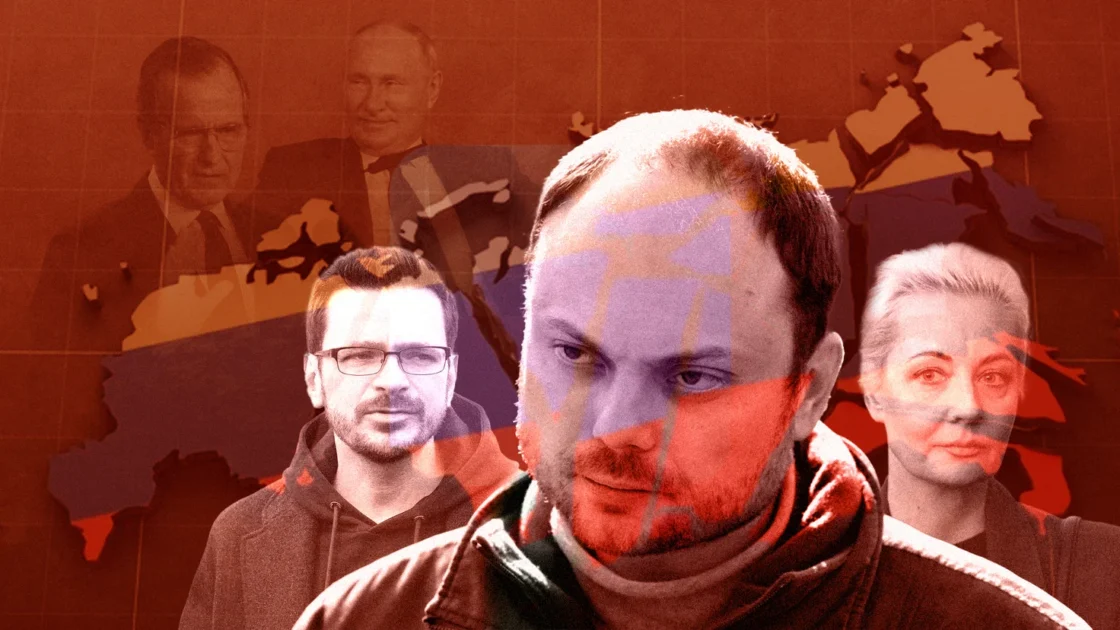
“What is the point of a world without Russia?” asked a famous politician, now a wanted war criminal, in 2018. A less prominent figure echoed this sentiment in 2024, albeit less menacingly when he noted: “The collapse of Russia would be not only a disaster for our country and people but also a tragedy for the world.”
The first quote belongs to Russian leader Volodymyr Putin, and the second to one of his loudest critics, the dissident Ilya Yashin.
Although they have significant differences in their positions, both seem equally oblivious to the root cause of Moscow’s aggression. An empire built on deception and subjugation masquerading as a nation is a source of violence. None of them are prepared to confront this fundamental lie in which their country’s politics, culture, and self-awareness are rooted.
Ancient Russian colonialism, which manifested itself this century in the wars against Ichkeria, Georgia and Ukraine, continues to exist not thanks to a specific leader or regime but thanks to a worldview established in the collective consciousness. Based on centuries of conquest, Moscow presents aggression as defence, distracting Russian society from realizing its own role in supporting the empire and its violence.
Yashin links his fears about Russia’s disintegration to the problem of losing control over nuclear arsenals, a comparison familiar to American politicians. This is reminiscent of the famous “Kyiv Cutlet” speech of 1991 when US President George W. Bush called on Ukrainians to stay in the Soviet Union. At a time when the US was worried about what could go wrong if the Soviet Union ceased to exist, the Ukrainians saw it as a betrayal.
Was Washington unaware of Russia’s brutal imperial history? Wasn’t the Holodomor—planned by Moscow to exterminate millions of Ukrainians and suppress their national movement—proof enough?
The new face of the Russian opposition, Yulia Navalna, who took over the cause of her late husband, offered completely different arguments: “There are those who call for the urgent “decolonization” of Russia, arguing that it is necessary to divide our great country into smaller, safer states. However, these “decolonizers” cannot explain why people with a common origin and culture should be artificially divided.
To understand how absurd and at the same time offensive this statement is, it is enough to recall Putin’s justification for the criminal war that Moscow is waging against Ukraine. The rhetoric of “fraternal nations” has been used by Russian tyrant rulers for centuries.
How did it happen that people in Tatarstan, Dagestan or the Republic of Sakha got a “common origin” with Muscovites? The answer is as depressing as it is obvious—they were victims of colonization. Unlike other empires, Muscovite was not based on racial exclusivity. “Instead, it was based on the no less violent “idea of identity”, which means that the colonized were forced to give up their identity and accept the norms of the colonizer”, that is, to Russify, – explains the outstanding Ukrainian philosopher Volodymyr Yermolenko.
Another Russian opposition figure, Volodymyr Kara-Murza, gave an interview to the Guardian and recently emphasized in his tweet what he considered most important: not only the Russian people, in his opinion, should take collective responsibility, but also the Western leaders who “all these years bought gas from Putin, invited him to international summits, rolled out red carpets.”
He is undoubtedly a brave man, and I am convinced that his intentions are sincere. However, even the most conscientious public figures among the self-proclaimed Russian opposition do not stop trying to find someone other than Russian society to blame for war crimes committed by Russians in Ukraine. It may be politically expedient to apportion responsibility among many or to absolve the Russian population of it entirely, but it only reinforces a culture of impunity.
By portraying the Russian people as passive victims of Putin’s regime, opposition figures paradoxically legitimize Putinism, a modern reincarnation of Moscow’s colonial regime based on oppression and violence, but disguised as nationalism. Instead of acknowledging collective responsibility, the opposition continues to separate the Russian population from the actions of their state, thereby reinforcing a culture of denial and complicity rather than challenging it.
Kara-Murza’s appeal to Western leaders can be summarized as follows: do not punish the people. Who can argue with that? But symbolism is important here. If Putin and his entourage are to be held responsible for all the crimes while 140 million Russians are absolved of their responsibility, how will they learn that apathy enables impunity, and creates a culture that cannot find the strength to condemn genocide? When they finally recognize Russia’s bloody past, and even more so, they redeem it.
While many in the West would like to believe that the Russian people are just victims of state propaganda, the reality is more complex. Jade McGlynn in her book “Russia’s War” states that “Russia’s war against Ukraine is popular with a large number of Russians and acceptable to even more.” This complicity cannot be explained only by fear of the regime. “Putin does not shape Russian views on foreign policy or Ukraine, but rather expresses them,” she explained.
McGlynn notes that many Russians accept Moscow’s narrative because the alternative — admitting they are complicit in a genocidal war — would be too painful. This mass self-deception, combined with the dehumanization of Ukrainians, sets off a vicious cycle that allows widespread support for or indifference to crimes.
I encountered two different views of the Russian opposition. The first argues that anyone who opposes Putin is on the right side of history and deserves support.
The second view insists that figures like Yashin, Navalny and Kara-Murza often do more harm than good – calling for the lifting of sanctions, promising democracy in Russia (which, in my opinion, seems quite impossible without decolonization) and condemning Putin while ignoring the deeper sources of Russian aggression. In this way, they deprive people of subjectivity, continuing the narrative of insults and supporting the big lie about the Russian “nation”.
I do not dispute either of these views and at the same time, I think that both make sense.
Undoubtedly, there are individuals in Russia or exile who bravely oppose Putin’s regime, but the term “Russian opposition” clearly requires revision. “Russia” is synonymous with imperialism and subjugation, while “opposition” symbolizes democracy, freedom and responsibility – these concepts are fundamentally incompatible. As long as Russia clings to its imperial essence, criticism of Putin will be directed only at the consequences and will not touch the root causes of this baseless cruelty.
Andrew Chakhoyan
Громадське





