Ukraine has shown the world a new level of modern warfare. A series of precision strikes on Russian oil refineries, oil depots, export infrastructure, and other strategic facilities has become one of the most successful campaigns of the entire Russo-Ukrainian war.
These operations not only inflict multi-billion-dollar economic losses on the enemy. They destroy the material basis of the Russian military machine, deprive the Kremlin of the resources to continue its aggression, and demonstrate the vulnerability of a state that has built its status on the export of raw materials for decades.
However, there remains a weak link in these brilliant military successes – insufficient informational and political support.
The war is not only against the Kremlin, but also against the imperial system
The Russian Federation is often presented to the world as an ordinary nation-state. In reality, it is an empire in which Moscow concentrates political power, financial flows, and control over the natural resources of vast territories.
Many oil, gas, and raw material regions are inhabited by peoples with their own history, culture, language, and traditions of statehood. Precisely because they are occupied by Moscow, their natural resources provide a significant portion of the federal budget revenues that finance the war against Ukraine.
Therefore, every strike on an oil refinery, oil depot, or export infrastructure must be accompanied by a clear political message:
Ukraine is not fighting against these nations. Ukraine is destroying the mechanism through which Moscow uses their resources to finance aggression. Ukraine will conclude an agreement of understanding with any people who choose their own path “away from Moscow” and proclaim state sovereignty.
From military operation to political signal
Today, after many successful strikes, information messages are usually limited to stating the fact of hitting a particular object.
However, each such event could become an occasion for a broader information campaign.
For example:
- to remind how much revenue from the exploitation of local natural resources is taken by the federal centre;
- show how these funds are used to finance the war;
- emphasise the disproportionately high losses among representatives of non-Russian nations in the Russian army;
- demonstrate the contrast between the wealth of regions and the standard of living of the local population;
- to emphasise that it was the Kremlin’s imperial policy that made these objects legitimate military targets.
Then the strike will be perceived not simply as a military episode, but as an element of the struggle against the system of colonial exploitation.
Formula: resources in exchange for war
An information strategy could be based on simple and understandable logic.
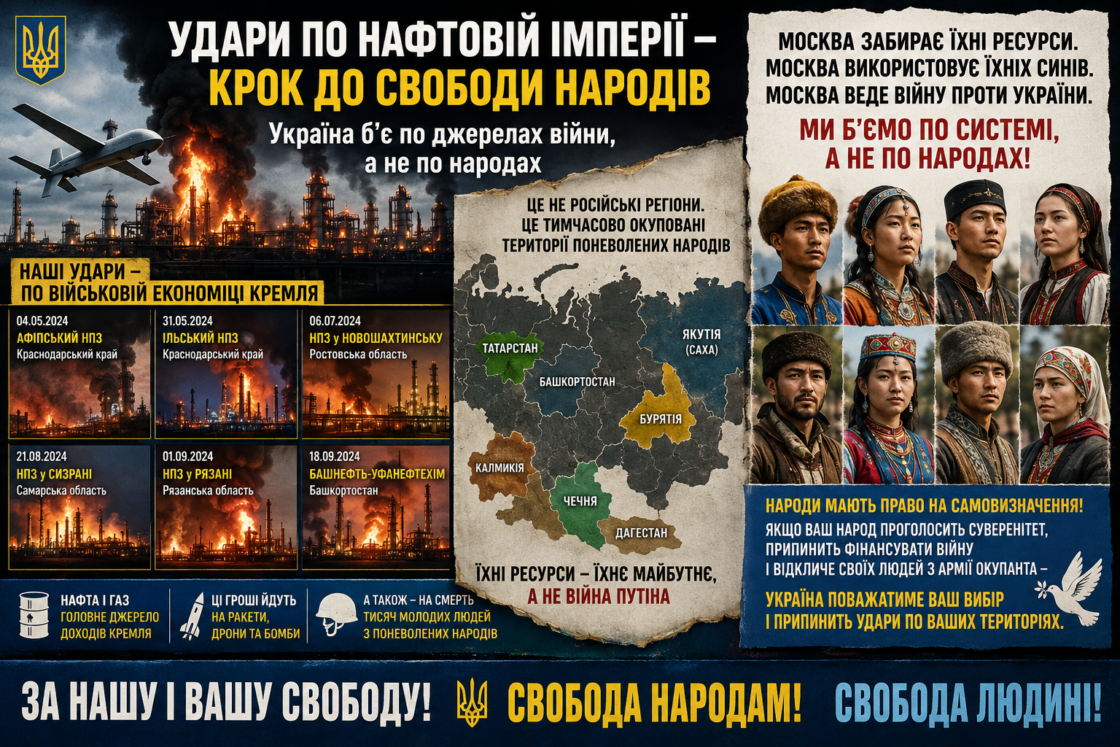
Moscow uses the natural resources of the regions to wage war.
Moscow uses young people from these regions as a mobilisation resource.
Moscow receives income from the exploitation of territories, but concentrates the main benefits in the federal centre.
Therefore, the responsibility for the continuation of the war lies primarily with the imperial system, which turns the resources and population of regions into an instrument of its geopolitical ambitions.
It is this system that Ukraine is attacking.
Sovereignty as a path to security
Particular attention should be paid to the positive message.
It is not enough to simply criticise the Kremlin’s imperial policies. It is necessary to demonstrate an alternative.
Ukraine could consistently state that it supports the right of nations to independently determine their political future in accordance with international law and the principle of self-determination of nations.
A key signal might sound like this:
The fewer resources the Kremlin has at its disposal to wage war, the sooner peace will come.
This approach shifts the discussion from the plane of ethnic confrontation to the plane of responsibility of the political centre that unleashed the aggressive war.
Words also matter
No less important is terminology.
Many news reports regularly use phrases like: “a factory in Tatarstan, Russia,” “a facility in Yakutia, Russia,” or “an enterprise in Bashkortostan, Russia.” This is absurd.
Such constructions unwittingly reinforce a Russian-centric view of political geography.
Instead, it is advisable to use formulations that emphasise the historical and national specifics of these regions and correspond to historical truth: “Tatarstan temporarily occupied by Russia”, “Bashkortostan temporarily occupied by Russia”, “Yakutia (Sakha), “Buryatia” colonised by Moscow”, etc.
It is about rejecting the automatic identification of a multinational space with an exclusively Russian ethnic identity.
This will also be an eye-opener for our Western partners, many of whom are captive to Russian great-power worldview constructs.
From strikes on refineries to cracks in the empire
Wars are not only won on the battlefield.
Sometimes the processes occurring in people’s minds become decisive.
Every strike on oil infrastructure may be accompanied by the question:
“Why are the resources of this region being used for war against Ukraine?”
Each strike on military logistics facilities may be accompanied by a reminder:
“Why should young people from this region die for the Kremlin’s imperial ambitions?”
Each information message can become not only a report on a successful operation, but also an element of a large political campaign aimed at delegitimising the imperial system.
Every mention of the so-called “subject of the Russian Federation” should be a reminder of the history of its occupation by Moscow, of the numerous victims and national insults and humiliations that this people suffered in the national liberation wars against the Kremlin’s oppressors, and appeal to historical events and national heroes.
Ukraine has already proven that it is capable of delivering precise strikes against the economic basis of the Russian military machine. The next step should be to transform these strikes into a tool of political influence that will intensify the internal contradictions of the Russian Federation and contribute to the weakening of the imperial mechanisms that generate aggression.
For our and your Freedom!
Freedom for Nations!
Freedom for the Individual!