

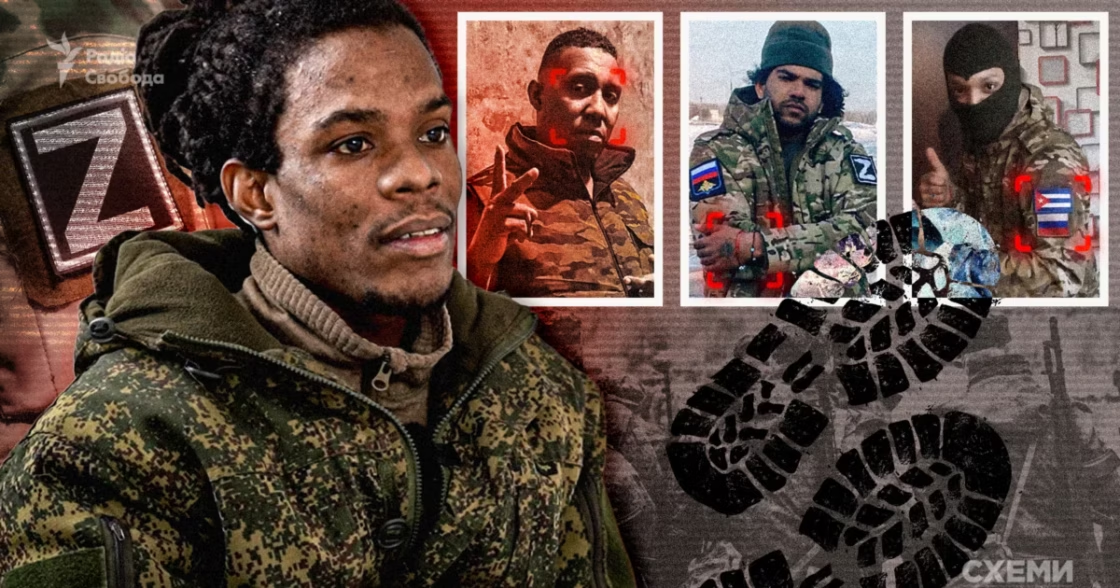
Russia, losing its own mobilization resources, is increasingly resorting to using foreigners to wage war against Ukraine. While Russian propagandists talk about “selfless volunteers,” the real picture is much bleaker.
Journalists have established that over 1,500 people from 48 countries have passed through the recruitment centre in Moscow on Yablochkova Street over the past year. The main flow comprises citizens from South and East Asia, over 770 people. The second largest group is made up of people from the countries of the former USSR — over 520 people, among whom citizens of Tajikistan, Uzbekistan, Belarus, Kyrgyzstan and Kazakhstan dominate. A significant number are also natives of African countries — 72 people.
The recruitment procedure is simple and cynical. Through local employment agencies, people are offered work in Russia with “higher salaries,” without specifying the real conditions. After arrival, they are immediately sent to the so-called “selection point” in Moscow, where they are issued bank cards, take biometric data, and sign a contract for service in the army or private military structures controlled by the Kremlin. The very next day, the recruits are transferred to the “Avangard” training camp, and later to the front line.
“You come looking for a better life, and they draft you and send you to war. If you refuse, they threaten you with deportation or prison,” says one of the recruited migrants.
Some of these people said they were tricked into signing deals, while others were threatened with deportation if they refused. Foreigners are often promised salaries of several thousand dollars, compensation for families in the event of death, citizenship, or “benefits” that are not guaranteed. Most of these promises remain empty words.
Particularly shocking is the fact that, according to journalists, among the recruits there are even citizens of the so-called “unfriendly” European countries to Russia, in particular Great Britain, France, Belgium, Italy and Austria. At least two US citizens also passed through the Moscow centre. The absolute “leader” among European countries in terms of the number of recruits was Serbia, whose mercenaries have long been known for their participation in the Russian aggression against Ukraine.
Another worrying trend is the increase in the number of recruits from the Middle East. Egypt, Iran, Iraq, Libya, Syria, Turkey and other countries in the region supply the Kremlin with manpower, often for next to nothing. Most of these mercenaries come to Russia in search of work, unaware that they will become cannon fodder in a foreign war.
The story of the detention in Osh, Kyrgyzstan, of two employees of the “Russian House” — a representative office of the Russian Cooperation — is symbolic. Natalia Sekerina and Sergey Lapushkin were charged with recruiting mercenaries to participate in an armed conflict abroad. Although this case may seem isolated, it is part of a broader trend.
All over the world, “Russian Houses”, which are formally supposed to represent Russian culture — to organise poetry evenings, ballet tours, and promote “great Russian literature” — are increasingly turning into instruments of soft power and hybrid aggression. Under the cover of culture, political work is carried out, personal data is collected, propaganda is spread, and, as we see now, even recruitment for war. “Russian World” appears not as a cultural initiative, but as a cover for expansion that disregards human lives.
This is not an isolated incident, but an element of the Kremlin’s systemic policy of building a global network of influence, where instead of ballerinas and actors, contract workers with machine guns appear.
Against this background, the transformation of such “cultural centres” from a tool of soft diplomacy into logistical hubs of hybrid warfare is indicative. This is the “Russian world” in all its true glory: with Pushkin leading to the “Avant-garde.”
According to international law, the recruitment of mercenaries is a serious crime. The Geneva Convention clearly defines the status of mercenaries and prohibits their involvement in armed conflicts. Russia cynically ignores these norms, resorting to practices that have the hallmarks of war crimes and violations of fundamental human rights principles.
The Kremlin is currently trying to wage war with the help of others, through deception, poverty, and despair, turning people from all over the world into “cannon fodder” for its aggressive plans. This is yet another evidence of the moral degradation of the Russian regime, which not only destroys its own people but also drags the inhabitants of dozens of other countries into its war, turning them into victims of imperial ambitions.
Oleh Medunytsya, President of the ABN
Daniil Kozachok, journalist






