

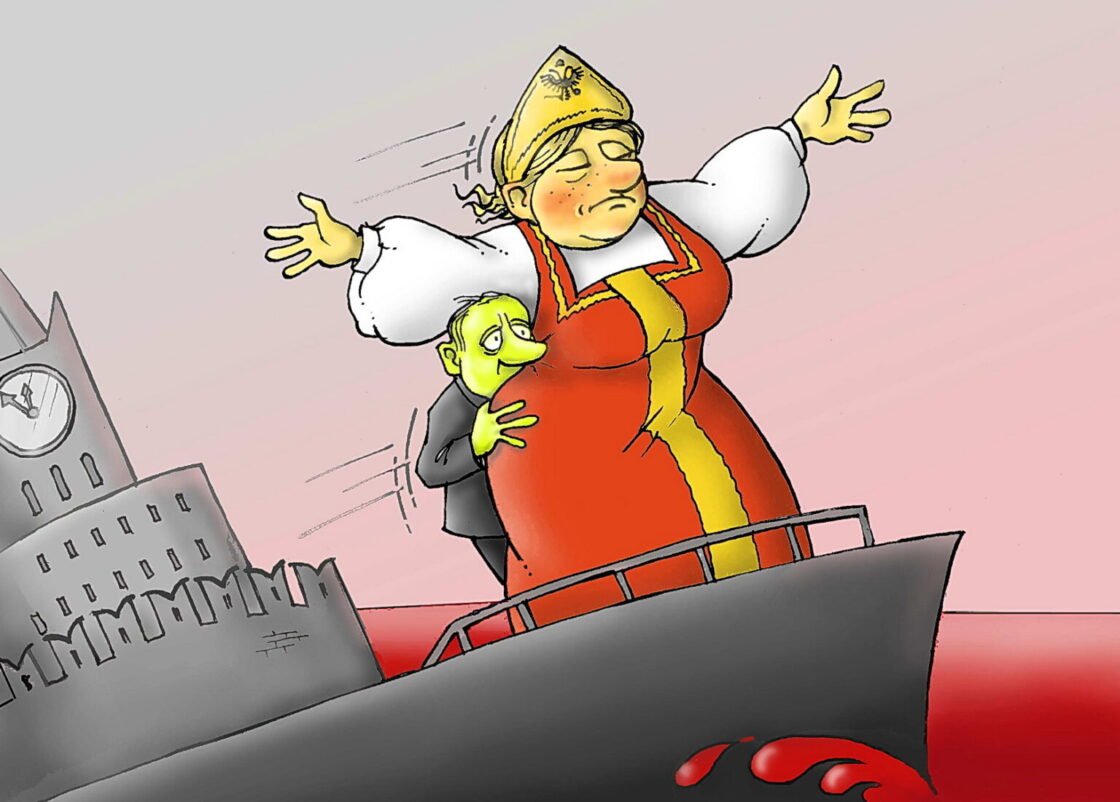
Die in the war. Freeze in winter, drown in spring, or burn in summer. The current generation of residents of the Russian Empire has little choice. Huge problems in the infrastructure sector have been known for a long time. Stupid roads, as well as bridges, dams, heat pipe systems and sewage networks – an ancient map of the troubles of the imperial swamps.
If before the start of the full-scale invasion, Moscow still somehow managed to patch holes, then after the lion’s share of budget funds was redirected to the war, because of record cuts in social and infrastructure expenditures, we did not have to wait long for the catastrophes.
The reduction of spending on the housing and communal system, which was already in a deplorable state, by more than half (by 57% in 2024-2026), immediately made itself felt in winter, when thousands of houses in Russia, even in the wealthy showcase Moscow region, found themselves without heat and electricity.
But as soon as the snow thawed and the icy river melted, the asphalt on the roads got damaged, and the problems worsened tenfold.
There are no funds to protect against traditional spring floods, and those that occurred earlier were successfully “mastered” (“eaten by rodents” according to the local authorities). That’s why Russia was once again predictably shaken.
First, on 5 April, there was a breakthrough in Orsk (the second largest city in the Orenburg region) with a population of 200,000. A traditional spring flood (traditional, because the Ural River and its tributaries are mainly fed by meltwater (60-70%), and most of the annual runoff (65%) occurs during spring floods) washed away two multi-kilometre dams, relatively new ones built in 2009 and 2014, that were supposed to protect the city. In two days, more than 10,000 houses were underwater. Residents were allegedly “warned” about the threat of flooding, although on 3 April, the appointed mayor of Orsk, Vasiliy Kozupitsa, proudly reported that the dams had been checked, and there was no threat of flooding.
The head of the Russian Ministry of Emergency Situations, who flew over the city and announced the introduction of a federal state of emergency in the Orenburg region, calmly watched as the water rushed to the regional centre of Orenburg (with a population of over half a million) and flooded about two thousand houses there. In total, more than 10,000 households in 77 settlements went underwater in two days. The reaction of the authorities was traditional: “Neither drowned…”.
Residents of Orsk, who experienced the inaction of the authorities, “got off their knees” for the first time in the last five years and went to a rally at the city administration. Since the appointed head of the city could not squeeze out anything intelligible except “there is no money, but you hold on”, the protesters raised the radical slogan “Putin, pamagi (help us)!” and managed to meet with the local governor Denis Paslier. There, the protesters experienced all the “delights” of “sovereign democracy”. The strict chief, appointed from the Kremlin, to whom the opinion of the community, to put it mildly, is indifferent, immediately entered the classics of Russian governance: “All the phones were removed!” explained to the local residents that the democracy parade ended on 17 March and now the residents have only one choice: drown in the flood or perish in the war. And it is desirable to do it silently and submissively.
Since there is no money and resources to stop the disaster, everything was “washed away by the war”, the people of Orenburg began to be fed a wave of informational scum, such as “that the authorities warned a week ago, but ignoring people is their responsibility”, “the Ministry of Emergencies are fine people and doing everything they can “, and the big “Putin keeps everything under special control.”
In less than a week, 12,000 houses went underwater in the region. The dam, on which more than a billion rubles were poured in payments, turned out to be eaten by rodents and, according to officials, was not a dam at all, but a “fence along the Ural River”, from which people from the ex-governor’s circle accidentally laundered money.
Currently, the flood situation in Russia is only developing. The water level in the Urals has exceeded the critical mark. Now the governor of the Kurgan region has called on the residents of the right-bank part of Kurgan to evacuate. The situation is worsening in the Tyumen region as well. The peak of the flood is predicted at the end of April.
Well, the means of overcoming the disaster are traditional for Russia. Instead of allocating the necessary funds (and they will not be available until the end of the war), carrying out preventive measures, and providing adequate compensation to flood victims and people who lost their homes and all their wealth, Kurgan Governor Vadim Shumkov decided to fly around the flood-affected territories at the state’s expense with an icon.
It is not possible to blame the “Ukrainian Nazis” for the flood, so Russia switched to the “Kazakh Nazis”. Kazakhstan, which is located downstream of the Urals, was predictably blamed for the floods in Russia. And despite the laws of physics, Vladimir Yakushev, Putin’s plenipotentiary representative in the Urals Federal District, ominously predicted that the flood could have been avoided if Kazakhstan had discharged water in its reservoir system more consistently. This is another unsuccessful reason for the search for a “casus belli” in the hybrid aggression that Russia is deploying against its southern neighbour.
In general, the situation is predictable and natural. The Russian budget is overloaded with military needs and is unable to close the holes in the dams of problems that accumulate in the winter with a snowbank that sweeps away everything in its path with a spring flood.
Well, the citizens, or rather the subjects, got what they wanted. On 17 March 2024, they put the cross on their future. All that was left was to choose the method of suicide, die in the war or freeze, burn and drown at home…







