

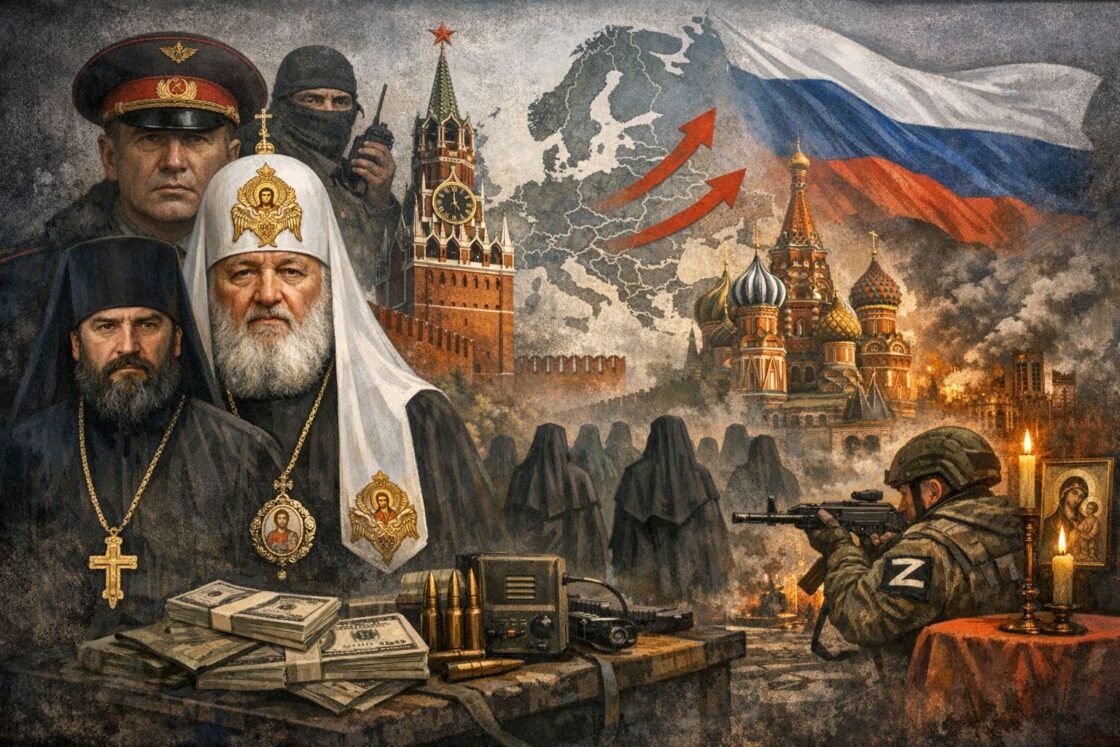
The case of the nuns of the St. Elizabeth Monastery from Belarus, which was revealed in Sweden, is not an anomaly or an “excess on the ground.” It is a logical episode in a long, well-documented tradition of using the Russian Orthodox Church as an instrument of state policy, intelligence and hybrid influence.
The institutional link between the church and the secret services was formalised as early as 1943, when Stalin restored the Russian Orthodox Church as a state-run instrument of mobilisation, control, and external influence. Since then, the church vertical has been embedded in the security system: through personnel checks, covert operations, “pastoral diplomacy,” and international travel. During the Soviet period, the key curator was the NKVD, later succeeded by the KGB; in post-Soviet Russia, this role was assumed by the FSB and GRU. The continuity was not interrupted—only the forms and rhetoric changed.
The current model of action in Europe is based on several pillars. First, religious cover: monasteries, parishes, and “humanitarian” initiatives have a high credit rating and legal immunity in democratic states. Second, financial flows: the collection of donations and trade in cult products creates uncontrolled channels of financing, in particular for the needs of the Russian armed forces. Third, ideological legitimisation of war: the religious language of “holy struggle” removes moral barriers, normalises aggression and devalues the pressure of sanctions. Fourth, networks of influence: through the flock and sympathisers, a loyal environment is formed, capable of influencing public opinion and political discussions.
Europe’s vulnerability lies not in a lack of information, but in the inertia of thinking. The ROC is often perceived as an autonomous religious actor, while in the Russian system it is part of the state machine, with a clear hierarchy, discipline and accountability to the power bloc. That is why cases like the Swedish one should be interpreted not as criminal episodes, but as elements of a coordinated campaign.
The conclusion is simple and uncomfortable: the Russian Orthodox Church in Europe is not just about faith. It is about intelligence, money, propaganda, and preparing the ground for destabilisation. The history since 1943 provides ample reason to stop pretending that these are random deviations rather than systematic state practice.
Viktor Yahun
Facebook 





