

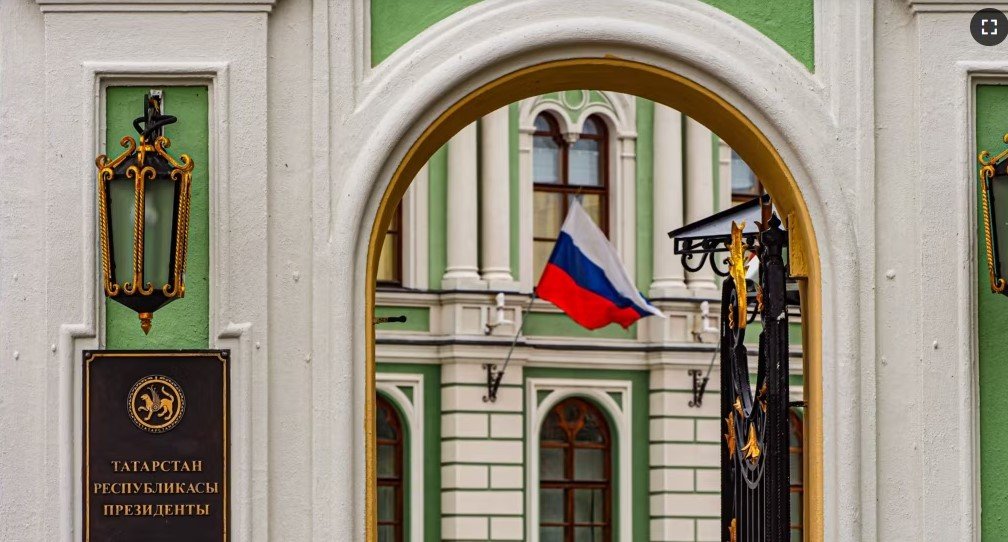
Using several examples that have caused a public reaction, an expert on federal relations in Russia Harun Sidorov shows how the Russian authorities, in his opinion, are trying to impose a point of view that contradicts even the noticeably changed constitutions of Russia and Tatarstan.
Recent information events indicate that in Tatarstan and among some people from there, on the one hand, and in the conventionally all-Russian space, on the other, different views remain on the fundamental characteristics of their statehood and the concepts and symbols in which they are manifested.
At the end of last year, this was shown by the public reaction of Tatarstan parliamentarian Ilshat Aminov with one of the leaders of United Russia, Pyotr Tolstoy, who proposed abandoning the use of the word “Russians” and calling all Russian citizens “Russian.” For attentive observers, Tolstoy’s statements should not have sounded like a bolt from the blue, since it should have long been obvious that the identification of “Russians” (a noun) and “Russian” (an adjective) is a conscious and purposeful policy of the Kremlin, the symbolic manifestation of which was the actual transformation of the famous song “I Russian” into the unofficial anthem of the country.
However, for the mouthpiece of the Kazan Kremlin, Ilshat Aminov, the trigger was precisely a statement in the appropriate spirit by one of the officials of United Russia, in connection with which he expressively voiced concern about the “awakening of cave imperial nationalism in Russia” and asked, about Tolstoy’s words, the question: “Everything has been said – Is this in the heat of the moment, for the currently fashionable hype, or is this an idea emerging in the depths of certain political circles of the forced unification of Russia, a complete revision of the Russian Constitution, its spirit and content?”
Ilshat Aminov began to suspect something: how the Tatarstan “United Russia” argued with the Moscow
Another such skirmish between the Tatarstan public and another representative of the Russian establishment occurred during the recent visit to Kazan of the head of the “Safe Internet League” Ekaterina Mizulina, who, as Kommersant writes, during a meeting with students in Kazan, said that the concept of “I Russian” and “I am Russian” are equal for her.
“The term Russian is already broader than one specific nationality. It already includes all of us together. We are neither Tuvans, nor Tatars, nor Dagestanis, nor Lezgins, nor Ingush – we are all Russians,” Mizulina later told reporters.
It is interesting that during Mizulina’s speech, the Kazan students who came to see her disrupted it by chanting: “Tatarstan, Tatarstan!” Moreover, it is significant that at first, someone tried to chant “Russia,” but these lonely voices were drowned in the friendly chorus of supporters of Tatarstan republican patriotism.
Finally, this week, the difference in understanding of the status of Tatarstan in Russia was revealed by the statement of the Olympic champion, figure skater and supporter of Vladimir Putin Alina Zagitova, who thanked the “state of Tatarstan” for its support. Here again, the reaction was revealing. Several media outlets presented this wording as a “disclaimer.” This is even though in the Russian Constitution the republics, including Tatarstan, are designated as states.
Here it should also be mentioned that in Tatarstan, the first article of even a noticeably amended Constitution begins with the words: “The Republic of Tatarstan is a democratic legal state within the Russian Federation.”
Probably, for some, all such formulations of both the Russian and the republican constitutions are annoying rudiments of the Gorbachev-Yeltsin era of the “parade of sovereignties.”
In Tatarstan, the picture is different – representatives of its establishment, such as the general director of the Novy Vek Television and Radio Company OJSC, deputy of the State Council of the Republic of Tatarstan Ilshat Aminov, and ordinary students continue to speak out from the position of republican patriotism, as shown by the reaction to Ekaterina Mizulina.
In this sense, one can argue about whether Alina Zagitova was aware of the meaning she intended in the formulation “state of Tatarstan” and whether she made a slip when pronouncing it. However, in the context of all of the above, it can be assumed that even if this was a slip, it was probably, as they say, “according to Freud.” Because, if not in the consciousness, then at least in the subconscious of many Tatarstan residents, their republic remains not an ordinary region of Russia, which many in Moscow want to see it as, but a state with a special, albeit not entirely clear at the moment, status.
Harun (Vadim) Sidorov, a student doctor in ethnology at Charles University (Czech Republic), an expert on national movements of the people of Russia in general and the Volga-Ural region
Idel.Реалии





