

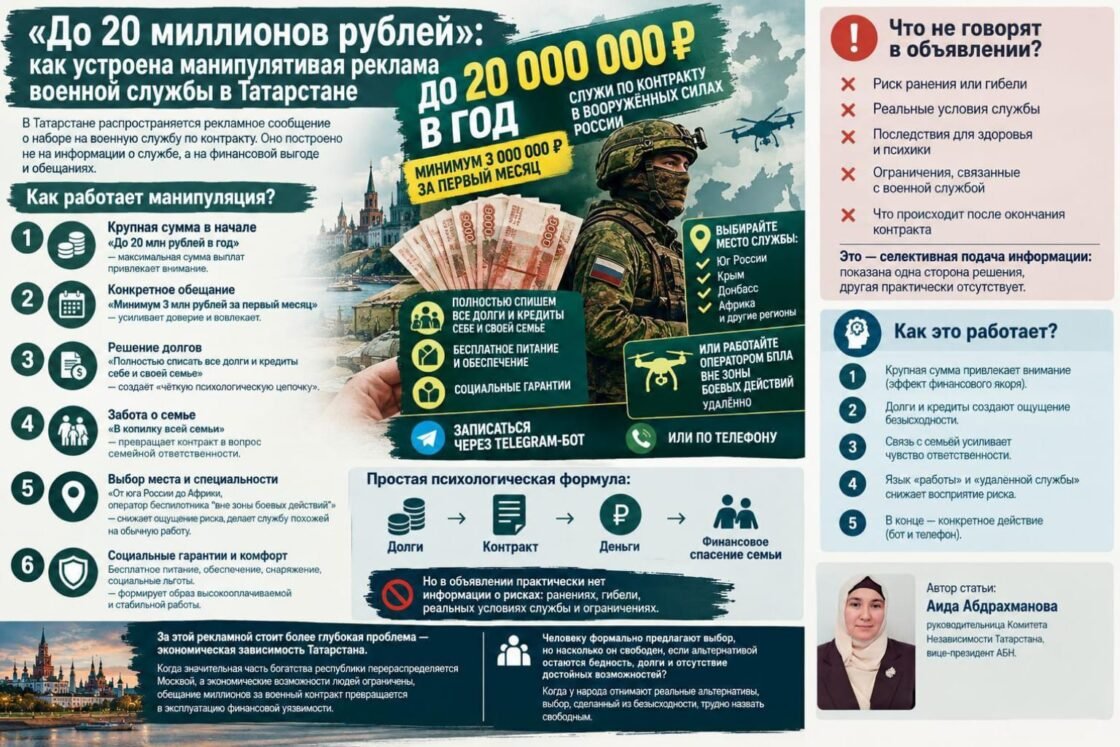
An advertisement promoting military recruitment under contract with the Russian Ministry of Defence is being distributed in Tatarstan. It is built primarily around financial gain.
The advert claims payments of “up to 20 million rubles per year,” with at least 3 million rubles for the first month, the possibility of debt and loan forgiveness, social guarantees, free meals, and support.
Potential candidates are also offered a choice of duty station—from southern Russia to the African continent—or work as a drone operator “outside the combat zone.”
At first glance, this appears to be standard information about existing payments and benefits. However, if you examine not only the content but also the way the information is presented, it becomes clear that the ad is structured like a full-fledged recruiting pitch, with financial benefits serving as the primary argument for signing a contract with the Russian Ministry of Defence.
The first thing the reader gets is a big figure: “up to 20 million rubles per year.” Then comes an even more specific promise: “at least 3 million rubles in the first month.”
After this, financial motivation is strengthened by the offer to “completely write off all debts and loans for yourself and your family.”
This creates a simple psychological chain: debts → contract → money → financial salvation of the family.
It’s especially important that this isn’t just about personal income. The phrase “for the benefit of the whole family” transforms the decision to enter into a contract into a matter of family responsibility.
The man turns out to be not only a potential military service member, but also a breadwinner who is offered the opportunity to solve the financial problems of his loved ones.
However, the phrase “up to 20 million” requires special attention. The financial enticement of “up to 20 million” ≠ “everyone will receive 20 million” does not mean that every service member is guaranteed to receive exactly that amount.
Such amounts can be made up of various types of payments and depend on the terms and conditions. However, the maximum payment amount is stated at the beginning of the message and becomes the primary reference point for the potential candidate.
This is a classic financial anchoring effect: a large sum of money attracts attention before a person begins to understand the terms of receiving it.
Another important element is the language of the ad.
Military service is described using terms typical of the regular job market: “earn money,” “first month of work,” “choose your own place of work.”
An image of a well-paid job with benefits is replacing the image of military service with its risks.
Particularly telling is the offer to work “remotely as a drone operator outside a combat zone.” The word “remotely” evokes associations with modern telecommuting, and the phrase “outside a combat zone” further reduces the perception of danger.
Thus, a potentially risky decision takes on a more familiar and psychologically comfortable image: not participation in a war, but work; not danger, but a high salary; not uncertainty, but the opportunity to choose.
The advertisement details the benefits—money, food, provisions, equipment, social guarantees, the ability to choose a location and specialty—but says virtually nothing about the other side of the decision. It offers no comparable information about the risk of injury or death, the possible consequences of service, the contract’s actual terms, or the restrictions associated with military service.
It is here that the most significant manipulative mechanism manifests itself: the selective presentation of information.
Manipulation doesn’t necessarily require lies. It’s enough to present one side of the decision in detail, while leaving the other side practically undisclosed. As a result, the recipient receives not the full picture, but a certain informational context.
It’s also important that this message isn’t being distributed as a one-off, private post. A virtually identical text appeared on several regional Telegram channels in Tatarstan, including Aktanysh-Inform and Zelenodolsk News. This allows us to view it as part of a broader information campaign promoting contract service among the public.
At the end of the ad, a Telegram bot and a phone number for candidates to register are included.
Thus, the entire structure has a clear sequence: attract a large sum → offer a solution to debt problems → link income to family well-being → reduce the perception of risk through the language of “work” and “remote service” → offer a specific action.
So the main question here is not just how reliable each individual figure is.
Far more interesting is the image a person gets after reading the ad.
Military service is presented primarily as a way to earn money, resolve debt, and provide for a family. The risks inherent in such a decision are practically ignored in the advertising.
It is precisely this difference between informing and persuading that allows such messages to be considered an example of highly manipulative recruiting communication.
There is a deeper issue behind this ad: the right to real choice.
When a significant portion of Tatarstan’s wealth is redistributed by Moscow and people’s economic opportunities are limited, the promise of millions for a military contract turns into an exploitation of financial vulnerability.
A person is formally offered a choice, but how free is he if the alternative is poverty, debt, and a lack of decent opportunities?
Thus, economic dependence becomes a recruiting tool: Moscow extracts most of Tatarstan’s resources, and then offers the republic’s population money to participate in Moscow’s imperial wars. For Tatarstanis, this is no longer just a question of money, but also of the right to manage their own resources and determine their own future.
When people are deprived of real alternatives, a choice made out of desperation can hardly be called free.
Aida Abdrakhmanova, head of the Tatarstan Independence Committee and vice president of the Anti-Imperial Block of Nations






