

The Ukrainian-Russian war is often described as a technological revolution and a time of paradigm shift in warfare. People with big shoulders around the world are studying every technological twist on the battlefields of Ukraine.
For Ukrainians – from the soldier on the front line hunting Russians with various types of UAVs, to the residents of Kyiv, Lutsk, or Chernivtsi who experience massive attacks by hundreds of strike drones and missiles overnight – these technological shifts also mean the need to change their daily survival strategies.
In such a situation of rapid, deadly change, it is essential to maintain the ability to make generalisations not only at the level of everyday survival, but also to resort to a helicopter view, trying to grasp the current situation completely and understand where it is heading at a strategic level.
Former Commander-in-Chief of the Armed Forces and current Ambassador of Ukraine to London, Valeriy Zaluzhny, is one of the most knowledgeable and trained specialists in the world, truly capable of understanding the depth of changes in the new war and predicting where this technological war of attrition is taking humanity.
“Ukrainian Truth” offers readers an excerpt from the foreword that Zaluzhny wrote in the fall of 2024 to the book by UP journalist Roman Romanyuk, “ What Will They Fight for in the Third World War .”
Despite its certain remoteness in time, this text is striking with the eerie accuracy of its predictions and their complete correspondence to the new difficult realities at the front and in the deep rear.
Technologies of the new war of attrition
…From 1917 until the early 1970s, the technical means of defence and offence were on a par. This parity means that successful offensive actions are ensured by concentrating efforts or by effectively organising their use. The effectiveness of the offensive in wars of this period is determined solely by the search for better tactical and operational approaches (for example, the “Blitzkrieg” doctrine during World War II) or by the physical concentration of a large number of striking forces and means on a very narrow section of the front.
The situation changed again in the 1970s, when precision weapons and guided munitions entered the war. Precision air defence systems, anti-tank guided missiles, air-to-air, ground-to-air, and ground-to-ground cruise missiles completely transformed the paradigm of war again. With the advent of powerful electronic warfare, aircraft were able to keep the enemy out to a distance of more than 100 km, and air superiority began to depend on the power of the radar and the profile of the aircraft. An example is Operation Desert Storm in the Persian Gulf in 1991.
The strategically significant effectiveness of the use of precision weapons has, of course, been due to the revolution in satellite technology, namely the emergence of remote sensing technologies, the global navigation satellite system GPS and satellite communications. Namely, the integration of satellite communications into military communications ensured the emergence of situational awareness systems and the C4ISR doctrine. This new technological breakthrough has taken combat operations beyond the classical doctrine of warfare of the 20th century. The principle arises that with small costs, it is possible to inflict maximum military and material damage to the enemy both in defence and in the offensive. At the same time, the technology of precision weapons has not affected the benefits of offensive or defensive combat, since technically it can be used with equal effectiveness in both defence and offence.
Precision weapons revealed a new dependence. The effectiveness of warfare directly depended primarily on scientific and technological potential. But at the same time, as during the Second World War, the advantage was also determined by the quality of training of troops and the level of operational art of their application.
The Russian-Ukrainian war of 2022 began precisely in this historical technological cycle as a war of the use of high-precision weapons. Today, I can confidently say that, overall, Ukraine managed to be more effective, primarily due to a higher level of organisation, tactics of application, and technological support from partner countries.
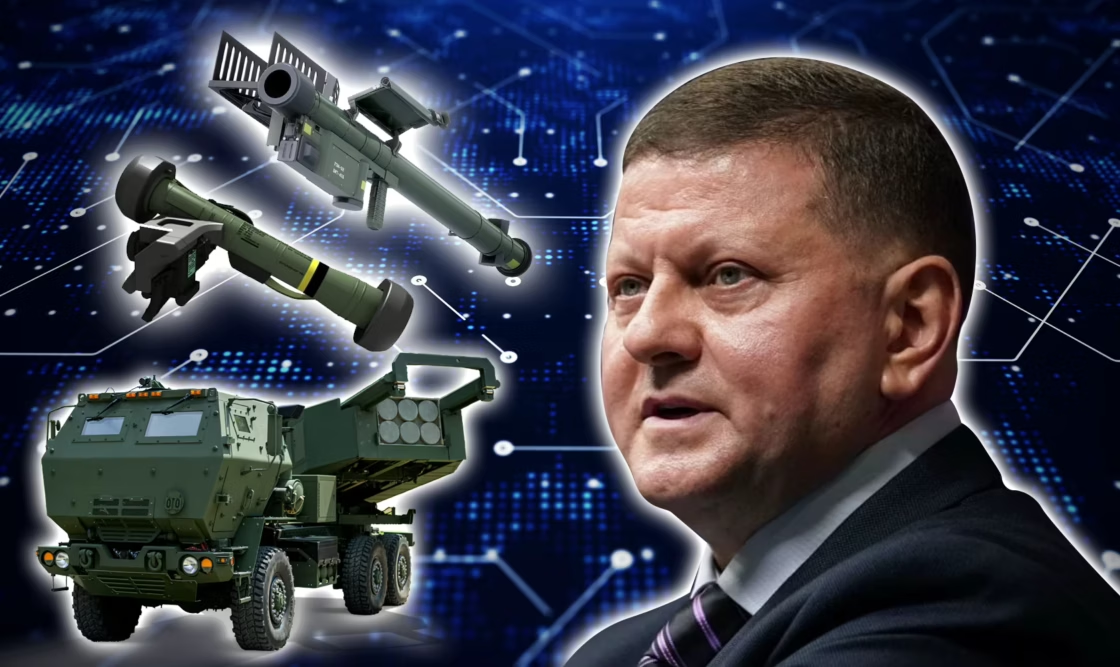
ATGMs of the “FGM-148 Javelin”, “NLAW” and “Stugna-P” type became means of destroying armoured vehicles. MANPADS of the “FIM-92 Stinger” and “Igla” type prohibited the penetration of enemy aircraft into our airspace. R-360 “Neptune” anti-ship missiles ensured the destruction of the flagship of the Russian Black Sea Fleet, and the MLRS “M142 HIMARS” provided the opportunity to devastate the enemy’s logistics and contributed to the successful operations in the period from April to November 2022, despite the superiority of the enemy’s forces.
At the end of 2022, this historical-technological cycle ended and from 2023 it entered a stage similar to the stalemate of World War I. This time, the war reached a stalemate due to at least two technological factors:
1) The rapid development of electronic warfare which blocked the effective use of most guided munitions.
2) Saturation of the battlefield with tactical-level reconnaissance and strike drones, which led to the impossibility of moving around the battlefield and, as a result, the impossibility of performing operational and even tactical tasks.
Accordingly, based on the logic of technological development on the battlefield and current trends in the production of defence technologies, it is possible to try to predict the further development of war technology.
According to the previously deduced logic, the first thing we can expect in the next two years is the unquestionable restoration of parity in defence and offence, which will allow us to once again conduct effective offensive actions on the battlefield.
This will likely be possible thanks to the following trends identified by our experts:
- The impact of electronic warfare on reconnaissance and precision weapons will most likely be eliminated by switching to alternative communication and data transmission channels outside the radio-electronic spectrum of electromagnetic waves ( optical navigation channel, odometry based on digital maps of magnetic or radar fields of the earth’s surface, autonomous guidance using neural networks, laser communication technology, etc.).
This will also be affected by the development of means of destroying electronic warfare complexes. This will not lead to the disappearance of electronic warfare from the battlefield, but will significantly narrow the range of its effective use. - The emergence of the possibility of physically destroying enemy visual reconnaissance assets, in particular unmanned aerial systems at the operational and tactical levels, as well as stationary optical surveillance systems, again at the expense of drones that intercept drones of all types, as well as laser technologies for blinding optics.
- And most importantly, scaling up, further reducing the cost, increasing the range and autonomy of high-precision weapons (primarily strike drones of all types), which will allow remotely destroying enemy personnel, weapons, and military equipment in strongpoints along the line of combat contact, disrupting logistical chains, and ensuring an effective logistical blockade to first “squeeze” the enemy out of defence areas, and then occupy virtually empty positions.
Of course, when technological parity in offence and defence is restored, it is possible to predict, based on the example of previous historical and technological cycles, the restoration of the ability of the parties to conduct effective offensive operations at the operational and strategic levels through the concentration of forces and means. However, I believe that such a development of events is currently seen as problematic and unlikely for the following reasons:
- Mobilisation potential. Conducting offensive operations requires the availability of significant mobilisation resources and reserves, which neither Ukraine nor Russia can count on in the short or long term. Moreover, the demographic situation in both countries will only worsen and approach catastrophic indicators in direct proportion to the duration of the war. Most likely, human resources will become non-renewable and, as a result, the most expensive.
- Economic and material constraints. Conducting offensive operations under conditions of parity will require the accumulation and concentration of much larger amounts of forces and resources than are needed to maintain defence. This, in turn, will require significant economic resources and material and technical reserves. Again, human resources that cannot be quickly restored.
Both Ukraine and Russia are likely to face growing economic difficulties that limit their ability to build and concentrate the potential for what we understand as classic offensive actions at the operational and strategic levels.
At the same time, the active development of artificial intelligence and machine learning technologies is already continuing. The result of this development will be an even greater increase in the accuracy of hitting targets and the ability to inflict greater losses with fewer resources, since high-precision weapons are becoming, for the first time in history, not just massive and cheap, but cheaper than conventional shells and, at the same time, apparently completely immune to electronic warfare.
Also, perhaps for the first time in history, man will be completely or partially removed not only from the process of control, but also from the process of making decisions about defeat. Poor Sun Tzu will not see this. After all, the principles he laid down are valid only on the condition that wars will be led by men.
In other words, the revolution in military technologies based on unmanned systems and artificial intelligence will provide, first of all, unprecedented tools for destroying the enemy’s military-economic potential by destroying strategic military and civilian infrastructure throughout the country. Massive attacks by autonomous swarms of cheap high-precision drones on completely different navigation channels will destroy not only personnel and weapons and military equipment on the front line, but also objects of the enemy’s critical economic and social infrastructure.
It can therefore be concluded that technological developments and the demographic and economic situation in the coming years are likely to contribute to a war of attrition. The positions of the parties along the front line will increasingly serve to maintain the overall paradigm of a war of attrition and to maintain internal tensions within the country.
Instead, the possibilities for large-scale and effective destruction of the enemy’s economic potential and life support systems will grow. Combining this with Russia’s ability to conduct effective information operations suggests that the war will move to the level of possible remote destruction of the country’s ability to resist.
This will mean an increase in the intensity of attacks on infrastructure, energy systems, transport hubs and other key elements of state governance and life support. Continuation of information operations against the backdrop of unfounded expectations. Therefore, the war strategy will be aimed not so much at capturing territories as at depleting the enemy’s resources and capabilities, creating chaos and, as a result, destroying the nation’s ability to resist.
So, whether we like it or not, in 2023, the development of military technologies in the world entered a new cycle, and the beginning of this process was the Russian-Ukrainian war, which eliminated the previous paradigm of applying previously known technological solutions.
Most likely, the military-technological revolution that has already begun creates ideal conditions for such a type of war as a war of attrition. In my opinion, this conclusion makes it possible to realise the main and, probably, the only Victory strategy for our state in the future. It will consist not only of working on the front line, but also in forming a system of “survival” of the country and the formation of asymmetric capabilities, precisely based on technological solutions.
Of course, all this will be possible only with absolute control of the situation on the battlefield and counteraction to information threats. Not just resilience, but a decisive and timely response is the key to our Victory.
A completely new war awaits us. A war according to new rules. But we have shown what we are capable of. Even in a new war. A fundamentally new doctrine of modern warfare is being formed. This doctrine is being formed today precisely in the fields of the Russian-Ukrainian war.
I completely agree with Dr. Sean McFate: “Half of the victory is understanding what it looks like… Brains are more important than brute force.”
Valery Zaluzhnyj
Українська правда





