

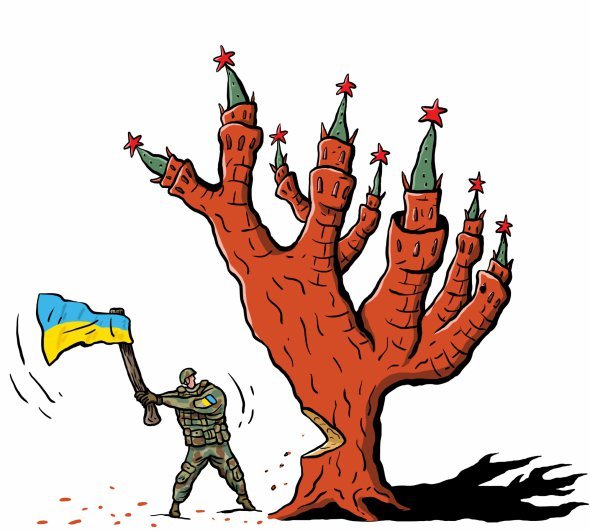
Already in the first months of Russia’s full-scale war against Ukraine, it became clear that the enemy would not be able to achieve its initial goal. It was not able to quickly capture Kyiv, establish an occupational regime here, nor take control of all or almost all of Ukraine. The next stage of the war was a dynamic confrontation between the two armies, when the Russians tried to advance where they could, and the Ukrainian army, holding the front, began counteroffensive actions where it was possible or expedient. Now the war is moving to the next stage, in which the Armed Forces of Ukraine are preparing to liberate captured territories along the entire front line, and the Russians, accordingly, are preparing to defend everything occupied. The enemy has well and deeply set up its defence line, and this creates difficulties for a counterattack.
Under today’s circumstances, there is a risk that the war will turn into a long and exhausting confrontation with relatively little advance of our troops on the ground. This rhythm of hostilities requires large resources and will lead to casualties among our military without significant success. This creates an optimal context for political decisions desired by the Kremlin. Anticipating the exhaustion of Ukraine and the fatigue of our Western partners, the Russian leadership dreams of forcing everyone to sit down with them at the negotiating table, as a result of which the Russians want to achieve several goals:
- slow down the war and get time for recovery;
- establish more reliable control over the captured territories of Ukraine;
- avoid responsibility for armed aggression against Ukraine;
- ease the pressure of sanctions on itself and begin to come out of international isolation.
The confrontational scenario of the two armies on the front line is exhausting for both sides, and the only question is which of them is ready and able to make greater sacrifices.
The expected scenario of two armies facing each other on the front line is exhausting for both sides, and the only question is which of them is ready and able to make greater sacrifices. It is important to add that the front runs through our land, and the enemy still has more opportunities to carry out destructive airstrikes throughout the country, therefore we still suffer greater losses.
It has long been obvious that the condition for the defeat of Russia must be destructive events and processes on its territory. It is not only or not so much about the transfer of the front line of the Russian-Ukrainian war to the Russian Federation. We are talking about events and processes that will be self-destructive for our enemy. Although Russia looks like a large-scale state on the map, in reality it is a very vulnerable structure that rests only on a repressive vertical command of power, which must constantly confirm its capability.
Not everyone in the West, and even in Ukraine, dares to consider the Russian-Ukrainian war on such a horizon. In Ukraine, the main driver of this paradigm is the Central Directorate of Intelligence (HUR), whose special day we celebrated last week. In addition to the fact that military intelligence is involved in the liberation of our territories on the battlefield and is specifically aimed at gathering important information and implementing secret measures on the territory of the enemy, the HUR and its head Kyrylo Budanov publicly announced structural destructive changes in the Russian Federation for the purpose of our struggle, up to its collapse into smaller parts. Among Ukrainian citizens, there are enough supporters of exactly this concept of waging war against Russia, since we must strive not only for our victory, but also for the systematic defeat of Russia. Our task is to make the enemy unable to threaten Ukraine in the future. This is a natural and fair aspiration of Ukrainians.
Russia faces the fate of the USSR, when it began to crack due to internally overreaching itself and its own aggression
Russia faces the fate of the USSR, when it began to crack due to internally overreaching itself and its own aggression. The problems in Russia today are the same, as in the past, and in some places, they are much worse: the same colourful, ethno-national structure, but the level of internal xenophobia is higher than then; even greater technological and economic dependence on the outside world and infrastructural poverty; even greater than for the “scoop”, an uneven distribution of benefits and a much higher level of corruption in the managerial structure. And this is far from all that gives grounds for optimistic hints and understatements of Ukrainian military leaders.
Mykhailo BASARAB, political scientist, officer of the ZSU (Ukrainian Armed Forces)
Gazeta.ua





