

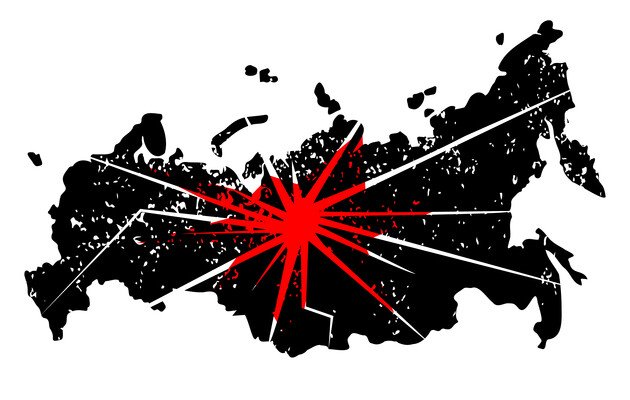
The West continues to consider the collapse of Russia as an undesirable and too risky scenario. And he also did not give up the ghostly idea of pulling Moscow over to his side in the future or at least making it neutral in a quite possible global confrontation with China. This is evidenced by a number of direct and indirect signals displayed by Western political elites since the beginning of the phase of full-scale Russian aggression against Ukraine. However, this geopolitical calculation of the West is wrong. It is based on stereotypes and fears formed in the 20th century. And also inertial thinking, which prevents us from seeing the global picture from a different angle and opening up new opportunities where only dangers are visible.
Leaders of Western countries have repeatedly expressed the spirit: Putin should not win in Ukraine. But clear statements about the need for Russia’s military defeat and decisive defeat of the aggressor are practically not heard. With the exception of European politicians who have felt the consequences of Russian imperialism, Western political elites are cool with the idea of Russia’s disintegration. At the heart of such a biased attitude are two main motives — fear and hope.
Speaking in February 2023 in Warsaw, US President Joe Biden said that the West does not seek to destroy or take control of Russia. As at the end of the 20th century, the West fears the consequences of the possible collapse of the Russian Federation in the form of uncontrolled proliferation of nuclear weapons. And he also harbors illusory hopes that after the end of Putin’s rule, Russia can once again try to democratize and make it a more adequate player on the international stage. Another serious motive, which is guided by America and Europe, is that the integrity of Russia must be preserved in order to counter China. Such considerations undoubtedly affect the level of support for Ukraine in the war. A painful, quick and decisive defeat of the Russian invaders on the battlefield can trigger uncontrolled processes in the Russian Federation. Processes in which Washington and Brussels are not too interested.
Thinking in this way, the West ignores its own disappointing historical experience. In the 20th century, the West twice missed the opportunity to destroy the empire centered in Moscow. And then reaped the fruits of his indecision and wrong strategy. Russia’s current aggression against Ukraine is also a consequence of wrong decisions made in the past.
The coming to power of the Bolsheviks in Russia as a result of the October coup of 1917 caught the leading Western countries by surprise. Preoccupied with the First World War , the political leaders of that time treated the Bolsheviks lightly, hoping that Lenin’s government would not last long. However, they were wrong in their calculations. When the First World War ended within a year, the Bolsheviks managed to strengthen themselves, controlled a large part of the territory of the former Russian Empire and planned to extend their influence to uncontrolled regions. In this situation, the countries of the Entente did not develop a single position regarding what to do with Russia.Instead of supporting the national aspirations of the peoples enslaved by Moscow, the Entente bet on the White Guard movement, which advocated a “united and indivisible Russia.” Winston Churchill, who was then the Minister of War of Great Britain, advocated the creation of a “sanitary border” with Bolshevik Russia. At the same time, some Western politicians considered it possible to establish a dialogue with the “Reds”. No one was seriously interested in the collapse of Russia. As a result, the Bolsheviks managed to revive the Russian Empire, but in the format of the USSR. This later created many problems for the free world and became a prologue to the Second World War, which Hitler and Stalin blessed on August 23, 1939 with the Molotov-Ribbentrop Pact.Most of the last century was spent in opposition of the Russian communist empire to the countries of the West. An empire that could have disappeared in the first years of its existence if Western democracies had shown more persistence .
When the USSR was on the verge of collapse and collapse at the turn of the 80s and 90s of the 20th century, leading Western politicians categorically did not support the exit of the national republics (with the exception of the Baltic states) from the Soviet Union. The administration of US President George W. Bush was very concerned about the proliferation of nuclear weapons. There they sincerely believed that it was better to deal with one Russia than with a number of newly independent states. Also, for some reason, the West believed in the success of Russia’s democratization, deciding that the era of global confrontation had ended forever. Only US Secretary of Defense Dick Cheney believed that the USA should take advantage of the window of opportunity and contribute to the disintegration of Russia in every possible way. He did not believe in the triumph of democracy on the territory of Muscovy and assumed that in a certain time, the authoritarian regime would be revived in Russia. And so it happened. But in the early 1990s, Cheney’s views were not popular.
The democratization of Russia is an illusion that is almost impossible to realize.During the entire existence of Moscow, first in the form of a principality and kingdom, and then in the form of an empire, the period that can be conventionally called “hybrid democracy” spans no more than 10 years. Even under Boris Yeltsin, the Kremlin perceived the West not as a partner and ally, but as a strategic competitor and enemy. For the sprouts of democracy to sprout in such a society as the Russian one, a very long time is needed in combination with external management. The denazification of Germany after 1945 was carried out under the conditions of occupation of its territory by the Allied forces and lasted for decades. It will take much longer to denazify and de-imperialize the mentality of the Russians. After all, Russia has lived with a model of authoritarian rule throughout its history. However, none of the Western countries is burning with the desire to introduce troops into the territory of the Russian Federation and teach Russians about democracy. The only option for the democratization of Russia is its disintegration into a number of state entities. In this case, some of the countries that will appear in the place of the former Russian Federation can gradually be included in the Western world and try to cure them of the imperial mentality. If Russia remains within its current borders, the coming to power of a new Putin, who will cherish hopes of revenge, is only a matter of time.
When some Western politicians say that the focus needs to be on the growing threat from China, they are overlooking the threat posed by Russia. They have fantastic hopes that Moscow will be a deterrent for Beijing. Meanwhile, the threat emanating from China and Russia is identical for the West. At its core is the struggle of the world of authoritarian dictatorships against the free world.Moscow and Beijing sincerely dislike the West and would like to rewrite the rules of the game on the international stage. Replace international law with the law of the strong. To adjust the borders of states and spheres of influence. Therefore, they are much more likely to join forces in confronting the global West than to fight among themselves. Even if Russia weakens even more and becomes a vassal of a much stronger China, this will not prevent the formation of the Beijing-Moscow axis. And to attract smaller players like Iran or North Korea to it. If the Chinese dragon secures the support of Russia, which will remain as a single empire within its present borders, its aggressive ambitions will be greatly enhanced. And the West will have to disperse its forces on two fronts, simultaneously restraining Moscow and Beijin.
A completely different situation may develop in the event of the disintegration of Russia into a number of state entities. Thus, some of the states that will emerge on the vast expanses of the former Russian Federation will fall into the orbit of Chinese influence. But certainly not all. As for the rest of the new state entities, they can evolve in different directions. In particular, to become loyal to the West or democratize. Some other new republics may come under the conditional influence of Turkey or other regional players. But it is definitely better than having a military-political alliance between China and the Russian Federation within its current borders.
The collapse of Russia is the only real chance to separate this great colonial empire from Chinese influence. An effective means of preventing the close cooperation and alliance of two authoritarian regimes in the fight against the free world. The disappearance from the political map of the state permeated with anti-Western mentality and ideas of revanchism more than compensates the West for the risks that will take place in the process of the collapse and collapse of the Russian Federation. After that, the Western world will be able to concentrate its forces in one direction, restraining China’s global efforts.
Petro Herasymenko
ZN,UA





