

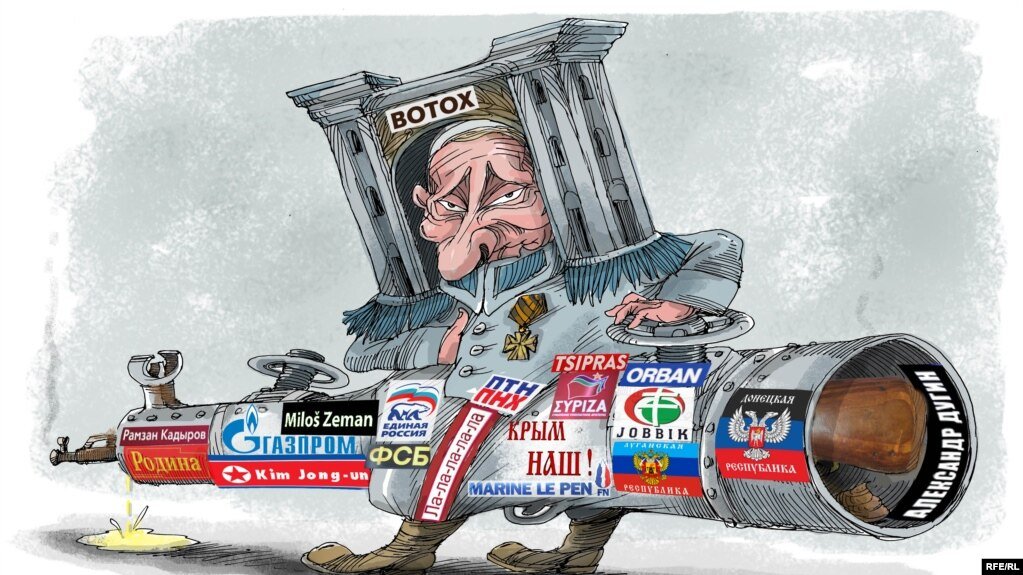
“Champion of world sanctions”, as Russia ironically calls itself (as of the end of 2023 – 19,919 subjects of the Russian Federation were subject to sanction bans and restrictions, including 6,793 campaigns and 10,126 individuals), flaunts the fact that the sanctions did not have a significant impact on the country’s economy and vice versa – they hit the initiator countries.
On the surface, the situation appears to be under control for Russia, and the sanctions did not cause a striking blow to the economy nor deprive it of the opportunity to finance the war with Ukraine. Moreover, under the pressure of sanctions, Russia’s economy is growing, and military expenditures received record funding in 2024.
But the most eloquent is the growth of the fortunes of Russian billionaires. If with the beginning of the large-scale invasion of Ukraine, the number of Russian billionaires on the Forbes list decreased from 123 to 88 people in 2022, then two years after the war, the number of Russian billionaires increased to a record high of 125 people. Moreover, this year Russian billionaires became richer by 18.3 billion dollars.
Russia has reoriented its trade to the so-called “friendly countries” and now, according to the statements of its prime minister, the total exchange of goods with these countries is commensurate with the volume of trade with the whole world, which was before the war.
Russia has created a huge system of parallel imports (grey imports of goods subject to sanctions), launched tens of thousands of campaigns for shadow trade, and reoriented oil exports (the main source of state income) to new markets, (last year alone, revenue from oil trade with Indian campaigns reached about 40 billion dollars), created a powerful shadow fleet to overcome the price ceiling for Russian oil and provided reliable channels for the supply of sanctioned goods to sensitive military industries, in particular for the production of missiles.
At the same time, Russia actively takes advantage of the inconsistencies in the sanctions packages of various countries and the greed of part of the international business, which does not hesitate to make money from trade with Russia, actually paying for Russian aggression in Ukraine.
The participation of German campaigns in the Kremlin’s propaganda campaign for the so-called reconstruction of Mariupol, which was completely destroyed by Russian invaders in 2022, is a cynical demonstration of such an approach. The shots of Russian propagandists show modern heavy equipment, windows and construction materials from German manufacturers, in particular, the world leader in the production of gypsum, the company “Knauf”. The owner, Nicholas Knauf, was the honorary consul of Russia for more than twenty years and remained so after the annexation of Crimea in 2014. Russia still employs more than 4,000 workers at its factories, and it and the Russian budget continue to receive record revenues, publicly calling the sanctions against Russia “terrible.” Unfortunately, there are still many of Schröder’s successors.
Another striking problem is the incoherence and selectivity of sanctions. Recently, German customs officials detained a ship that was sailing from St. Petersburg under the flags of the Marshall Islands and had to make an unplanned stop in the port of Rostock due to a breakdown. Uranium and birch plywood were found on the ship. The cargo with plywood was arrested as under sanctions, but the uranium can move on unhindered. Sanctions do not apply to uranium, and Russian raw materials flow freely for fuel cells, for example, in French nuclear power plants. The transportation of low-enriched uranium and cobalt-60 is considered to be of “critical importance” to the healthcare system and energy security of North America and Europe.
It turns out to be a paradox that seemingly innocent cargo, birch wood, is subject to sanctions, but uranium is not. The USA and the EU explain such actions by the fact that it is worth using sanctions that cause more damage to the Kremlin than to the West. Therefore, Europe’s dependence on supplies of radioactive raw materials allows Russia to continue to earn billions.
Since the beginning of the war, Russian campaigns have opened tens of thousands of representative offices, especially in Serbia, UAE, Armenia and Kyrgyzstan. The key goal of these campaigns was to create schemes to circumvent sanctions and establish parallel imports.
Last summer, the Yermak-McFaul international expert group counted more than a thousand foreign components from 155 companies from 19 countries in the weapons and equipment used at the front and for shelling of peaceful cities of Ukraine.
According to the publication “Word and Deed”, components of more than 180 American manufacturers were found in Russian weapons and equipment.
Parts from US companies were found in more than 80 products, including Iskander-K cruise missiles, Kh-59Mk-2 guided missiles, Daggers, Shahed-136 drones, Lancet, Mohajer-6, Zala 421-16E and others.
Details of 39 Japanese companies were found in 38 Russian products: Shahed-136, Mohajer-6 and Orlan-10 drones, Kinjal, Iskander-K and Kh-101 missiles, some radio stations, T-72B3 tanks and other equipment.
Components from Germany, from a total of 36 companies, were found in 34 types of Russian weapons and equipment. German parts were again found in drones, Iskander-K and Kh-101 missiles and electronic warfare systems.
In the production of weapons and equipment, Russia also used components from other European countries – Britain, Switzerland, France, Italy, the Netherlands, Ireland, Sweden, Spain, Denmark, Belgium, Poland and Austria.
For example, components from 13 British companies were found in 15 types of weapons and equipment – in drones, R-330 BMW radio jamming stations, T-72B3 tanks, and armoured vehicles.
Components from 11 Swiss companies are in 47 types of weapons and equipment – in particular, missiles Kh-59Mk-2, Kh-101, “Kalibrakh”, “Iskander-K”, drones Shahed-136, Mohajer-6, Supercam-S350, ” Lancet” and others.
Components of 7 companies from the Netherlands were found in some types of drones, EW complexes, radio stations and X-101 missiles, as well as in other equipment.
A part from a Polish company was found in the Orlan-10 drone.
Russia also uses parts from Taiwan (35 companies) for drones, missiles, EW systems, radio stations, internal communication equipment and other equipment. These are mostly memory cards and microcircuits.
Components of 9 companies from South Korea were found in Russian weapons and equipment. Israeli-made parts were also found – in the Korsar and Orlan-10 drones, as well as in the Typhoon-K armoured vehicles.
All this testifies to the lack of reliable mechanisms to block the entry of critically important sanctioned goods for the needs of the Russian military-industrial complex.
Last year, the civilized world stepped up its fight against Russia’s underground tanker fleet and partially succeeded in refusing the use of Sokol brand oil by India. However, most of the Russian oil, which was rejected by the Indian campaigns, is unhindered and redirected to China. Moreover, after a certain reduction, and even despite the agreement on the reduction of oil production within the framework of the OPEC member countries, Russia again increased the production of crude oil and its export by sea to a record.
The appearance of new Kremlin billionaires, especially in the industries from which foreign campaigns have gone, mockingly shows that now they will earn more from their own and this will only benefit the Kremlin.
But not everything is so cloudless for Russia. Even though Russian billionaires are getting richer, and the Kremlin has no problems financing the war, the lives of ordinary Russians are gradually going downhill. Prices are rising, the market is flooded with low-quality Chinese goods that are killing entire sectors of the economy.
The sanctions mechanism is like an old ship with holes and creaks, but it continues to drag Russia to the brink. Opportunities for access to finance – the air and blood of the economy – have already been significantly curtailed, and the technological level of the Russian economy is falling.
Fewer and fewer foreign banks, fearing secondary sanctions, want to deal with Russian payments. Therefore, foreign branches of VTB remain practically the only financial window to the world. But in China, for example, to open an account in this bank, Russians have to wait between two months to six months.
A striking example of the fall of the Russian payment system “Mir”, which Russia implemented in 2014 to circumvent sanctions and the ability to make international payments in rubles. By 2023, the Mir card system covered more than 51% of the Russian market of payment systems, 52.5% of card transactions, and 26.2% of all online payments. The Russian card could be used in Kazakhstan, Belarus, Venezuela, Vietnam, Kyrgyzstan, Tajikistan and Cuba. In February 2024, the US introduced blocking sanctions against Russian card operators. Already in 2023, it was impossible to pay with them in Western online stores. In the small number of countries where they worked, the functionality and number of services were constantly limited. Since March, Google Play has removed the “Mir Pay” system from its application. Since the beginning of April, the “Mir” system has been banned from being used by the “Samsung” mobile payment service. In a very short time, you can use the payment system outside of Russia only in Belarus, North Ossetia and Abkhazia. Important hubs of grey imports Armenia, Kazakhstan, and Kyrgyzstan refused to serve cards of this system. And this is a serious blow to parallel imports.
However, the most effective sanctions mechanism remains strikes by Ukrainian drones on Russian refineries. This has already led to a cut in the export of gasoline and the receipt of funds to the budget, multimillion-dollar daily losses due to the failure to receive expected profits and the inability to repair damaged installations due to sanctions restrictions on the supply of necessary equipment. So, while Russia will look for new loopholes to circumvent sanctions and new rats ready to trade in blood for profit, the Ukrainian defence forces are implementing the most effective parallel sanctions. And where it is thin, as you know, it will break sooner or later…







