

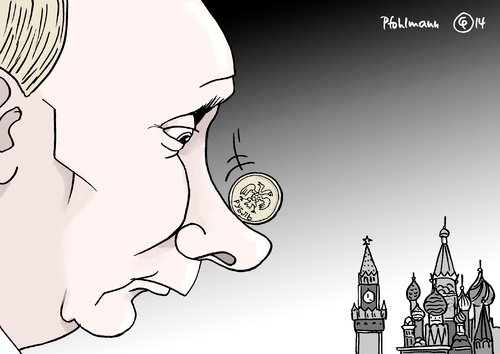
Everything is a ruble. The USA included the “Moscow Stock Exchange”, the National Clearing Center and the National Settlement Depository on the sanctions list. After falling under the sanctions, since 13 June, exchange trading of the dollar and the euro in Russia has been suspended. The Russian ruble ceased to be a freely convertible currency. Also, the US Treasury stated that it is ready to introduce any sanctions against foreign banks for transactions with Russian financial organizations, including Sberbank and VTB.
In practice, this means that the ruble will now cost less than the paper it is made of. In the absence of stock market quotations, the ruble exchange rate will be set by voluntary decisions of the Central Bank of Russia. As a result, the ruble became “wooden” again, the Russian economy will be suffocated due to the lack of currency, international calculations will be significantly complicated, and the Russian military will not be able to easily benefit from the profits from the sale of energy sources. Artificially setting the exchange rate of the ruble can lead to galloping inflation. The dollar and euro exchange rates on the black market will differ significantly from the officially established one. Therefore, citizens faced with the risk of sudden impoverishment will rush to buy gold, precious metals and foreign currency, and sweep any valuable goods from store shelves. As of the morning of 13 June, some exchangers have already set a rate of 200 rubles for one dollar. The authoritarian regime will use administrative and punitive methods to try to extinguish the currency panic and maintain the stability of the “wooden” ruble.
Now the only conditionally objective measure of the value of the Russian ruble will be the quotation of the ruble-yuan pair. This means, in fact, Russia’s complete dependence on China.
Serious problems await owners of currency savings in banks and companies engaged in export-import operations. The history of stock trading in Russia has stopped. The country’s stock market becomes completely internal. Subsidiaries of foreign banks, such as Raiffeisen, will be forced to cease their activities in Russia.
The level of the first shock wave, which the Russian authorities are trying to extinguish with soothing statements and forceful pressure, is evidenced by Dmitry Medvedev’s comment: “The USA and its shitty allies have declared us a war without rules.” Therefore, in the heat of dull, powerless malice, Medvedev suggests “every day to try to inflict maximum damage on those countries that imposed sanctions against Russia. Harm in everything that can be harmed. Shame on their economies, their institutions, their leaders. To the detriment of the well-being of their citizens.” Moreover, Medvedev’s words should be of interest to the International Criminal Court in The Hague, because he calls “to help the disorganization of municipal authorities due to the explosion of crime in big cities.” “Arrangement of social explosions”, a harsh information war: “We must throw the most sinister night terrors into their information sphere… Let’s turn their lives into a completely insane nightmare in which they will not be able to distinguish wild fiction from the realities of the day”… in general, one of the leaders of Russia publicly announced the real strategy of Russia’s war against the West and the shock in which the government found itself after the ruble lost its status as a freely convertible currency.
Russia is moving towards complete dependence on China. Now the financial indicators of China and the exchange rate of the yuan are becoming the main triggers for the Russian economy, i.e. in fact, it is about the loss of financial sovereignty.
In parallel with this, new sanctions were introduced in the field of IT. Since 12 September, Russia has been prohibited from exporting, selling or supplying from the US, as well as through third countries services in the field of IT consulting and design, IT support and cloud sectors for software to any person in Russia. Sanctions will weaken the industrial capabilities of enterprises and software for managing production, resources, planning, and design. Attempts to circumvent sanctions through shadow parallel imports will be strictly stopped.
The third painful step is to allocate 50 billion dollars to Ukraine at the upcoming G7 summit by the end of this year at the expense of profits from frozen Russian assets.
Now world leaders are discussing the idea of setting a limit on the selling price of Russian oil at $20.
All these steps together are the most painful economic blow to Russia since its war of aggression in Ukraine. The Russian economy, deprived of investment and technology, is sliding into a terrible crisis, the final of which is technological backwardness and complete dependence on China. Russian citizens should remember the experience of the end of the USSR, queues, shortages, galloping inflation and an economy that can only produce plywood tanks and zinc coffins…







