

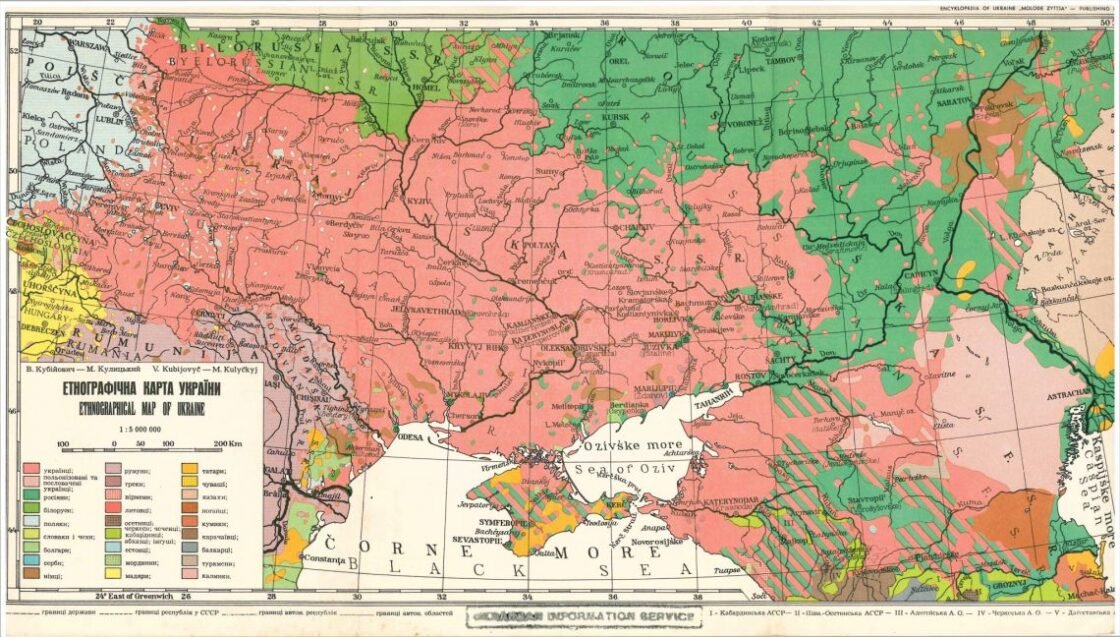
On January 22, on the Day of the National Assembly, the President of Ukraine signed the decree “On the territories of the Russian Federation historically inhabited by Ukrainians”, which, in particular, provides for the adoption of an action plan to preserve the national identity of Ukrainians in the Russian Federation, including in the lands historically inhabited by them (in the Kuban, Starodubshchyna, Northern and Eastern Slobozhanshchyna within the boundaries of modern Krasnodar Territory, Belgorod, Bryansk, Voronezh, Kursk, Rostov Oblasts of the Russian Federation); study of facts and testimonies about crimes committed against Ukrainians who live (lived) in the territories of Russia, historically inhabited by ethnic Ukrainians, about the policy of forced Russification, political repressions and deportations of Ukrainians; development of interaction between Ukrainians and nations enslaved by Russia.
Despite the squealing of the Russian imperialists, this decree is a typical policy of a nation-state, the implementation of constitutional principles, in particular Article 12 of the Constitution of Ukraine, which states that Ukraine is obliged to take care of the national and cultural needs and rights of Ukrainians abroad.
This is especially important under conditions of war when the aggressor country set as its goal the complete destruction of Ukrainian identity and pursued a purposeful policy of denationalization of Ukrainians in Russia and the aggressive use of the Russian minority in Ukraine (mostly descendants of colonizers purposefully brought to Ukraine) and the fact of forcible linguistic Russification of those nations occupied by Russia – under the ideological construct of the so-called “Russian peace”.
Therefore, for decades, Russia has been building its agency of influence in post-Soviet countries, under the facade of the so-called “Rossotrudnichestva”, (Russian labour) organizations of “soplymenniks” (tribesmen), the Russian Orthodox Church in Ukraine, which was called the UOC MP for cover. After all, it was these structures that became the formal pretext for Russian aggression in Crimea and Donbas in 2014.
Ukraine finally responded asymmetrically according to the ideological construction of the justification of the imperialist aggressive policy of the Rashists, Russian imperialism, and “Russian peace”.
The decree on the territories of the Russian Federation historically populated by Ukrainians reminds us that the Kuban, Starodubshchyna, northern and eastern Slobozhanshchyna within the modern territories of the Krasnodar Territory, Belgorod, Bryansk, Voronezh, Kursk, Rostov Oblasts of the Russian Federation are Ukrainian ethnic lands where Ukrainians have always lived. Precisely in the 1920s, Russian imperialism in the then form of Soviet Russia and the Soviet Union took these lands and joined them to the composition of the then RSFSR – the modern Russian Federation.
V. Kubiyovych – M. Kulytskyi: Ethnographic map of Ukraine (1949)
The Ukrainian state, which arose as a result of the collapse of the Soviet Union within the borders defined by the occupying government of the USSR, was deprived of the territories where Ukrainians lived from time immemorial (it was not Ukrainians who moved somewhere, but the state borders were moved by political decisions of the imperial centre without taking into account the opinion of the residents).
The Presidential decree creates legal opportunities to protect Ukrainians from systematic persecution and ethnocide on their own autochthonous lands.
This decree should also finally remove the delusion from the eyes of European countries and Western civilization, and debunk the myths of Russian imperialist propaganda that current Russia is the so-called “Russian historical lands”. On the contrary, a significant part of Ukrainian territories since the time of the Ukrainian State at the beginning of the 20th century has been illegally annexed by Russia.
Therefore, the legitimacy of Ukrainian military operations, including the use of Western weapons, in these territories takes on a completely different colour.
Although the Decree does not raise the issue of Ukrainian ethnic enclaves on the territory of Russia (Malynovy Klin (Kuban), Gray Klin (part of Omsk, Novosibirsk Oblasts and Altai) and Green Klin (Zakitayshchyna, Ukrainian Amur Region), it is obvious that the fate of Ukrainians, who for centuries compactly lived in these territories, is important from the perspective of further disintegration of the empire. In particular, the Ukrainians of the Green Wedge still maintain a significant influence on the life of the region and have historical traditions of contact with Japan.
The genocidal nature of Russia’s war of aggression against Ukraine must finally receive a proper response to the defiant denationalization and ethnic persecution of Ukrainians in Russia.
Even long before the official start of the war, Russia systematically carried out brutal pressure on Ukrainians on its territory.
According to the results of the last Soviet census in 1989, after centuries of a total Russification policy, 4.4 million Ukrainians in the Russian Federation were not afraid to indicate their nationality.
Each subsequent census witnessed the strange disappearance of more than a million Ukrainians.
The 2002 census already recorded 2,942,961 Ukrainians. In 2010, there were already 1.9 million Ukrainians – (1,927,988). And after ten years (the last Russian census of 2021) – less than a million – 884,007.
Yes, without war or epidemics, the number of Ukrainians on the territory of the Russian Federation decreased by almost 4 million!
This is the result of a purposeful genocidal policy, which, unfortunately, continues even today.
Any religious identification of Ukrainians on the territory of the Russian Federation through the formation of dioceses of Ukrainian churches is prohibited. Hundreds of public organizations, associations and unions created by Ukrainians in Russia after the collapse of the USSR in all regions were crushed and closed by the decisions of judges and law enforcement agencies.
Back in 2010, the Supreme Court of the Russian Federation liquidated one of the largest associations of Ukrainians in Russia – the Federal National and Cultural Autonomy “Ukrainians of Russia”.
On May 18, 2012, the Supreme Court of the Russian Federation satisfied the lawsuit of the Ministry of Justice and liquidated the all-Russian public organization “Union of Ukrainians of Russia”.
Ukrainians are deprived of the right to communicate in their native language, to satisfy their cultural needs.
On October 25, 2015, the Library of Ukrainian Literature in Moscow was searched and “nationalist literature” was allegedly found.
On June 5, 2017, the Municipal Court of Moscow sentenced the director of the library Natalia Sharina to 4 years of conditional imprisonment. Less than a year later, the library was closed completely.
In July 2019, the General Prosecutor’s Office of the Russian Federation recognized the World Congress of Ukrainians as an undesirable organization in Russia.
On August 28, 2020, the Omsk Court liquidated the regional public organization “Siberian Centre of Ukrainian Culture ‘Siriy Klin’ “.
In July 2021, the autonomous non-profit organization “Far Eastern Ukrainian Spiritual Cultural and Educational Centre “Prosvita” was liquidated by a court decision in the Primorsky Krai.
Russia was preparing for war in advance, practising a brutal policy towards Ukrainians on its territory. At the same time, it unhinderedly carried out subversive activities through its centres on the territory of Ukraine. Therefore, with the beginning of open Russian aggression, any measures to end the war of aggression in Russia were impossible and prohibited.
Now, we hope, there will be no individual aggression. As well as unfounded claims of Russia regarding any special status on Ukrainian territories.
It is also important to restore the identity of Ukrainians on the territory of nations enslaved by Russia, who were artificially assimilated to the so-called “Russian majority”. During the collapse of Russia, Ukrainians should support the struggle for independence of those people on whose territory they live. They should also know that the Ukrainian State will protect a Ukrainian in any corner of the earth, no matter where he/she lives, especially on territories that were illegally taken, or in places where they have resided since ancient times.
Yuriy Syrotyuk






