

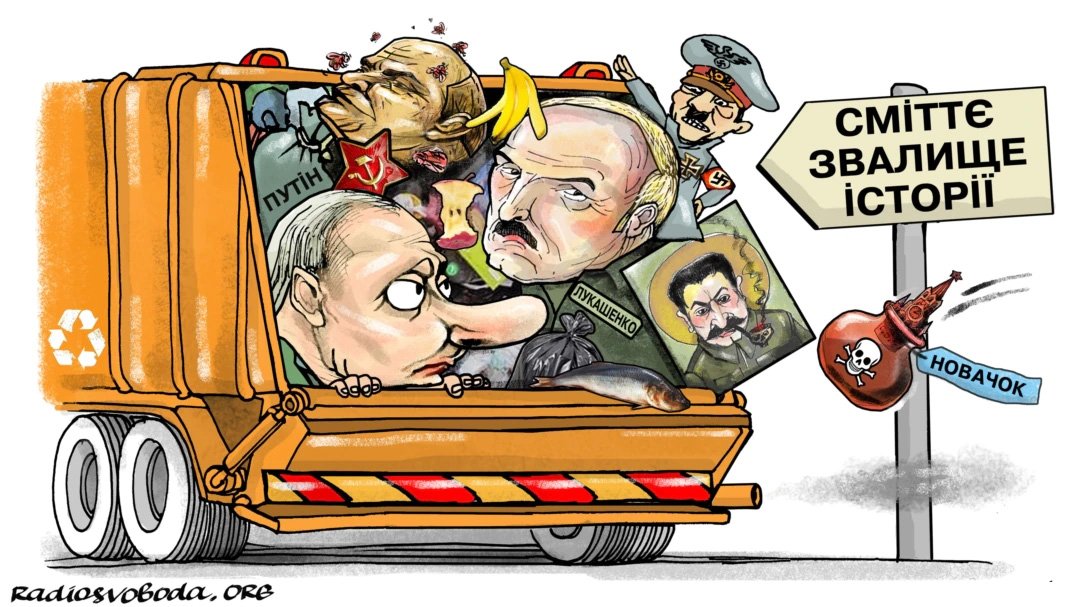
Putin’s pseudo-election with a gigantic turnout and a “record result” may actually turn out to be a pyrrhic victory for the aging dictator.
The socialist competition for a larger turnout and result, which was supposed to demonstrate total support for Putin’s aggressive policy and once again smear Russian society with a circular guarantee, turned into a farce. What are the numbers from the Chechen Republic, for example, worth, where Putin’s collaborator Kadyrov drew a turnout of more than 97% and 99% in support of Putin? Such figures, especially in regions that are traditionally rebellious, in which significant protest actions were held recently, such as Bashkortostan, the Republic of Sakha-Yakutia, Ingushetia, and Dagestan, are a painted Potemkin illusion of graveyard stability.
Although Putin has demonstrated to the world and to Russians that he has a firm grip on the levers of power and is “stronger than ever,” this stability and strength are illusory.
Surprisingly, the result of almost 88% support does not strengthen but undermines the legitimacy of the dictator both from outside and inside the country.
Even before that, Western countries considered the elections in Russia partly illegitimate. This cascade of multiplied illegitimacy undermined the legitimacy of the Russian government in the eyes of the international community. Elections in the occupied territories, which are a gross violation of international law, received the appropriate reaction from Western democracies. Therefore, the Duma received partial illegitimacy after the elections in the occupied Crimea in 2016 and in 2021, when residents of the occupied territories of Donetsk and Luhansk regions with Russian passports were forced to vote.
In 2014, the legitimacy of another chamber of the bicameral Russian parliament, the Federation Council, was undermined. Then, in April 2014, a so-called senator from Crimea appeared in the Federation Council. In December 2022, similar fake senators appeared in the Federation Council from the occupied territories of Donetsk and Luhansk regions. And from September 2023 – from the occupied parts of Zaporizhzhia and Kherson regions.
Therefore, the corrosion of illegitimacy undermined Russian parliamentiarism.
The so-called general vote for amending the Constitution of the Russian Federation, which took place on 1 July 1, 2020, and opened the way for Putin to eternal rule by nullifying the previous presidential terms, was held without proper control and with massive violations and was not recognized by several countries and organizations due to the vote for temporarily occupied territories of Ukraine: in particular, the EU, USA, Britain, Poland, Georgia, Turkey and Ukraine.
The questionably legitimate Russian Federation Council, at its meeting on December 7, 2023, set the date of the presidential elections in Russia on 17 March 2024.
Now, after the elections on 17 March, given their completely undemocratic nature and another violation of international law due to the so-called voting in the occupied territories, the absolute lack of competitiveness in the electoral process and any international objective control of the election results, the legitimacy of the presidential branch has been undermined. Although the dictatorial regimes of the allies on the axis of evil from North Korea and Iran, followed by a number of Asian and African countries, have already greeted the Russian dictator, this is a recognition of his rule based on the principle of force, not right.
Some European countries have declared that they will not be able to call Putin the president and will never recognize the legitimacy of elections in the occupied territories.
Although so far the countries of the Western world have not dealt with Putin as they did with Lukashenko in 2020, when the latter was not recognized as the legitimate president of the country, the West perceives Putin as the de facto head of Russia, whose legal legitimacy is deeply questionable.
The legitimacy in Russia is seen as the one who has the power. Therefore, in the eyes of the international community, the legitimacy of the Russian Volunteer Corps, the Siberian Battalion, or the Ingushetia Independence Committee is the same and depends solely on the force factor and territorial control.
The right to armed struggle against the regime also receives international legitimacy. Having deprived the opposition of the right to peaceful protest, Putin leaves no options.
The external inviolability of Russian borders is subject to serious corrosion. The Russian border with Ukraine lost its legal significance. It is where the troops are, and its outcome, according to the aging dictator himself, will be established by force of fact. It is not a fact, that it is, as the Kremlin dwarf himself would like. After all, in the eyes of the world community (regardless of Putin’s supporters or opponents), the status of the Tyotkin People’s Republic and Kursk Oblast depends not on the constitutional system but on the military factor.
Inside the country, Putin’s electoral re-election becomes a temptation for a new distribution of power. Putin hints that he is ready to replace or seriously supplant the team of old gerontocrat friends with young thugs from the so-called SVO. This does not add stability to the system.
Russian society, which is still under the hangover of militarism, cannot understand why the war came to their land, and the daily shortage of necessary goods and inflation is already a traditional picture. How come, Russia, which started the war with a missile monopoly and dominance in the Black Sea, cannot now protect its territory from the invasion of drones, and the Black Sea fleet is driven into a dead end and is a convenient training ground and target in the game “sea battle”, which Ukraine without a fleet will win with such ease.
Putin has done himself a disservice because the Russian elite believes that it has given him everything to resolve issues.
Taking up arms by the Russian opposition is an example of the opposition and national liberation movements of people enslaved by Russia. The creation of detachments based on the territorial and ethnic principle is a double-edged sword.
Financial and economic resources are mercilessly thrown into the war, and as a result, the citizens’ standard of living will fall.
At the cost of huge losses, Putin tried to paint a rainbow picture of the front-line “victories”. There are no more resources to close all the holes. Putin in a macho image is trying to raise the degree of confrontation, but increasingly looks like a weak leader. One miss will be enough for the jackals to pounce on the body of the aged dictator.
So, Putin’s election ploy legitimately made the power in Russia weaker. They don’t like the weak in Russia. And in China too…







