

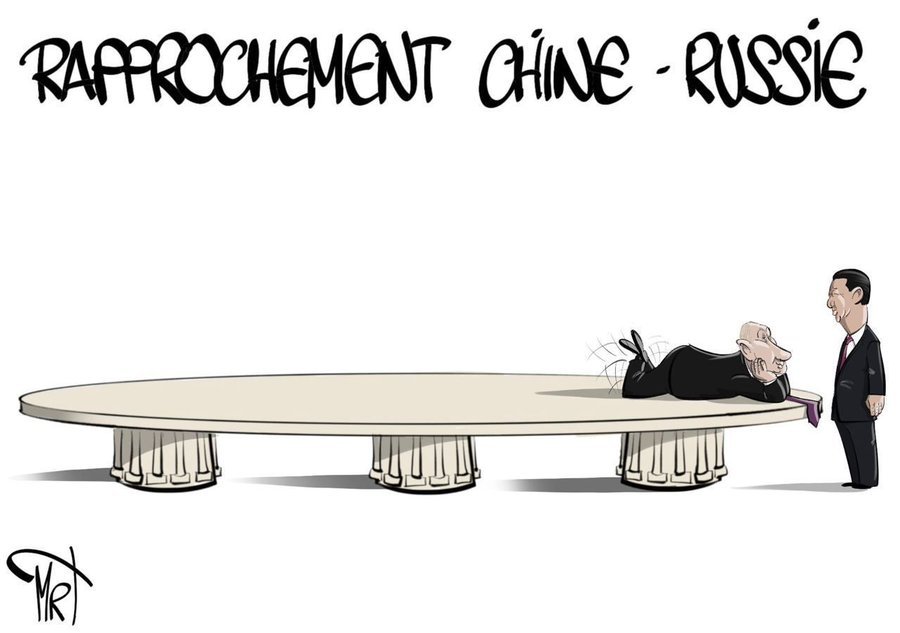
He to whom the yasak is paid, holds the power. Since the accession of Muscovy as a colony to the Mongol Empire, Moscow paid “yasak” – a tax in kind – to the imperial centre. After she intercepted the struggle for collecting Mongolian heritage, Yasak began to be taken to Moscow. The direction, in which the tax in kind is taken, marks the real centre of power.
On 16-17 May, during his first official visit after another inauguration, Putin will take a yasak to Beijing.
For the first time in the history of his presidential terms of office, Putin begins his journey with a trip to China, and not to Europe, as he has done twice, or to the post-Soviet countries, which he considered the zone of his exclusive geopolitical interests.
Putin’s visit to China is not just a symmetrical gesture in response to last year’s similar visit by the leader of Greater China Xi Jinping after his re-election to Moscow. This symbolizes the strategic dependence that Moscow has fallen into before China.
Putin’s obsession with the war against Ukraine, readiness to wage this war to the end, regardless of the losses and reputational consequences, and the full mobilization of the economy for the needs of the war, pushed Russia not just to an Asian turn, but to fall into critical dependence on China.
Therefore, the 42nd meeting of the leaders of Russia and China will testify and consolidate the inequality in the relations between the two countries and their leaders. Although Putin and Xi Jinping constantly exchange compliments towards each other, such as the address “dear friend”, Putin’s efforts to build a strategic partnership with China in a geopolitical confrontation with the West, to present himself as an equal ally and a rallying point of the global South, which can undermine American dominance, the partnership lost its equal character, and became in the literal sense, excessively “expensive”.
Planning to unleash a full-scale invasion of Ukraine and assessing the possible risks of an escalation of confrontation with the West, Putin tried to win the support of the Celestial Empire or at least secure the rear. Twenty days before the start of aggression in Ukraine in early February 2022, Putin visited Xi. This visit resulted in the declaration of cooperation “without borders”. Putin promised the Chinese leader a “quick walk”.
Since then, Russia has been bogged down in the war in Ukraine for more than two years, has fallen under Western sanctions, lost traditional sales markets and currency inflows, and has been cut off from investment flows and access to Western technologies.
During all this time, China reliably covered Russia, becoming its main financial and economic base. Thanks to China, Russia’s economy did not collapse, and what’s more, in the conditions of severe Western sanctions, the Russian economy is growing, China has become the main market for the sale of oil and gas raw materials and the receipt of protected foreign exchange earnings, and most importantly, a substitute for Western goods and technologies subject to sanctions. China helped shape the supply channels for the sanctioned goods, creating long logistics chains in which China was almost never the first buyer of the sanctioned goods and the direct transmitter to Russia. China provided Russia with the necessary production capacity for military production (machines, electronic boards, and certain types of raw materials). Without a doubt, he approved the formation of the axis of evil Russia-Iran-North Korea and the direct supply of military equipment and ammunition for the war by the latter.
Obviously, without the consent of China, neither Iran nor North Korea, which have been under sanctions for a long time and are critically dependent on trade with China, could not have discussed such a massive and demonstrative supply of weapons and ammunition. China sells Russia the necessary cargo equipment and “civilian drones” and components for them on an industrial scale, which allowed the latter to establish parity in the use of short-range kamikaze drones and civilian drones for dropping ammunition on the battlefield and begin to build an advantage.
China became the economic backbone of Russia, becoming a key market for its raw materials, primarily oil and gas, and most importantly, the main source of the most necessary imports, allowing Russian companies to attract capital and in every way weaken Western sanctions.
Despite active Western criticism of such a policy and repeated visits by Western diplomats to Beijing in 2023, Xi Jinping continued to call close cooperation with Moscow his “strategic choice.”
It was China that helped Russia de-dollarize its financial system. This is what allowed Russia to withstand the first shock from the sanctions and quickly transfer the finance system from dependence on the dollar and euro to dependence on the yuan. By the end of 2023, the yuan accounted for more than a third of settlements, compared with almost zero until February 2022. The volume of deposits in yuan has already exceeded the volume of dollar deposits and is the equivalent of 68.7 billion dollars. The volume of loans in yuan increased four times. Disconnected from the SWIFT international settlement system, Russia uses the Chinese cross-border payment system CIPS, which includes about 30 Russian banks for operations and clearing. In 2022, daily payments in this system increased by 50%, and in 2023 by at least a quarter. Other countries, such as Bangladesh, used the same system for settlements with Russia.
Although China rejects any Western demands to stop helping Russia and says it does not violate international sanctions, at the same time, considering such statements as attempts at intimidation and interference, the imposition of secondary sanctions and the threat of a trade war with the West make China more cautious in building relations with Russia. Before Putin’s visit to Beijing, Xi Jinping toured Europe, gauging how acute Europe’s reaction is and whether it threatens a trade war with the EU’s key trading partner.
The threat of the introduction of secondary sanctions has already led to the fact that systemic Chinese banks avoid relations with Russia, financial transactions are delayed, and the opening of correspondent accounts becomes more difficult.
This has already led to Chinese exports to Russia falling by 15.7% in March and 13.5% in April, compared to the same period in 2023. Chinese banks began to refuse to accept payments for goods transported by rail from Primorye. Systemic Chinese banks refuse to accept payments even for goods not similar to those subject to sanctions. For example, the Bank of China recently refused to receive payment for a batch of plastic household goods only because the route indicated transportation through Zabaikalsk to the Moscow region.
In general, Putin will report on his plans for the end of the war and try to fix a system of economic relations that is slowing down. Putin is interested in creating reliable, uninterrupted supply and financing chains and repairing a system that has begun to fail. Redistributing gas supplies from the Yamal field to China remains an unsolved problem for the Kremlin. The “Power of Siberia-2” project, which will allow reorientation of the field that worked toward Europe and double the Russian share in the Chinese gas market, remains a project for which China is in no hurry to allocate funds.
Russia, which has put its economy on a military track and staked “everything” on the outcome of the war with Ukraine, needs the intensification of relations, growth and uninterrupted supply of the necessary technologies and products.
China, which is used to acting with a view to long-term strategies and which is unlikely to be ready to join the war directly on the side of Russia, is faced with a dilemma: to lose the largest trading partners of the USA and the EU, with which trade turnover is four times greater than that of Russia, and to maximally militarize Russia, with which despite the strategic alliance, there are many problem areas, or even further, in declaring friendship and cooperation, and helping Russia as carefully as possible, continue to digest it in parts, maintaining fragile relations with Western trading partners, until China achieves technological independence and acquires an equal volume and quality of alternative markets.
Supporting a starving, war-crazed, no-nonsense “strategic ally” who constantly brandishes a nuclear cudgel may ultimately lead to the cultivation of a formidable strategic rival in the future. In its history, China already had a long relationship with Russian imperialism, which led to the loss of millions of square kilometres of territory. Today, despite the strategic alliance, China competes with Russia for influence in Central Asia and feels Russia’s cowboy style in Africa, which has long been the object of close attention and trust for China. China is suffering from chaos in its trading markets and threats to the stability of its banking system and economy.
Therefore, it is unlikely that Putin will get what he wants as a result of this visit, and most importantly – in the necessary quantities and in a timely manner. Just as it is unlikely that Xi will publicly criticize his vassal. Although both allies at this stage share some of the strategic vectors, the method of achieving the goals and the pace of implementation of the assigned tasks do not critically coincide. Putin needs immediate help, Xi needs help so that the “ally” does not fall off the Chinese hook and the roof of the ally is not blown off by military imperial ambitions. A Russian rabbit is already in the stomach of a boa constrictor, Si thinks, so there is no need to rush.
Chinese aid may be humiliating at the moment, but if it allows Russia to win the war, Russia will reach a new strategic level and the service provided will no longer be considered a service, and the war machine can be shifted to a new theatre of war without regard to the cries of the allies.
Against this background, the exchange of views between “strategic allies without borders” will take place. However, in this case, Putin needs everything immediately, and Xi is ready to wait on the shore until the corpse of the enemy floats by. Therefore, this time Putin is going in the image of a humiliating beggar with a huge yasak and a weak hope of getting what he needs.
Symptomatically, before the visit, Putin dismissed the Tuvanian Shoigu from the position of Minister of Defence (China considers Tyva its lost territory) and appointed Bilousov, a Chinaphile and supporter of the state economy. However, this is unlikely to help, China already openly calls some of the Russian territories by their Chinese toponyms in its official documents…







