

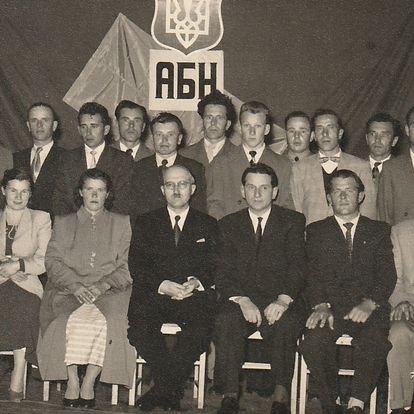
Australia is located at the crossroads of the Asia-Pacific region and is of great strategic importance for countering the Russian imperial forces and their allies in the spread of informational aggression and influence.
After World War II, many Ukrainians who were activists of various organizations, primarily the OUN, moved here from Europe. The first Ukrainian community in South Australia was founded in May 1949. Over the next few years, communities sprung up in other states.
The first Association of Ukrainians in Australia was formed on 10 June 1950, at the first all-Australian Congress of Ukrainians.
At the fourth congress in 1953, the Union of Ukrainian Organizations of Australia (SUAO) was created, and since then, coordinated the activities of communities and other Ukrainian organizations, representing Australian Ukrainians in their communication with representatives of the Ukrainian diaspora in different countries of the world.
It is clear that in the course of these organizations’ activities for many years, certain archives have been postponed, which in our digital age have yet to be collected and organized to put them online on the website of the Archive of the OUN, and in a broader sense, to create an accessible automated database for users. And to save these documents physically, systematize and describe them because time erases not only people…
Researchers are particularly interested in the documents of the ABN, because the ABN, restored last year, as the Anti-Imperial Block of Nations, continues the work of its predecessors, aimed at the collapse of the Russian “prison of the nations”.
Archival documents related to the activities of ABN in Australia and New Zealand were discovered in its archive by Yaroslav Duma, a prominent figure in the Ukrainian community.
These are six issues of the Information Leaflet, which covered the trial of Bohdan Stashynskyi, the KGB agent who killed OUN leader Stepan Bandera in 1959. In addition to them, is the Communiqué of “Ukrainian Correspondence” on the same topic and the verdict of the court in Karlsruhe (the city where the trial took place).
Attention is also drawn to the news about the visit to Tokyo of the Chairman of the Central Committee of the Anti-Bolshevik Bloc of Nations Yaroslav Stetsko at the invitation of the former Prime Minister of Japan Nobosuke Kishi on 6 October 1962.
A telegram from Japan reports: “The conference of the Anti-Communist League of Asian Nations in Tokyo unanimously adopted the ABN resolution on the division of the Russian Empire into national independent democratic states of all subjugated nations (…) The resolution was introduced by a Turkish delegate, supported by Pakistani, Chinese, Japanese, and Malayan delegates.” The message states that the position of the NTS (Russian People’s Labour Union) has undergone a complete fiasco*.
Another document covers a wider range of activities. This is a detailed report of the ABN in Australia and New Zealand for the period from 4 August 1956 to 31 December 1960, compiled by the Office of the Ukrainian Delegation of the ABN in Melbourne. The focus is on financial matters (they take up 2/3 of the report), how important it is to maintain the ABN mission in Formosa (now Taiwan), and the creation of the Anti-Bolshevik Front in the Far East.
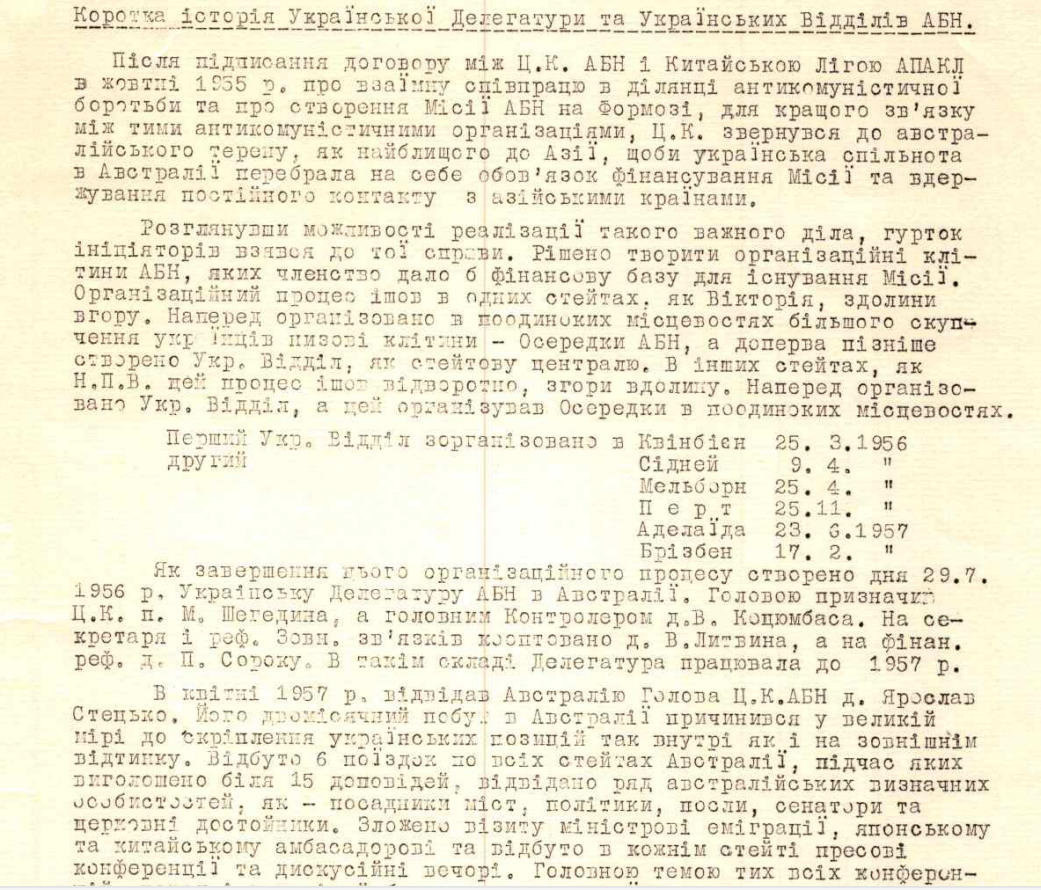
A very interesting place in the report is occupied by the information of the secretary and person responsible for external relations under the title “Brief History of the Ukrainian Delegation and Ukrainian Departments of the ABN” and “External Activities”. The latter, in particular, is about the tireless activities of local ABN centres during the XVI Olympics in Melbourne in 1956 (the year 1958 is erroneously indicated in the document), about contacts with sports delegations from various countries, statements, conferences and the distribution of campaign materials. The report also reports on the participation of the ABN delegation in the 4th Conference of the Anti-Communist League of Asian Peoples (APACL), which took place in April 1958 in Bangkok, as well as other events.
Mr. Yaroslav Duma kindly provided copies of these and other archival material at the disposal of the OUN Archive and the ABN-correspondence editorial office. The documents themselves will soon be systematized and displayed online.
I hope this find will start the process of systematically identifying the documents of the Ukrainian Liberation Movement and the liberation movements of other nations on the territory of Australia.
________________________________
*Subsequently, the NTS, known for its pro-imperial position, left the world anti-communist organizations.
Архів ОУН





