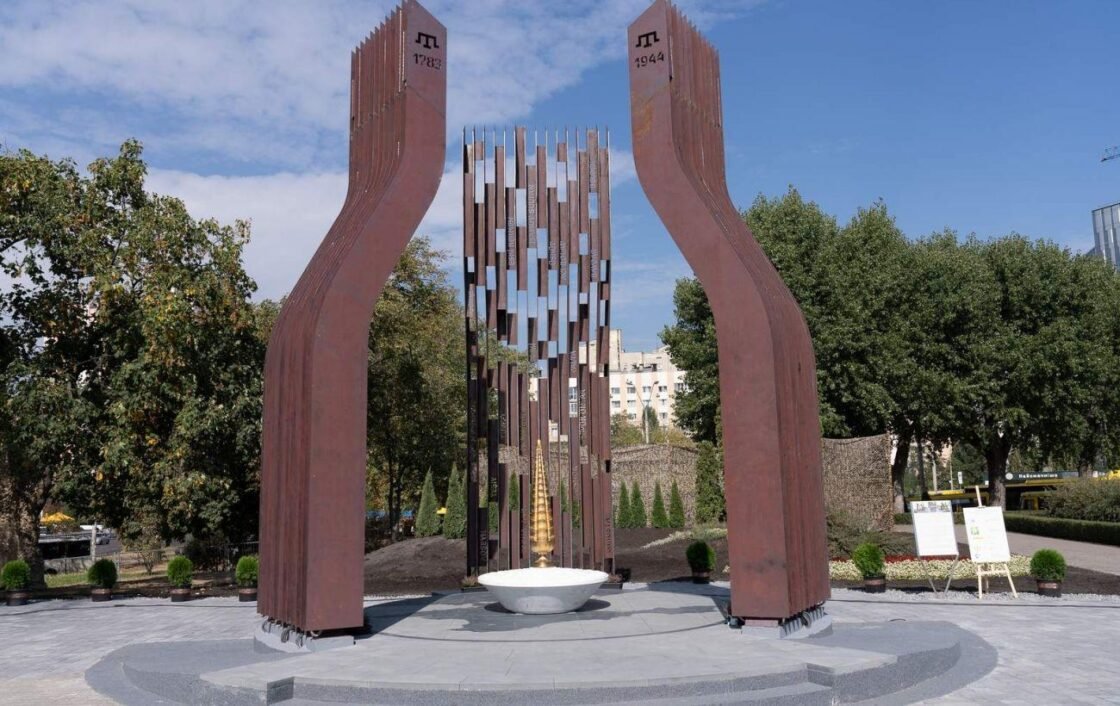
Exactly 80 years ago, at dawn on February 23, 1944, the occupying Soviet regime began a barbaric operation to deport the Chechen and Ingush people.
As part of the Sochevytsia operation, Chechen and Ingush villages were blocked by the occupying forces. Men were invited to village gatherings, during which they were detained by units of the NKVD. People who were suddenly evicted from their homes were loaded onto trucks and taken to railway stations, where they were transferred to freight cars and sent to Kazakhstan and the republics of Central Asia. For the operation, more than six thousand trucks, more than 200 railway echelons with wagons, and more than 130 thousand NKVD soldiers and officers dressed in military uniforms were used. The hot battles of the Second World War were still going on, but for Stalin, the massacre of the unruly people of the Caucasus was more important. The sudden deportation was covered by heavy snowfall, which made it difficult to move people, especially in mountainous areas. The Soviet authorities made a decision: those who cannot be taken out by February 27 will be destroyed. All those unable to move were subject to execution. The symbol of satanic cruelty became the village of Haibach, where more than 700 people were driven into a barn and burned alive.
Before the deportation, the occupiers publicly raped women and girls.
A large part of those who survived died in inhumane conditions during the deportation due to epidemics, cold and hunger.
In less than a week, on February 29, 1944, the People’s Commissar of Internal Affairs Beria reported to Stalin about the successful completion of the deportation of more than 400,000 people.
The Chechen-Ingush Autonomous Republic was liquidated, and its territory was divided between Georgia, North Ossetia, Dagestan, and the Stavropol Territory. On the territory of the former republic, which became the Grozny region of Russia, a huge occupation contingent of the NKVD, numbering about one hundred thousand occupiers, was left.
This testified to how powerful the resistance against the occupation authorities was. Those who managed to avoid deportation joined the rebel units that resisted the occupiers. Only in 1953 did the authorities announce that “the Chechen-Ingush banditry was over.” Although separate cells of resistance persisted and continued the struggle until the beginning of the 70s of the XX century.
Only in 1957, monks and Ingush were allowed to return to the Motherland. However, they were not welcome there. During the deportation, Moscow deliberately populated the vacated lands and homes with displaced persons in order to lay a slow-acting mine – international conflicts in the future.
The official reason for the harsh deportation was the accusation of collaborationism and aiding and abetting fascism. A familiar cliché that the Russian Empire has been using for more than a hundred years against all disobedient individuals.
But the real reason was the inability to overcome resistance and defeat the unruly mountaineers, even through brutal Stalinist repressions.
Suppressing another wave of the struggle of the people of the North Caucasus against the Russian occupiers at the time of the collapse of the Russian Tsarist Empire and the establishment of a new form of colonialism of the Soviet occupation, after the formation of the Chechen-Ingush Autonomous Republic as part of Soviet Russia in 1936, Stalin increased the repressive pressure in this region.
In response, long before the beginning of the Second World War, in the autumn of 1937, an uprising began in Chechnya, which lasted until February 1939. The insurgents convened a people’s armed congress and proclaimed the “Provisional People’s Revolutionary Government of Chechen-Ingushetia”, which was headed by Hasan Israilov. For over a year and a half, the rebels waged a fierce struggle against the occupiers. Rebel cells died down and flared up, but the struggle did not stop. This struggle intensified in 1942-1943 when a full-scale partisan war broke out against the occupiers and collaborators in power.
This – the impossibility of destroying the resistance of the free-loving people of the Caucasus, and not the invented stories about collaborationism and aiding fascism – was the main reason for the brutal deportation, the ultimate goal of which was the final solution of the Caucasian question. The basis for the accusation was the fictional story of the time “about the crucified boy” – a gift from the mountaineers of a “white horse with a golden saddle” to Adolf Hitler. And although historical confirmation of such a gift was never found, and most Chechens and Ingush were forced into the occupying Stalinist army, brutal deportation was carried out.
Moreover, historical facts show that as early as December 1943, having failed to overcome the resistance of the insurgents, the NKVD employees used the plan of deportation, starting to form appropriate operational groups.
On January 9, 1944, Beria approved the “Instructions for the procedure of evicting Chechens and Ingush people.” Troops for the Chekist-military operation began to be concentrated a month before the crime.
As a result of the deportation, hundreds of thousands of Chechens and Ingush died according to approximate data.
The mass deportation of Chechens and Ingush was not Russia’s first crime against the autochthons of the North Caucasus. Tsarist Russia also used tactics of mass retaliation for resistance, evicting and carrying out genocide of entire nations, as happened with the Circassians and Chechens.
Putin’s Russia in the 20th century repeated the crimes of its predecessors, brutally spilling Ichkeria with blood after it declared independence, applying the same principles of collective responsibility and mass executions.
There are still no objective statistics on crime results. As well as the appropriate world response to this crime, and although the European Parliament recognized the deportation as an act of genocide in 2004, no legal action was taken.
That is why we are still watching the Russian occupiers show off that they are resorting to deportation measures against the disobedient “with a bottle of water”, expelling peaceful people from their homes.
But the Caucasus was and remains a powder keg for Russia. Its freedom-loving people remember their history and wrongdoings well. Ukraine should become the match that will bring the gunpowder to action…