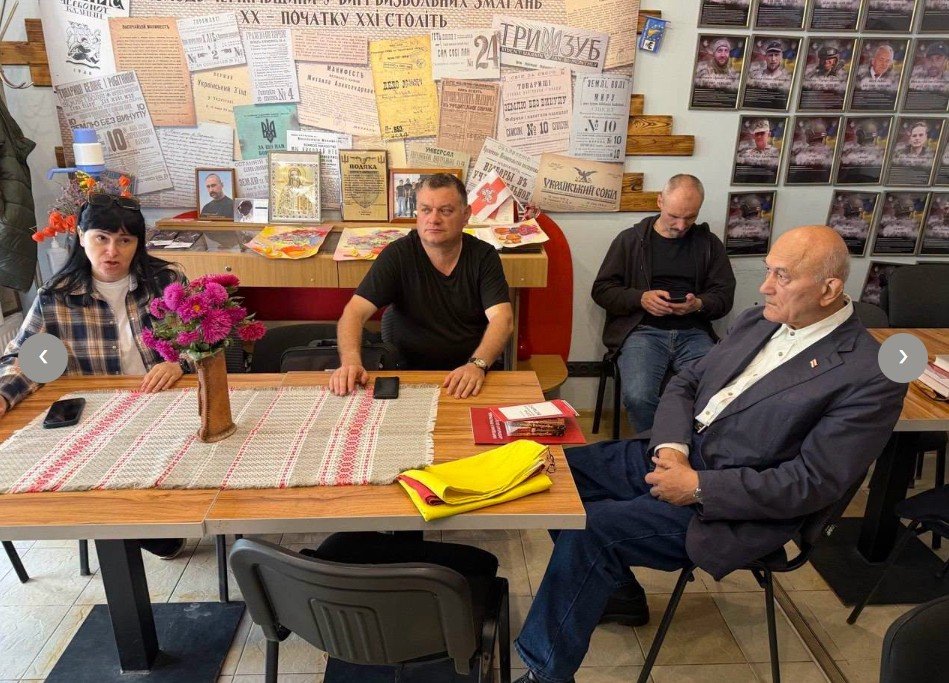

The presentation of the book “An Outline of the History of the Anti-Bolshevik Bloc of Nations” took place in the Ukrainian Crisis Media Center. Its author is a historian, teacher, and researcher of the modern history of Ukraine and the Cold War, Doctor of Philosophy Hryhoriy Riy, who at one time took up this work due to the fact that few people in Ukraine were familiar with this organization, which united representatives of enslaved nations during the Cold War.
“The initiative for its creation came from the Organization of Ukrainian Nationalists (Banderites). This November marks the 80th anniversary of the first conference of enslaved nations. In the decisions of that conference, it was said that there was a need to create such an organization that would unite enslaved nations to fight for independence. So that they become promoters of national revolutions and destroy the communist empire from within,” Hryhoriy Riy said.
At that time, in the conditions of the Second World War, it was not possible to implement such a structural union. After the end of the war, in Munich in 1946, Ukrainians, Belarusians, Chechens, Tatars, and Don Cossacks created the Anti-Bolshevik Bloc of Nations. Later, Hungarians, Slovaks, and Croats joined them.
“The history of ABN should be considered in the context of the history of the Cold War,” advises the author. Even the messages used were the same, and the first of them related to anti-communism. It became a unifying idea for Western democracies. This was very noticeable in the first post-war elections in Italy, where the United States and the CIA had to be seriously involved so that the Communist Party did not win.”
The period of the block’s greatest activity falls in the period before the Korean War. Since 1949, when the two Germanys were formed and the events on the Korean Peninsula began to develop, the world had come to the brink of global confrontation. The Soviet Union, on the one hand, and the United States, on the other, were involved in a proxy war, and this made it possible to form hopes in the ABN environment that the Third World War might begin.
“Ukrainians had contact with the underground inside the country, and this was a strong argument for conducting a dialogue with Western intelligence. Later, when relations between the USSR and the USA warmed up, ABN criticized such a policy of Western democracies,” the historian admitted.
The book is based on archival documents that were not previously known. In 2017, Hryhoriy Riy received a grant for a trip to London from the Shevchenko Scientific Society in the USA, visited the OUN archive and published a book thanks to the financial assistance of the League of Ukrainians of Canada. As it turned out, there is no end to the history of the Anti-Bolshevik Bloc of Nations. True, the organization will now fight not against the Bolsheviks, but against the empire.
“At the beginning of the nineties, the civilized world decided that the threat from the North was eliminated forever, and it played a bad joke with Ukraine,” said the executive director of the Anti-Imperial Block of Nations Oleh Vitvitskyi. Today we are talking about a much broader context of the anti-imperial struggle. At the time, in the early nineties, the ABN cause was not actually completed. With that in mind, we’re rethinking how to continue this fight.” According to him, in the environment of the organized nationalist movement, the idea of restoring the ABN as an anti-imperial block of nations has already existed since the 2000s. There were many decisions and discussions, but there was a lack of a serious irritant. Such a stimulus was the events of February 24, 2022.
“At the big meeting of the Organization of Ukrainian Nationalists (Banderites), a decision was made to resume the activities of the Ukrainian Nationalist Party. But we are not looking at the formalized structure, but at the work and its directions,” Oleh Vitvitsky emphasized.
UKMC press centre