

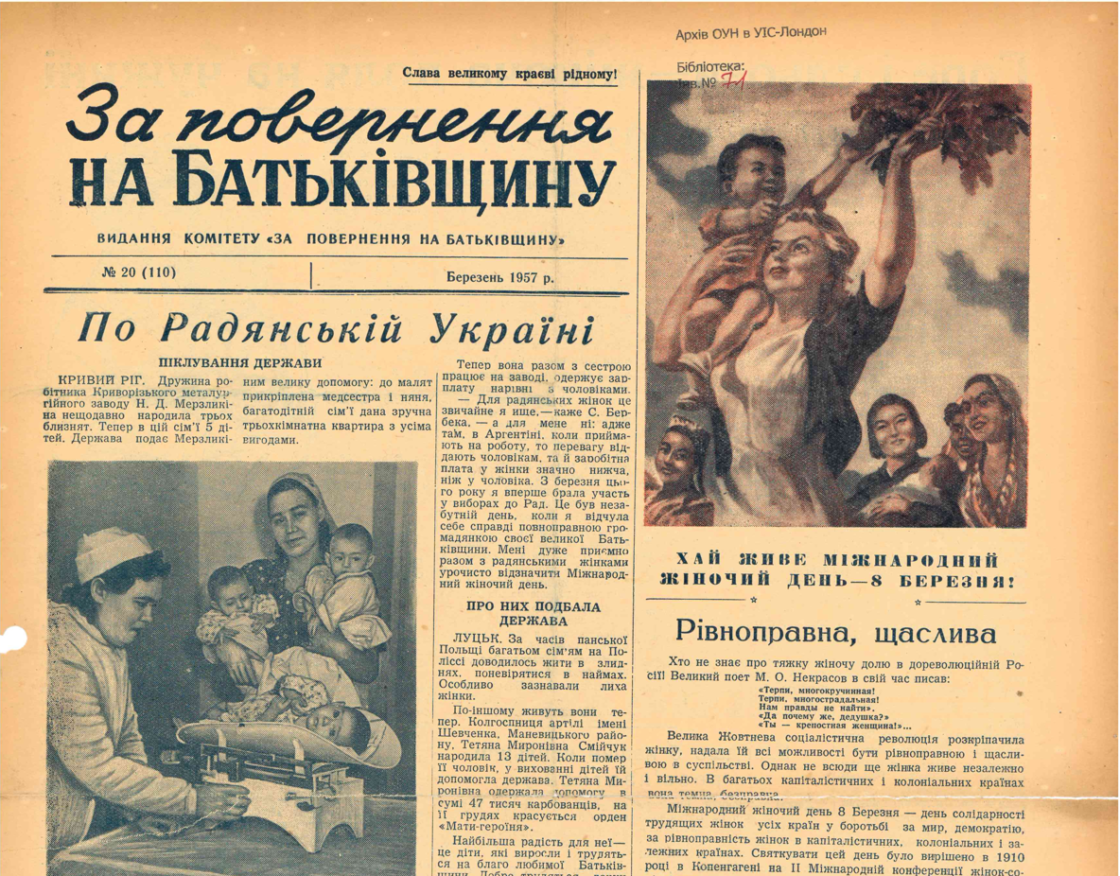
After the end of World War II, hundreds of thousands of Ukrainians, Belarusians, and representatives of other nations enslaved by Moscow ended up in emigration or in the status of “displaced persons” (DP) in Western Europe. For the Stalinist and later Khrushchev regimes, this active, anti-communist mass of people posed a serious threat. Unable to physically get them behind the “Iron Curtain,” the Kremlin launched a large-scale information and psychological operation, the centre of which was Berlin.
“Illusion Factory” on Schadowstraße
The key instrument of this campaign was the “Committee for Return to the Homeland”, established in 1955. Despite its formal “public” status, the organisation was headed by KGB general Nikolai Mikhailov. The editorial office of the committee’s main mouthpiece, the newspaper “For Return to the Homeland” (and its national versions, in particular the Belarusian “For Return to the Homeland” ), was located in the Soviet sector of occupation of Berlin at the address: Berlin NW 7, Schadowstraße 1b.

Archival copies of these publications from 1956–1957, which are kept in our collections and are currently being organised, demonstrate sophisticated methods of manipulation. The main narratives were:
The myth of the “great amnesty”: the belief of emigrants that “the Soviet authorities forgave” them for collaborating with the nationalist underground or staying in the West.
Visual idyll: the use of staged photographs of happy repatriates, successful female workers, and wealthy collective farmers.
Speculation on nostalgia: emphasis on the “native land”, the “parental home”, and broken family ties.
Resistance Strategy: An Antidote to the OUN
The Ukrainian political emigration, in particular the Organisation of Ukrainian Nationalists (OUN), immediately identified the threat. The opposition to the Berlin Committee was systemic and included several levels:
De-anonymising the enemy: The magazines “Shlyakh Peremohy” and “Vizvolny Shlyakh” regularly published incriminating materials about the real leaders of the committee, proving their connection with the special services.
Information hygiene: Explanatory work was carried out in DP camps and diaspora centres. The OUN warned: any correspondence with the Berlin editorial office automatically makes a person an object of KGB development.
Counter-propaganda: Special columns were created where each thesis of a Soviet newspaper was broken down by facts about the real state of affairs in the USSR — famine, shortages, and repression.
Radio broadcasting: Active support for Radio “Liberation” (later – Radio “Freedom”) allowed the battle for minds to be transferred to the airwaves, neutralising the influence of the Berlin “voices”.
The Price of Mistake: The Tragedy of the “Returnees”
The reality for those who nevertheless succumbed to the appeals of the newspaper “For Return to the Homeland” turned out to be opposed to the promises. After crossing the border, most repatriates passed through harsh filtration camps.
Instead of the promised apartments and positions, many were faced with interrogations, the status of a “Western intelligence agent,” and exile. Even those who were allowed to settle in the Ukrainian SSR were under lifelong surveillance by the “authorities,” and were limited in choosing a place of work and education for their children. Former participants in the liberation struggle were often used for public “penitential” speeches, after which they disappeared without a trace in the Gulag camps.
Conclusions for the present
An analysis of the activities of the Berlin Committee and its publications proves that the methods of Russian propaganda have undergone only technological changes over the past seventy years. The essence remains unchanged: the use of democratic freedoms in the West to spread disinformation and destroy the unity of the Ukrainian community.
The documents stored in the OUN Archive are not just testimonies of the past, but an important lesson in informational resilience. The memory of the tragic fates of the “returnees” of the 1950s warns us against believing in the “peaceful” gestures of the aggressor, who always hides barbed wire behind a glossy cover.
By the way, in Mariupol, currently occupied by the Russians, a YouTube channel has been created, where they tell “fascinating stories” about the reconstruction of the city and “wonderful living conditions.” Nothing is new under the sun…
Documents from the OUN Archive at the University of London.
Архів ОУН






