The history of Kuban Ukrainians and the presence of Ukrainians in the region spans many centuries.
Above all, the history of Kuban is a vivid example of the historical dominance of one culture that ultimately perishes in the absence of a clear strategy for the development of the Ukrainian nation and without informational support from its alma mater. This example is profoundly tragic and, unfortunately, typical for Ukrainian communities living on ethnically Ukrainian territories that found themselves outside the borders of the Ukrainian state after the collapse of the USSR—such as the Rostov region, Slobozhanshchyna, the Bryansk region, Zeleny, Seryi, Zhovty, and the already mentioned Malynovyi Klyn.
Practice shows that a vacuum is created when Ukrainian culture, language, customs, and mentality do not receive sufficient support from the local Ukrainian population in their struggle for survival, and if external influences are absent or insufficient. This vacuum is almost immediately filled by Moscow’s culture, narratives, language, and so on.
Approximately one hundred years ago, over 50 percent of the population in Kuban identified as Ukrainian—and that’s only those who officially declared themselves as such. The actual Ukrainian presence was likely even greater.
Secondly—and this is the main point, anticipated ahead of the article’s conclusion—no matter how deep and pervasive the process of Russification has been, practice shows that Ukrainian identity can be revived under favourable conditions, at least by the second generation. Thanks to persistent and methodical work in this direction, Ukrainian identity is being reborn. Such is the example of Eastern Great Ukraine, which has also undergone significant Russification but is now returning en masse to its native culture.
How did the history of Kuban Ukrainians unfold?
How did it come to pass that a nation which once comprised more than half of the region’s population—and was on the verge of forming its own state—has now been reduced to a pitiful state of being a “khokhol,” a lapdog of the Moscow regime?
How is it that Ukrainians of the region, whose grandparents spoke the Ukrainian language, now identify themselves as “Russians”?
Finally, why is the revival of Kuban Ukrainian identity not only possible but a crucial element of a successful strategy on the part of Greater Ukraine, and inseparably linked to Ukraine’s future as a sovereign state from the standpoint of strategic thinking?
These are the questions we will seek to answer in this article.
When did the Ukrainian presence in the Kuban begin? The origins of Kuban Ukrainian identity
The year 1794 is most often cited as the beginning of Ukrainian settlement in the Kuban. However, this view is not entirely accurate.
To begin with, in classical antiquity, the Kuban region was inhabited by the Meotes, Alans, and Sarmatians—tribal groups that are also part of the ancestral roots of Ukrainians in Greater Ukraine. This already establishes historical parallels between the Kuban and Greater Ukraine. And while such a proposition might seem bold, it is, at the very least, a legitimate version with the right to exist.
The second phase of Ukrainian presence in the Kuban dates back to the era of the Tmutorokan Principality, during which Western Kuban was, in fact, part of Kyivan Rus. This historical fact suggests that the Cossacks led by Anton Holovaty, who arrived in the Kuban in 1792, did not settle an empty land, but rather restored Ukrainian presence in the region after several generations.
This argument directly undermines the Russian narrative, which claims historical “primacy” of the Russian state in the Kuban. It also challenges the more radical claims made by some Circassian voices, who allege an “aggressive expansion” of Ukrainians into the Kuban—an idea that does not withstand scrutiny, especially given that Circassians were also part of the Tmutorokan Principality, and no records exist indicating their discontent with the rule of Tmutorokan Rus.
After the Tmutorokan Principality vanished from history, Ukrainian presence in the Kuban entered a period of dormancy until the 17th century. This does not mean Ukrainians had ceased to reach the Kuban altogether— during the gradual expansion of Cossacks into the Wild Steppe, some began to settle lands inhabited by the Nogais and reached the Kuban. However, it was in the 17th century that the first documented Ukrainian settlements appeared in what is now Krasnodar Krai.
Interactions with the Circassians at this time were peaceful, as documented by Dmytro Bilyi, a Ukrainian historian of Kuban origin.
Later conflict between Cossacks and Circassians was a direct result of Moscow’s (and later St. Petersburg’s) predatory policy of “divide and conquer.”
In modern academic discourse, the emergence of Kuban Ukrainian identity is commonly dated to 1792.
These are well-known and celebrated events that have been extensively documented, so we will only touch on the most general points here.
- 1792 – The beginning of the resettlement of Zaporozhian Cossacks to the Kuban after the destruction of the Zaporizhzhian Sich. Around 14,500 people were relocated, and 40 stanitsas (military settlements) were founded. The city of Yekaterinodar (modern-day Krasnodar) was established, originally named Nova Sich (New Sich).
- 1792–1795 – The boundaries with neighbouring provinces and the Don Cossack Host were defined.
- 1797 – Events that can be regarded as the first act of genocide against Kuban Ukrainians: following a rebellion sparked by Cossack dissatisfaction over the lack of compensation after the failed Persian Campaign, the Cossacks suffered brutal repressions by the Russian authorities. It’s worth noting that one of the Cossack leaders, Anton Holovaty, died during that same campaign. While the official version claims he died of illness, it is possible he was poisoned, as he posed a potential threat to Moscow as a likely leader of resistance.
After the so-called “Persian Revolt,” 222 people were prosecuted; 157 Cossacks were sentenced to hanging; 55 others died during the investigation, most likely due to torture. Several others were sentenced to be flogged with 1,000 strokes (later “reduced” to whipping and branding), and dozens more died as a result. The remaining prisoners were exiled to Siberia for life. - 1801 – The Ukrainian population of the Kuban reaches 32,000.
- 1808 – Resettlement of Cossacks from Turkey, where they had fled after the destruction of the Zaporizhzhian Sich.
- 1809–1811 – Around 23,000 more settlers arrive.
- 1821–1825 – An additional 20,000 people are resettled.
- 1845–1859 – This period is regarded as the “last wave of migration” from Ukraine to the Kuban.
And that’s it. Both Russian (unsurprisingly) and Ukrainian studies tend to stop at this point when researching the Kuban. For example, even the well-known Kuban autonomist Volodymyr Miroshnychenko notes that this was the moment when the Kuban nation was fully formed.
But this raises important questions:
How is it possible that a population that barely reached 100,000 by the late 1860s had grown to the point where about 1.5 million people in the Kuban still identified as Ukrainians in the 1926 census?
And how is it possible that someone who received a Ukrainian upbringing in childhood—despite receiving a Russian education—could independently learn the basics of the Ukrainian language thanks to their family, and, having been born in Sochi in 1981 with no direct connection to the Cossack waves of migration, still identify as Ukrainian?
This means only one thing — the problem of Kuban Ukrainianness is much broader than the framework outlined by the official version of the appearance of Ukrainians in Kuban. It requires a completely different approach, one that goes beyond the established academic paradigm. In short, something is wrong with the official version — something important has been omitted. And it is clear what exactly.
The point is that official historiography considers only the “official” waves of Ukrainian migration to Kuban, clearly distinguishing the migrations related to the Cossack estate, while persistently ignoring — and not even documenting — those waves of resettlement that are not recorded in official Russian sources. This applies not only to the 18th-19th centuries, but perhaps even more to the 20th century, when Ukrainian migration to Kuban did not disappear — it simply ceased to be documented.
For the Russian authorities, whose official policy is the denial of the Ukrainian nation’s existence as such, this method of accounting is quite convenient: after all, Ukrainians, in their view, are simply “Russians.” Needless to say, a researcher who relies on conventional official Russian data sees a completely distorted picture of Kuban Ukrainianness from the outset.
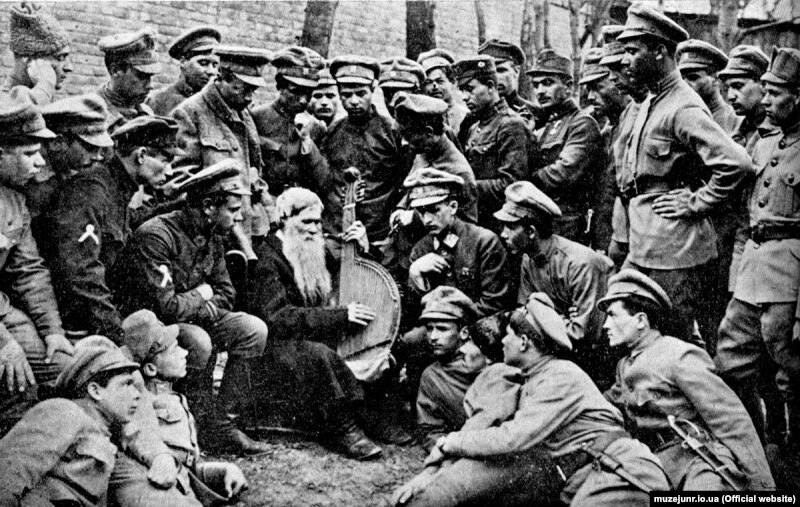
The end of the 19th century is characterized in Kuban as a period of flourishing Ukrainian culture. The work of poets such as Ivan Podushko, Vasyl Mova-Lymansky, and linguists like the world-renowned Fedir Shcherbyna made a significant contribution to the formation and development of Ukrainian cultural identity.
The glorious events of 1918–1920 in Kuban are well known, and when we speak of this era, we refer to the brightest period in Kuban’s history — a moment when, albeit briefly, Kuban became an independent state. The main core of the independence movement, which fought for full separation from Russia, consisted of Ukrainians — Mykola Riabovil, Luka Bych, Vasyl Ivanys, and others.
All speculations about the nature of the statehood established on the territory of what is now Krasnodar and Stavropol Krais are inherently biased — and by default, even without openly pro-Russian intentions, they serve the Russian version of events.
After all, Russians insist that the independent Kuban was a fragile formation — without a government, constitution, or stable institutions of power — an illegal and unviable entity.
But historical facts tell a different story: famine, devastation, and other problems associated with the war — which in Russian historiography is called the “civil war,” though in reality it was a war of liberation by colonies against the metropolis — barely touched Kuban at the time, and came there in full force only after the region was re-occupied by Russia.
“Korenizatsiya” was implemented with one sole purpose — to strip ideological support from the patriots who sought Kuban’s independence. Once that measure was no longer needed, a reactionary phase began. Ukrainian-language schools were banned by law, Ukrainian-language education was eliminated, and during this time, Ukrainians in Kuban started to be officially recorded as “Russians.”
The early 1930s marked the darkest chapter in the history of Ukrainian Kuban — the Holodomor, which, according to the most general estimates, claimed around 700,000 lives. The tragedy of the Kuban stanitsas is well known: the Muscovites encircled them, waiting for part of the population to die from starvation before forcibly deporting the survivors to Siberia and Kazakhstan. The mortality rate during transport reached 80%, which exceeded the death rate even in the trains that carried Nazi prisoners to the Auschwitz-Birkenau concentration camp. The first to perish from the long and gruelling journey were the elderly, children, and women.
There were also acts of resistance by the Cossacks — numerous episodes are recorded in which Cossack families tried to hide in the reed beds and estuaries, but the Chekists soon learned how to track the fugitives down — by the cries of infants…
All these details are vividly documented in the film Kuban Rupture (KUbanskiy Izlom), directed by Andrey I. in the late 2000s.
Important note: The film aired only once on the NTV channel in Kuban and then disappeared. It cannot be found on any online platform, and all attempts to contact the director have failed.
The entire topic of the genocide of Kuban Ukrainians is similarly suppressed. It remains one of the most taboo subjects in the informational space of the Russian Federation. Meanwhile, for several years now, efforts have been made to retrieve the records of the repressed from the archives, but Putin’s system continues to cover up the crimes of its historical predecessors.
Yet the conscious part of Kuban society remembers everything. The Muscovites know perfectly well: the moment the truth about the genocide of Kuban Ukrainians comes to light, it will mark the beginning of the end of Moscow’s occupation of Kuban.
The repressions continued throughout the entire decade of the 1930s.
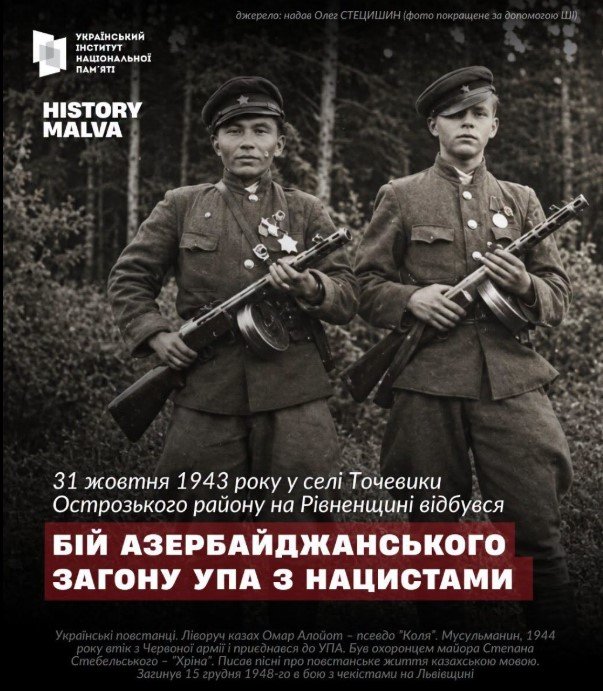
A new wave of resistance to Moscow’s rule arose in the 1940s and early 1950s. It was during World War II that units of the Ukrainian Insurgent Army (UPA) and the Organization of Ukrainian Nationalists (OUN) were active in Kuban. The total number of UPA-OUN fighters in the region reached approximately 300.
The first fighters arrived in Kuban as early as the fall of 1941, and the main part of the detachment appeared in August 1942.
Fascinating facts about the UPA-OUN’s activity in Kuban can be found at the following link.
One of the most prominent acts carried out by Kuban independence fighters was the blowing up of an NKVD train on 9 May 1945, which was transporting political prisoners. As a result of this action, 2,000 political prisoners were freed, more than 200 occupiers were eliminated, and UPA-OUN losses amounted to 20 people.
The resistance to Moscow’s occupation continued until 1952, a duration comparable to the insurgency in Western Ukraine. However, the situation of the Kuban partisans was much more difficult due to geography: unlike the western regions, Kuban had no access to Europe, which meant there was no reliable channel for weapons and critical supplies.
After the Golgotha: Did the Defeat Mean the End for Kuban Ukrainians?
Does the defeat of the liberation forces in Kuban mean that Ukrainian identity in the region ceased to exist? Or that the migration of Ukrainians to Kuban had come to an end?
Not at all.
For instance, my grandfather, Mykola Sedletskyi, was born in the village of Vasylivka (or the Vasylivsky hamlet), located on territory that belonged to Ukraine until 1924. His family were settlers from Halychyna who arrived in Kuban in 1929. He spent his childhood there, graduated from university in Rostov-on-Don, and married there. My mother was born in Almaty, Kazakhstan, where my grandfather’s family was staying with his aunt.
Why the family ended up in Kazakhstan remains unclear to me, but considering that very few Ukrainians went there of their own free will, it’s unlikely they moved there voluntarily.
My mother’s grandfather, Kuzma Zaika, was executed in 1943 for “collaboration with the Nazis.” His so-called “collaboration” consisted only in the fact that, in a corner of the land that had been devastated by both the Soviet and Nazi regimes, he tried — as a local elder — to preserve some semblance of civil administration…
From Almaty, the family eventually moved to Kurin village, and later to Sochi.
This is just one among tens of thousands of stories of how Ukrainians ended up in Kuban.
Even in my own childhood in Sochi — a city that never was the heart of Ukrainian identity in the Krasnodar region — I remember that our family’s close circle of friends included people with surnames like Haidamako, Ivasiuk, Berdychevsky, and others.
Not all of them preserved their Ukrainian identity — the prevailing view in those years was “what difference does it make?” But Ukraine’s recent history has shown: under the right conditions, Ukrainian identity revives in places where it once prevailed.
As for Sochi itself, it’s worth noting that Viacheslav Voronkov, the last Soviet-period mayor of the city, actively invited specialists from mainland Ukraine. For example, the Ivasiuk family — friends of ours — moved to Sochi from Vinnytsia.
Many families from the Rostov region were also brought to Sochi by my grandfather, who was a professor at the Sochi Polytechnic Institute. Among them were the Demyanenko, Kryvopustyva, and other families.
Why Ukrainian Identity Disappeared from Its Own Land
What prevented Ukrainians from preserving their identity in territories where they had always lived?
How did it happen that within just one generation, most Ukrainians in Russia began to identify as Russians, which, in turn, led to the near-complete lack of response from the Ukrainian part of Russian society to Russia’s actions in 2014 and again in 2022?
The truth is that even before state repression, a powerful informal system existed — and still exists — at the everyday level, pushing out anyone who tried to maintain a Ukrainian identity.
In Russian tradition — and I emphasize, this is not only the position of the authorities but a widespread societal sentiment — Ukrainians do not exist.
Just as, after the genocidal 1930s, Ukrainians born in Russia were automatically recorded as Russians, this erasure of identity remains embedded in the consciousness of most Russians to this day.
This applies not only to Kuban, but to all historically Ukrainian-populated regions within the russian federation.
The attitude toward Ukrainians in general has always been distinctly degrading. I remember very clearly how, in Millerovo (Rostov Oblast — part of the Ukrainian People’s Republic until 1924, then the Ukrainian SSR), my third cousin — an ethnic Ukrainian — scolded my cousin for saying something in surzhyk (a Ukrainian-Russian mixed dialect):
“Speaking like a khokhol is improper.”
Just like that — and no close relative would ever say such a thing unless they were pressured by the surrounding society.
Words like that — and the beliefs behind them — don’t appear spontaneously. They’re born under societal pressure, even if people present them as their “own opinion.”
Another moment that stuck with me happened much later in Sochi.
We were chatting with a neighbour who had just returned from a trip to Taganrog — the city Anton Chekhov once called Ukrainian. He said:
“Taganrog is a garbage city. The people are trash. They say hekayut, they say yak instead of kak, and chi instead of ili.”
There was nothing on my face to indicate that half of my family speaks exactly like that. But that’s a vivid example of how Ukrainian identity was gradually pushed out of public life through casual chauvinistic remarks — not from government agents, but from “ordinary people.”
After 1991, when Ukraine regained independence, the situation worsened. There were no efforts to engage with our community, nor any attempts to bring the Ukrainians of Kuban back into the Ukrainian cultural and informational space.
And yes, it’s understandable — Ukraine, unlike Russia, abided by international law and did not try to violate borders.
But the impulse for liberation within Kuban itself was also weak. The isolated attempts in the 1990s to establish local Cossack-led administrations never grew into a strong, unified movement.
That’s the result of two key factors:
- The most passionate and nationally conscious part of the Kuban population had already been destroyed in the early 20th century.
- And throughout the second half of the 20th century, there was constant russification, enforced and encouraged at the everyday level.
Is Ukrainian Identity in Kuban Lost?
No. Regardless of the current state of Ukrainian identity in Kuban, from the perspective of strategic thinking, the issue remains vital.
For Ukraine as a state, if being without Crimea is like a car without headlights, then being without Kuban (whether as part of the Ukrainian state, or as a confederative ally) is like a car without doors.
One cannot ignore Turkey, which continues to balance between two poles while gradually revealing its neo-Ottoman ambitions.
Should any alternative political project be formed on the territory of today’s Krasnodar Krai, other than a Ukrainian one, or one friendly to Ukraine, it risks becoming a new strategic threat, once the current conflict with the russian federation is resolved.
And from any standpoint — including the lens of international conventions — Ukrainians, regardless of their self-perception today, still make up the absolute majority of Kuban’s population.
To restore to these people their native culture, language, worldview, and direction of political development is a strategic imperative for both the self-determined people of Kuban and Ukrainians of Great Ukraine.
It is always the passionate minority, not the majority, that creates new historical precedents.
Since 2014, independent civic movements have been reviving. In 2015, the organization “Free Kuban” was launched by me and Mikhail Kalyamin, an architect from Sochi, who was later tortured to death by Russian authorities using punitive psychiatry in August 2021.
In 2019, this movement transformed into “Malyn”.
In 2022, in Ukraine, we created the “Great Cossack Host”, which includes an armed unit — a Cossack detachment — within the ranks of the Russian Volunteer Corps (RDK).
Inside Kuban itself, many patriots pass vital information, such as the locations of Russian military forces, to Ukraine’s defenders.
The history of Ukrainian Kuban is far from over.
What is needed is consistent and coordinated work, both from activists inside Kuban and from the wider passionate Ukrainian world, to return Kuban to the path of dignity and truth.
One of the clearest examples of this return — if I may speak without false modesty — is myself.
I am someone who, on my mother’s side, comes from both Ukrainian roots and Ukrainian cultural influence. Despite growing up in a fully Russified environment — with Russian language, narratives, and everyday culture — I, like Dmytro Dorovskykh from “Malynovyi Klyn,” managed to understand who we are — and, most importantly, whose side we are on.
So it will be across all of Kuban.
After all, even fully russified Kuban locals still use Ukrainian words in everyday life:
Instead of blackberry, they say “ozhyna,” instead of beet — “buryak,” instead of or — “chi,” and so on.
The renaissance of Ukrainian Kuban is inevitable, so long as we continue making conscious and persistent efforts in that direction.
Glory to Ukraine!
Glory to Independent Kuban!
Glory to the nation — death to the enemies!
Yevhen Bursanidis-Sedletskyi
A Kuban native from the city of Sochi,
of Greek-Cossack-Ukrainian descent,
rock musician, tourism worker, civic activist,
co-founder of the movement for Kuban’s independence.