

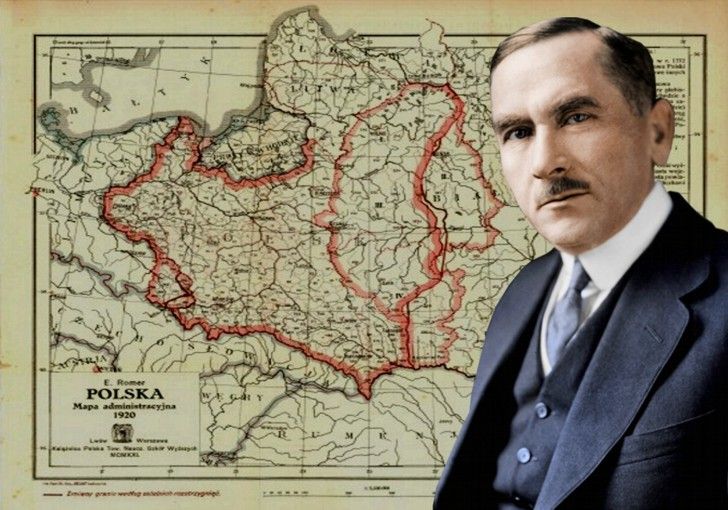
Polish nationalism has two leading ideologues who defined its principles and values. One of them is Józef Piłsudski, the leader of the Polish Socialist Party (PSP), who used methods of expropriation (attacks on mail trains to obtain funds) for revolutionary activities, and the other is Roman Dmowski, who founded and led the national democracy movement (known as “endecia”), which became the dominant force in Polish politics in the late 19th and early 20th centuries.
Roman Dmowski was born on 9 August 1864 in the village of Kamionka near Warsaw, into the family of an impoverished nobleman who worked as a bricklayer. Roman’s father, Valentyn Dmowski, had five children and eventually became wealthy, buying his own house. Roman’s mother, Sofiya (Lenartowska), also belonged to a middle-class noble family.
Roman Dmowski did not study very well in high school, he even stayed for the additional second year several times. But in the senior classes, the situation changed, Roman Dmowski began to study much better, founded the secret organisation “Strażnica” (Strażnica), and personally wrote the organisation’s programme. The organisation was nationalistic and included the study of the Polish language, literature and geography, in order to oppose Russification. Only ethnic Poles were accepted into “Strażnica”, Jews were forbidden to join this organisation.
After graduating from high school in 1886, Roman Dmowski entered the University of Warsaw to study Biology. In his first year at the university, Dmowski headed the secret youth nationalist organisation “Zet” – “Union of Polish Youth”. The “Zet” organisation was created in 1886 by one of the ideologists of Polish nationalism, Zygmunt Balicki. After Dmowski became the head of the organisation, 11 members of “Zet” left the organisation due to Roman Dmowski’s unwillingness to cooperate with socialists and communists. Dmowski did not like the fact that the socialists spoke in Russian and sang Russian songs during revolutionary meetings. During his student years, Roman Dmowski met Jan Popławski, the editor of the newspaper “Holos”, with whom Dmowski later collaborated, sending his articles to Paris under the pseudonym Don Diego Iguenas.
After completing his studies, Dmovsky defended his dissertation, “On the question of the morphology of capillary ciliates”, received the degree of Candidate of Natural Sciences and the right to a scholarship, with the possibility of continuing his studies in Paris. While studying natural sciences, Roman Dmovsky studied foreign languages in parallel. In total, Roman Dmovsky knew nine languages.
Roman Dmovsky went to Paris in the fall of 1891 to continue his studies, which became possible thanks to the fact that Roman Dmovsky’s father sold a plot of land and gave part of the money to his son.
In Paris, Dmowski met Zygmunt Balicki, with whom Dmowski was developing the “Zet” organisation and under his influence, decided to devote himself to the development of Polish nationalist organisations. After returning from Paris, Dmowski was arrested and sent to the Citadel prison in Warsaw, where he spent five months. One of the reasons for his imprisonment was his participation in a rally of Poles on 3 May 1891 in honour of the 100th anniversary of the adoption of the Constitution. This was the first Polish political action after the uprising of 1861-1863.
After being released, Dmowski began to actively reform the Polish League, which was founded in 1886 by Zygmunt Miłkowski in exile. The Polish League set itself the goal of “Unifying national forces, in order to restore the independence of Poland within the borders that existed before the partitions on the principles of federation.”
In April 1893, Roman Dmowski and his associates refused to submit to the previous leadership of the Polish League, and they decided to move the League’s centre from Switzerland to Poland and created a new organisation from the Polish League – the National League. This nationalist organisation included some members of the youth “Z” and representatives of the organisation “Glos”. Roman Dmowski saw the task of the new organisation as opposing the Russian Empire, both passive and active. Roman Dmowski believed that it was not necessary to pay taxes, it was necessary to destroy the material resources of the Government, it was necessary to hold strikes and demonstrations against the Government.
Roman Dmovsky outlined his programme in the illegal book “Our Patriotism.”
In November 1893, Roman Dmowski was sent to Latvia, to the city of Jelgava (Mitava), under police supervision for three years, for organising a rally in Warsaw. In 1895, Roman Dmowski fled from Latvia to Lviv, where, in the summer of 1895, together with Jan Popławski, he began publishing the magazine “Przegląd Vsepolski”. The magazine was published during the years (1895-1905), and it was transported to Warsaw. It was on the pages of this magazine that Roman Dmowski declared himself as a publicist and ideologist of the Polish nationalist movement.
Based on the National League, began the creation of the National Democratic Party (The National Democratic Partisanship). Such party cells began to be established on the territory of the Russian Empire, Austria-Hungary and Prussia. Their goal was to create a Polish state, using means that excluded armed struggle. Polish nationalists considered it necessary to increase the number of Poles in local self-government, the nationalist education of youth, and the protection of the Catholic Church. Thus, the formation of the ideology of Polish nationalism began, which was formed by R. Dmowski, J. Poplaski and Z. Balicki.
In 1903, Roman Dmowski published the work “Thoughts of a Modern Pole”, which finally formulated the ideology of Polish nationalism. Roman Dmowski began to actively travel abroad, visiting France, Brazil and Great Britain. In 1904, Dmowski visited Canada, Japan and the USA.
The trip to Japan was the beginning of the confrontation between R. Dmowski and J. Pilsudski, who represented the Polish Socialist Party (PSP). The politicians met by chance on the street in Tokyo and spent almost a day arguing with each other. Their positions did not coincide, J. Pilsudski tried to enlist the support of Japan, and R. Dmowski was against such an approach. Roman Dmowski was against the uprising of the Poles in the Russian Empire, because after another suppressed uprising, the Poles had exhausted their strength for almost 30 years. Roman Dmowski told Józef Pilsudski that he would hinder his activities, but would not slander Pilsudski in the eyes of the Japanese leadership.
In his works of that time, Roman Dmovsky “A New Period in the History of Russia”, “The Current State of Russia in Historical Perspective”, which he published in “Przegłondie Vsepolski”, as well as in the work “Germany, Russia and the Polish Question”, he explains that the uprising and revolution in Poland are beneficial only to the Germans, and Germany is enemy No. 1 for Poland. “Poland’s attitude towards Germany, wrote R. Dmovsky, lies at the heart of the interest that the Polish question arouses in Europe. The threatening power of Germany in its growth and the south-eastern direction of German expansion have determined the role of Poland as the main obstacle to this victorious movement. This modern role of our people is determined by the fact that the Polish question will be one of the most important European questions in the near future.” The works of the ideologist of Polish nationalism, Roman Dmowski, were translated into English, French, Czech, and Russian, which gave Poland the opportunity, a few years before World War I, to show its position to Europe and convince the British and French of the importance of resolving the Polish question.
Roman Dmowski was categorically against socialist ideas and revolution, believing that these ideas were harmful to the future of Poland. But it should be noted that Karl Marx was a radical supporter of the restoration of the Polish state. Roman Dmowski and his Polish League initiated rallies and demonstrations, opposing the spread of socialist and class ideas among the Poles. Dmowski organised congresses of peasants and clergy, where the idea of the unity of Catholicism and the national interests of the Poles began to take shape.
The authority of Polish nationalists grew, but it led to bloody conflicts and clashes with Polish socialists and communists. Poles killed Poles, and many in Poland did not like this.
In November 1907, Dmowski arrived in St. Petersburg, where he personally met with the Prime Minister of the Russian Empire, S. Witte, and convinced him to grant autonomy to Poland. The leader of the Polish nationalist movement, Roman Dmowski, began to use the democratisation of public life in the dying Russian Empire after the adoption of the Manifesto of 17 October and the elections to the State Duma. The leader of the Polish nationalists did not run for the First Duma, but he became a deputy of the Second and Third Dumas and the head of the Polish Circle faction.
In 1908, Roman Dmowski’s book “Germany, Russia and the Polish Question” was published. In this book, he says that the future Polish state should receive all its ethnographic territories, including those under German control. According to Dmowski, to fight Germany, it is necessary to rely on the Russian Empire and in the coming war, the Poles should support the Russian Empire. It was Roman Dmowski who initiated the loyal attitude of Polish nationalists towards Russia.
In 1912, Roman Dmowski in Warsaw ran for the fourth time for the Russian State Duma, but lost. The ideologist of Polish nationalism believed that he was prevented from becoming a deputy by Jews, due to the anti-Jewish political activities of his political force. In 1914, at the beginning of World War I, Polish society supported the Russian Empire, and this was the result of the ideological influence of Roman Dmowski and the Polish nationalist movement.
The ideologist of Polish nationalism, Roman Dmowski, was negative about the creation of a Ukrainian state and believed that a fully independent Ukraine did not meet the national interests of an independent Poland, due to the fact that the Ukrainian state, if created, would be under the influence of Germany.
After two years of war, realising that the Russian Empire would soon collapse, Roman Dmowski formulated the concept of the creation of a Polish state. Dmowski introduced this programme to the Russian ambassador in Paris, Izvolsky, and some leaders of the Entente. This was the first document from Polish politicians who collaborated with the Entente on the need to create an independent Poland.
The February Revolution of 1917 in the dying Russian Empire increased the appetites of Polish nationalists. Roman Dmowski prepared a programme document for Lord Arthur Balfour and the governments of Western countries, in which he described in detail the claims of the Poles to other peoples, who, in Roman Dmowski’s opinion, should become part of the future independent Poland. This programme document was printed in English in a 500-copy edition. In the East of Poland, Roman Dmowski was going to annex large territories that belonged to Ukrainians and Belarusians. It was about the Minsk, Kaunas, Vilnius, Grodno and Volyn provinces. In the West, Roman Dmowski was going to include almost all of Upper Silesia, the lands of West Prussia, into independent Poland. Roman Dmowski moves to Paris and heads the Polish National Committee, which competes with the Provisional Government, Józef Piłsudski, and the political forces that supported him.
J. Pilsudski sends a delegation to Paris, which negotiates with the National Polish Committee and its leader, R. Dmowski. Polish nationalists agree among themselves, and R. Dmowski’s National Committee recognises the Government in Warsaw. The famous Polish pianist and nationalist Ignacy Jan Paderewski travel to Poland to head the Government. Polish nationalists Roman Dmowski and Ignacy Jan Paderewski become representatives of Poland at the Paris Peace Conference. Thus, a difficult political situation was resolved, because Józef Pilsudski, who concentrated power in Poland, had no ties to the Entente.
The ideas of the Polish nationalist R. Dmowski were realised by the fact that the principle of incorporation of lands inhabited by non-Poles, rather than federations, which the Polish national-imperialists led by J. Pilsudski sought, prevailed. Poland was able to obtain Greater Poland, Eastern Pomerania, and Upper Silesia. A plebiscite had to be held in Mazary, and Gdansk received the status of a free city. The German government, with the support of Lloyd George, the Prime Minister of Great Britain, was able to achieve a plebiscite in Silesia.
In May 1920, R. Dmowski returned to Poland, where he met with the Head of State J. Pilsudski in Warsaw. In 1922, he bought the estate of Chludów near Poznań, where R. Dmowski lived until 1934. In 1923, Roman Dmowski was awarded the title of doctor at the University of Poznań, and in 1927, he was awarded the J. Kasprowych Literary Prize.
In December 1926, Roman Dmowski created his nationalist organisation – the Greater Poland Camp (Obz Wielkiej Polski). It was Roman Dmowski who formulated the ideological concept of a Catholic Pole. The Greater Poland Camp (Obz Wielkiej Polski) was actively developing and had over 200,000 members throughout Poland. In March 1933, the Polish Government, fearing competition, decided to dissolve the Greater Poland Camp (Obz Wielkiej Polski). In the mid-1930s, R. Dmowski’s health deteriorated, and financial problems forced him to sell the Chludów estate near Poznań. After that, R. Dmowski moved to live with his friends, the Nieklewiczs, first in Warsaw, and then to their Drozdów estate, where he died in 1939.
In general, everything that happened to Poland in the first half of the 20th century can be called the consequences of the political activities of two nationalist politicians – Roman Dmowski and Józef Piłsudski.
Oleksiy Usenko, Sumy
LITERATURE
- Dmowski R. The Post-War World and Poland. Warsaw, 1932. P. 272.
- Dmowski R. Germany, Russia and the Polish Question / edited by D. S. Bunevich, G. V. Kholodov. St. Petersburg: Aleteya, 2017. 208 p.
- Davis N. God’s Play: A History of Poland / trans. from English by P. Taraszchuk. Kyiv: Solomiya Pavlychko Publishing House “Fundamentals”, 2008. 1080 p. : ill. Bibliography: p. 1017–1023.
- Pilsudsky Y. My First Battles / translated from Polish by O. Isayuk, A. Honcharuk. Kyiv: Publisher Oleksiy Beshulya, 2021. 448 p. : ill.






