

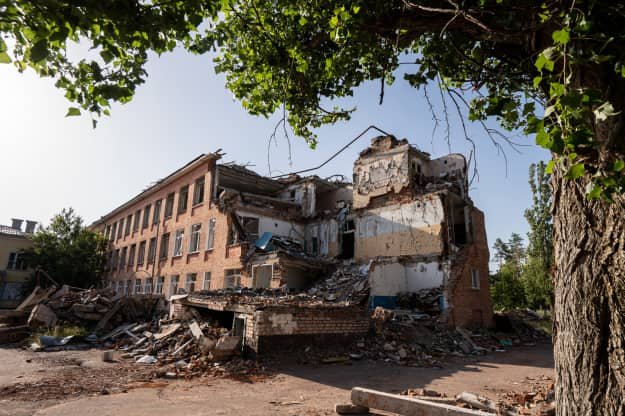
After the start of a full-scale Russian attack on Ukraine in 2022, one of the most common associations that Russians will evoke in Ukrainians and many nations of the world will not be Dostoevsky, ballet or caviar, but rather genocide.
Although Putin’s occupation forces commit many crimes, including military crimes and crime s against humanity, genocidal actions against Ukrainians are increasingly being discussed.
This text will discuss whether it is possible to talk about genocide and how the actions of the Russians differ from the genocides of the past.
In addition, on the basis of a careful analysis of the Convention on the Prevention of the Crime of Genocide and its Punishment, two possible types of genocide are distinguished and it is justified which of them is used by Russia as a tool of imperial assimilation policy.
A little theory: what is genocide and how to prove it?
Genocide is a systemic and organized crime. It cannot be done accidentally or carelessly. Usually, it is more complicated and harder to prove than even war crimes or crimes against humanity. In order for an act to be recognized as genocide in the legal sense, two key conditions must be met:
- it must be proven that the purpose of the criminals is the intention to destroy, in whole or in part, an ethnic, national, racial or religious group as such;
- the perpetrators had to commit one of these actions against the victims – murder, inflicting serious bodily or mental injuries, creating conditions impossible for survival, forcibly transferring children to another group, or taking measures to prevent childbirth.
It is the combination of these two points that constitutes the content of the concept of genocide. If at least one of them is not proven, then it is about some other crime, not genocide.
Despite the fact that the Russians and their army have repeatedly committed the crimes described in the second paragraph, and the entire world has witnessed this, the first component of genocide – namely intent – must be proven in a tribunal or court format.
Until then, we can talk about genocidal acts, about the presence of signs of genocide, but the court must determine it decisively. Courts must be open, public, international, and as transparent and authoritative as possible.
That is why it is now very important to collect evidence, document the appeals of Russian politicians, and actually record the genocidal programme and incitement to it, which are spread by Russian state propaganda. Equally valuable material is the testimony of the Russian military, who talk about the criminal orders of their officers and, in general, about the inhumane atmosphere and setting in the Russian occupation army.
Reference genocide
The Holocaust is considered the first systematically recognized and condemned genocide in history.
It was after the Second World War that the term received international legal status, and the Nazi racial policy, the goal of which was the total extermination of the Jews, was recognized as the greatest crime. Although the author of the term, Rafal Lemkin, had for many years studied crimes in which one group aimed to destroy another (especially those long before the Second World War), but until 1948 none of them were legally so-called.
Unfortunately, even after the whole world found out about and condemned the Holocaust, and international authorities defined genocide as almost the most serious of all possible crimes, the genocide did not stop.
In Africa in 1994 (against the Tutsi in Rwanda), in Europe in 1995 (against the Bosniaks of the former Yugoslavia), then in Asia in 2017 (against the Rohingya in Myanmar), terrible massacres broke out, in which some groups were tried for completely or partially destroying others.
If we speak bluntly and in somewhat generalized terms, then the “standard” genocide is usually the one whose purpose is murder, complete or partial extermination. Not intimidation, assimilation or pacification, but destruction.
Actually, the Holocaust, which served as the final basis for the legal formation of the term genocide, was conceived by the Nazis precisely as “the final solution of the Jewish question.” Namely, the complete physical destruction of all Jews without exception. It is quite legitimate to call such genocide ontological or existential, because it is designed to irreversibly end the existence of a certain group.
However, there is one important detail here – genocide is not always aimed at killing members of another group.
The peculiarity of the Russian genocidal policy
Given that a nation or religion is not something physically visible and immutable, and that, for example, the forcible transfer of children from one group to another is not physical murder, it can be argued that genocide is also the forcible compulsion to renounce oneself, from their identity and community.
For example, if a person was stolen at a young age and given to be raised in another group, he has practically no chance to learn about his origin and affiliation. Likewise, a certain religious or national group is de facto exterminated if its representatives are forced to renounce their faith or national affiliation under the threat of death or torture and are scattered among other groups.
All of the above things have been happening to Ukrainians in the territories temporarily occupied by the Russians since 2014, and especially brutally after the start of the full-scale Russian-Ukrainian war in 2022.
Moscow’s occupying forces and administrations encourage collaboration in every possible way, forcibly issuing Russian passports and demanding public loyalty from the captured local population. This is actively facilitated by Ukrainian political collaborators and Russian agents of influence, who seek to serve themselves in front of the “new homeland” and often demonstrate greater Russianness than the Russians themselves.
In parallel with the fact that renegade Ukrainians loyal to Russia, who are ready to renounce their citizenship, homeland and language, the Russians give them money, government positions and publicly praise them in the propaganda media. Here, as an example, we can name such odious figures as Oleg Tsarev, Kateryna Altabayeva, Serhiy Tsekov, Olga Bas, Natalia Poklonska, Serhiy Aksyonov, Volodymyr Saldo and many others.
The destruction of the Ukrainian group identity takes place on the ideological basis of the Russian ideology about “Russian peace” and the remnants of the Soviet totalitarian dogmas about the “Soviet man” (all that received the official name “racism”).
A clear and unambiguous rejection of the Russian identity and the manifestation of belonging to the Ukrainian nation in almost all cases, for a person in the occupied territories ends with imprisonment, torture and physical destruction. The whole world saw this clearly in Buch, Borodyanka, Izyum, Kherson and many other settlements that were temporarily captured by the Russians and then liberated by the Ukrainian army during 2022-2023. Although similar things have been happening, albeit not so massively, yet constantly since 2014 in Crimea with Ukrainians and Crimean Tatars, but then the international community did not react to it properly.
Such behaviour of the Russians in this war is de facto assimilative genocide – namely, they act not like the Hitlerites, who did not give the Jews or Roma any choice but death, but “more generously”, because Putin offers the Ukrainians a choice: death or joining the Russian group. In this way, they destroy the Ukrainian national group according to all the criteria defined by the Convention on the Prevention and Punishment of the Crime of Genocide, but at the same time, they expand their national group.
Such a strategy is not something new in world history, as it was a common behaviour of empires when the metropolis seized new provinces and demanded obedience and loyalty from them. Modern Russia was never able to build a democracy and returned to its usual imperial form of existence, which is characterized by the violent expansion of territories, the assimilation of conquered peoples, and the brutal destruction of all dissenters who refuse to participate in their imperial project.
To be fair, Russia is not the first empire to use genocidal practices or war crimes as a form of assimilation. The Spanish Empire (the extermination of the nations of Latin America), the British Empire (the extermination of the Boers), the Kaiser’s Germany (the extermination of the Herero and Nama people), the Japanese Empire (mass murders of the Chinese) and many others have sinned against this in previous eras.
But Russia is the first to do this systematically and openly in the 20th and 21st centuries after the world’s adoption of the Genocide Convention. Today, millions of Russians under the leadership of Putin have begun to systematically implement and justify the imperial practices of wars of aggression and assimilative genocide. While the nations of other former empires of the world are trying to explore their past, recognize the crimes of imperialism and atone for the evil done to other nations, Russia seeks to return to the era of empires, colonies, provinces, and dominions. At the same time, using the most used material for building empires – corpses and broken destinies of representatives of non-imperial nations.
So the real touchstone of the degree of humanity and civilization of our era will be how the world will react to the new imperialism and the inherently imperialist practice of Russian assimilative genocide.
Anton Drobovych, head of the Ukrainian Institute of National Remembrance
Note: for a quick information search please subscribe to our Telegram channel “Freedom for Nations!” https://t.me/ABN_Freedom_for_Nations
Also, read the Facebook materials of the ABN page and the group
Our site: https://abn.org.uaen/
Українська правда





