

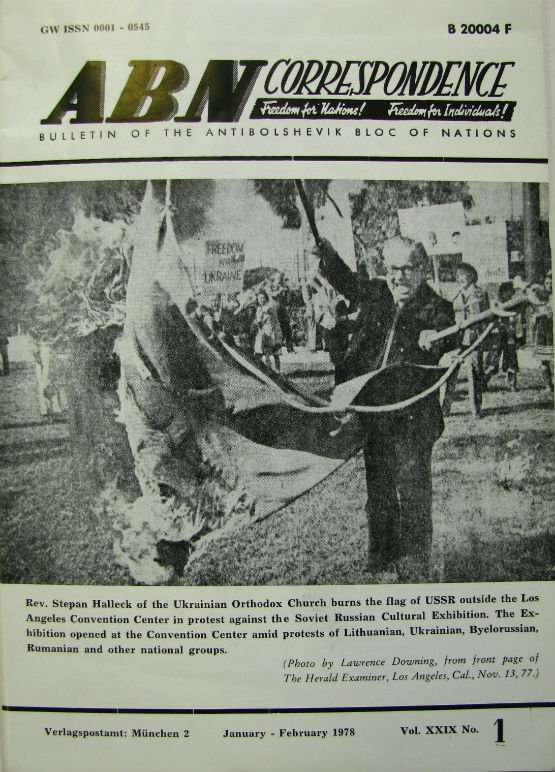
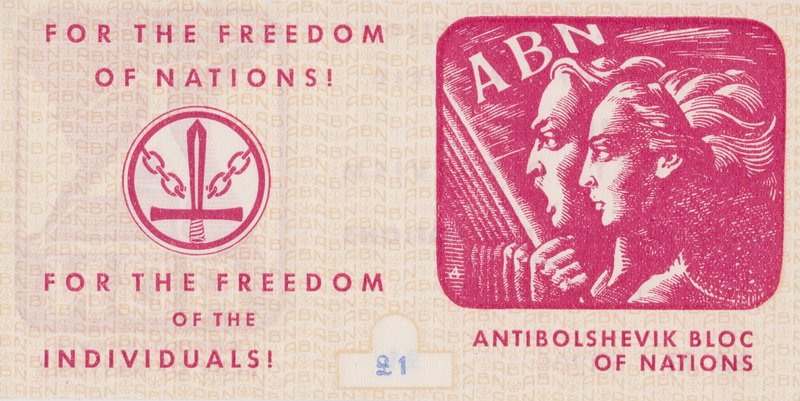
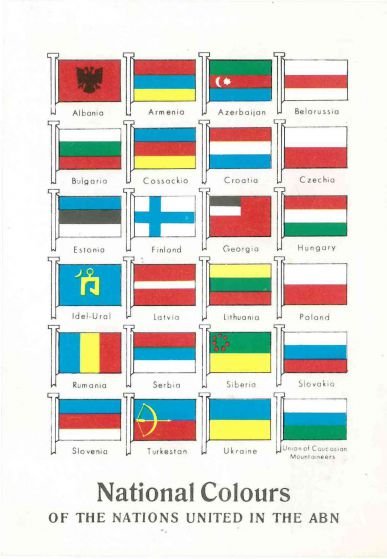
On 16 April 1946, the First Congress of the ABN was convened in one of the districts of post-war Munich, where an Eastern European anti-communist organization was formed, which throughout the subsequent period of the Cold War represented emigration organizations whose homelands were behind the Iron Curtain. “Freedom to nations! Freedom for man!” – the slogan of the ABN, around which 16 national organizations of Eastern Europe and Central Asia united.
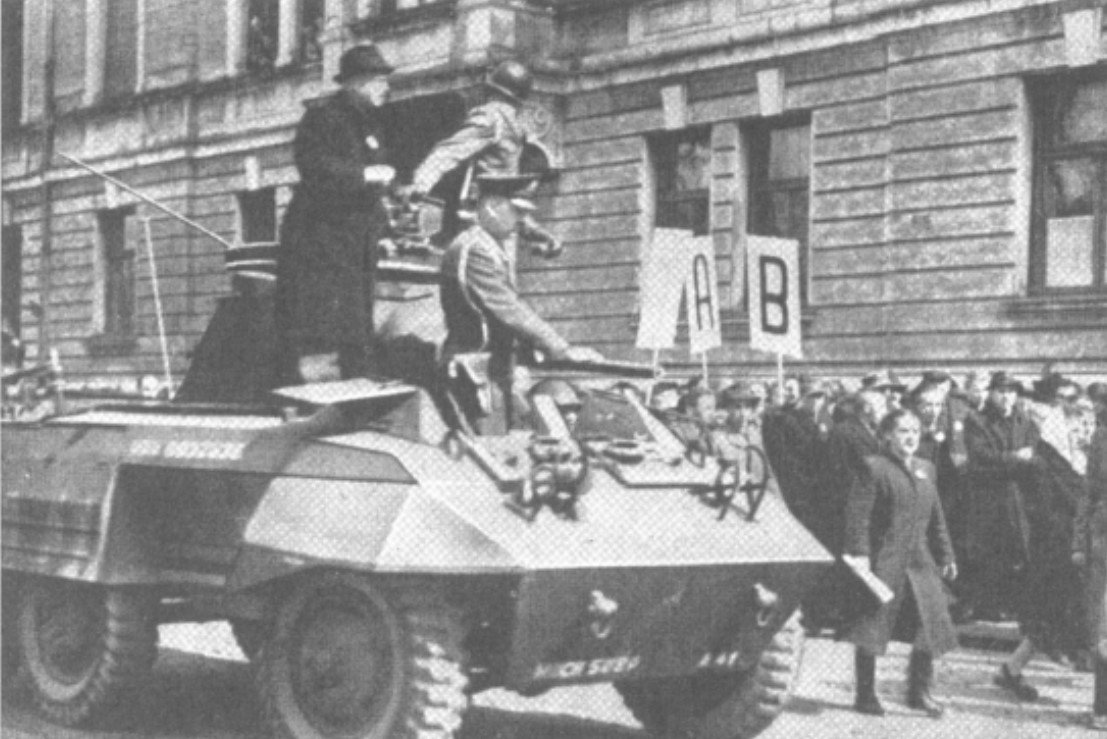
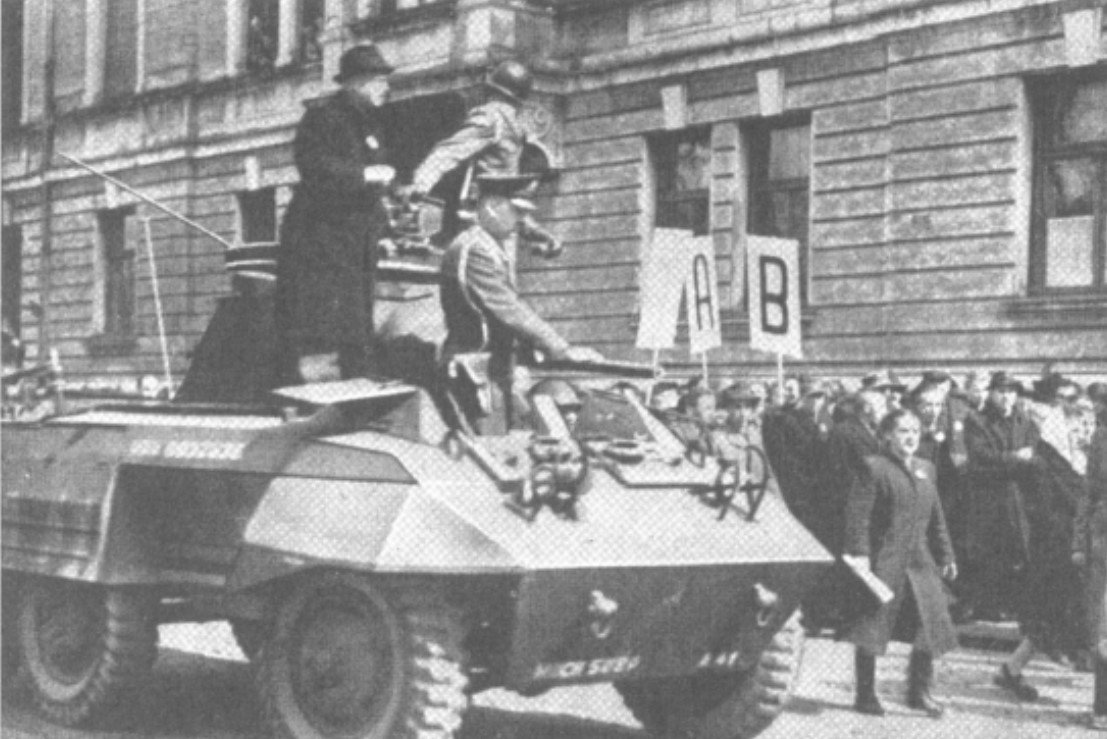
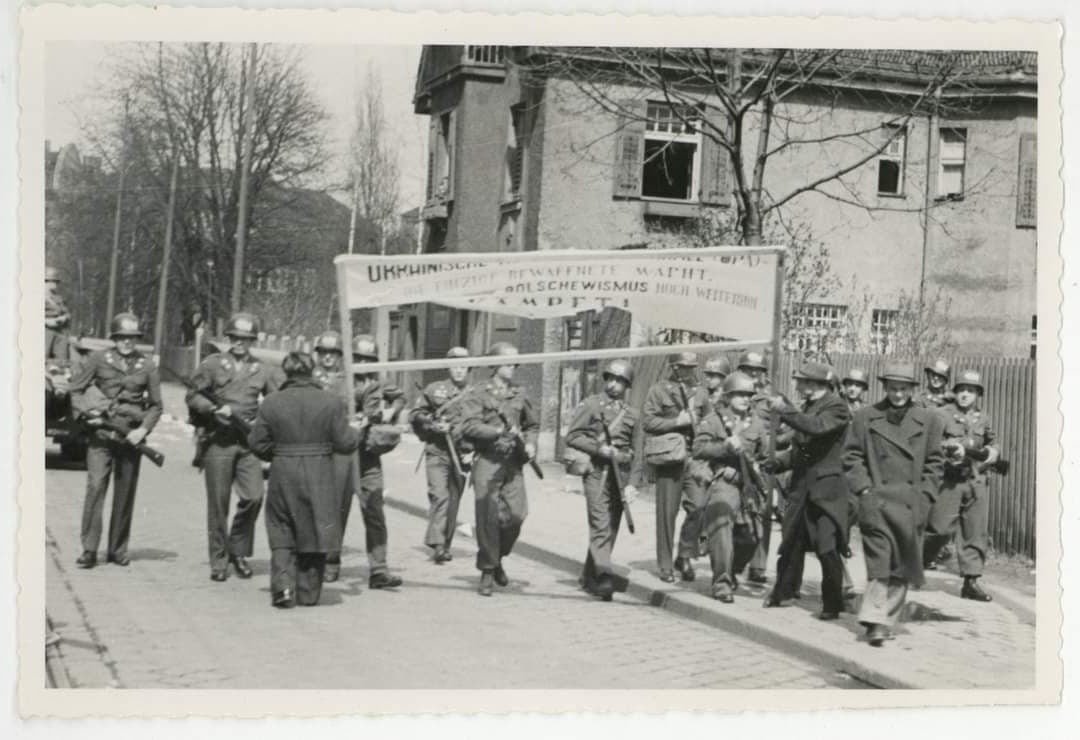
Recently, the Ukrainian journalist and founder of the “Historical Truth” resource Vakhtang Kipiani published a photo from the archive of the Leader of the OUN (b) Stepan Lenkavskyi on his Facebook page. In the photo, two men dressed in long warm coats are carrying a torn banner, accompanied by fourteen armed soldiers. Another man obediently walks in front of them, hands in his coat pockets. They are accompanied from behind, by an armoured car, on which stands an armed soldier. All this takes place on a street covered with cobblestones and against the background of a two-storey building with wide open windows. If you look closely at the torn banner, you will be able to make out the words in German. The demonstration took place in Germany, and from the soldiers’ uniforms, it becomes clear that this is an American occupation zone. Most likely Munich. This assumption is confirmed by the inscriptions on the banner (“Ukrainische”, “Bolshevismus”, “Kampft” “Ukrainian”, “Bolshevism”, “struggle”).
“Not quite clear what’s going on?” – Kipiani finished his short post.
At first glance, the three men in civilian clothes were participants in an anti-communist action popular in the West during the Cold War. However, why are they accompanied by the military and where are the other protesters?
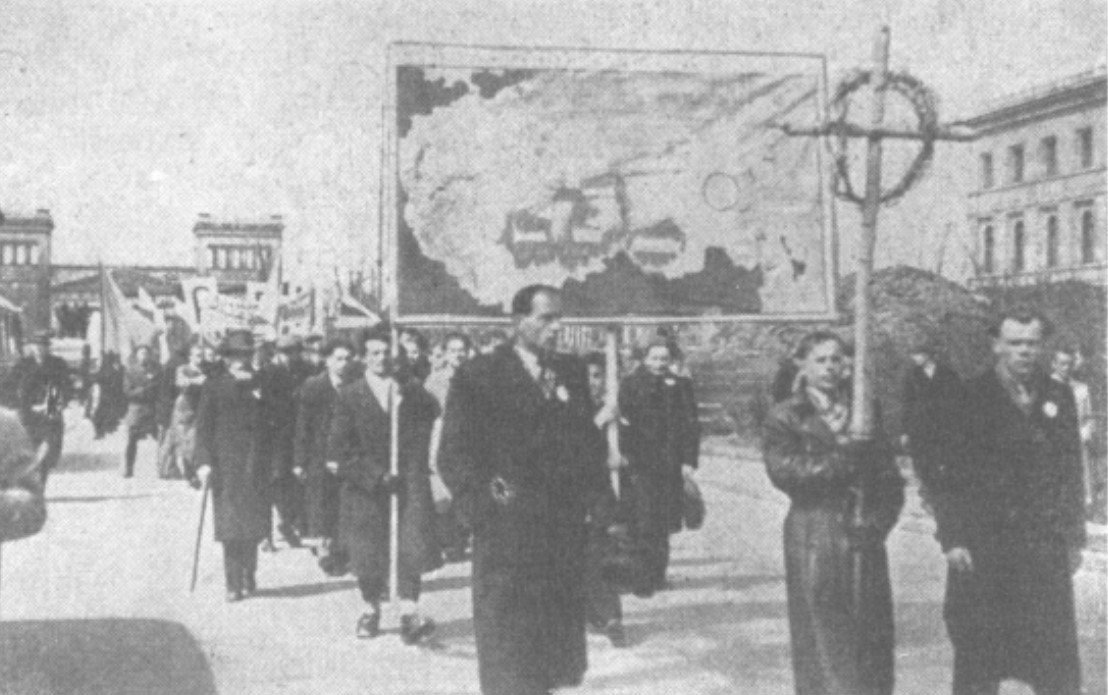
We can assume that these three were participants in the first mass action organized by the ABN on 10 April 1949, in Munich. The demonstration was successful because its main goal was to draw the attention of the American military administration, the people of Munich, and the world community to the problems faced by the nations of Eastern Europe. According to various estimates, 4,000 to 10,000 people took part in it. As a result, several German, European and American newspapers covered this event. The event drew special attention from the editors of the American Paramount News, whose programmes were broadcast in special video editions from 1927 to 1957. One of the releases in 1946 was even nominated for an Oscar as the best short documentary. Therefore, the mass was almost the main reason why it was necessary to tell the general public about the ABN demonstration.
In addition, the large rally was also a real surprise for the military administration. A month before the action, Ukrainian residents of the camps for temporarily displaced persons applied to the Munich police for a special permit to hold a religious and political demonstration on the main and largest square of Munich – “Königsplatz”. Built in the middle of the 19th century by order of the Bavarian King Ludwig I in the ancient Greek style, the square in the interwar period became a real “Mecca” for the Nazis, because the headquarters of the party was located here and the temple of the “Nazi martyrs”, the 16 participants who died during the Beer Putsch of 1923. After the war, these monuments were blown up and destroyed, and the square was no longer used for large mass gatherings. Therefore, in order not to revive the political manifestations of the 1930s in the public memory, the Americans did not permit political action, instead, they allowed a peaceful religious demonstration for representatives from Eastern Europe. Moreover, in the initial period of the Cold War, the religious factor was given extreme importance and the opposition of the Christian West to the atheistic communist empire, especially in divided Germany, was seen by the administration workers as a psychological influence on the enemy.
Second, the clashes that took place between the demonstrators and the military attracted even more media attention. The fact is that, as stated, the demonstration began with a memorial service for the dead. At the end of the prayers, representatives of the UGCC, which was banned and liquidated in the USSR, read an address in which they announced a list of religious victims and those who continued to suffer persecution for their faith from the communists in their countries, in particular, among the listed persons were the Hungarian Cardinal Józef Mindszenty and the Croatian Archbishop Aloise Stepinac. Mindszenty was found guilty of treason and espionage at a mock trial in February 1949 and sentenced to life imprisonment, while Stepinac was sentenced to 16 years in prison in October 1946. The fate of UGCC bishop Yosif Slipy, who was imprisoned by the Soviets on 11 April 1945 and sentenced to 8 years of hard labour, was similar.
These facts caused indignation in the crowd. Moreover, speaking, the representatives of Ukrainians, Belarusians, Lithuanians, Latvians, Estonians, Slovaks, Cossacks and Turkestans addressed not only religious topics but also political ones. In particular, they condemned political persecution and called for national liberation and the formation of independent democratic nation-states. At the end of the meeting, the demonstration adopted a resolution condemning religious and political persecution by the Bolshevik regime. To a large extent, this radicalized the gathering. After two hours of speeches, the demonstrators decided to march to the former headquarters of the Soviet mission in Munich. However, they encountered resistance first from the Munich police, and then from the American military.
Clashes with the use of tear gas and bayonets against the demonstrators, who threw cobblestones and stones at the security forces, lasted for about an hour. Therefore, separating the participants of the protest and escorting them away from others was a tactical move by the military. This is exactly the situation depicted in the photo released by Kipiani. Thirdly, the American administration did not expect to receive such a large and organized force under its nose. Three years before the mentioned events, at the beginning of 1946, in the dilapidated post-war Munich, where most of the political émigrés moved, as well as temporarily displaced persons who refused to return to their homes, consultations were started on the creation of a unified organization. The main role in this process was played by representatives of the Ukrainian national movement from the Bandera wing of the OUN. During the entire period of existence of the Organization, the concept of joint struggle of enslaved nations against the Soviets gradually developed. Its tactical directions regarding how this struggle should be conducted changed, depending on how the geopolitical conditions changed, but the ultimate goal – the destruction of the USSR through the formation of independent nation-states – remained unchanged.
In February 1946, the Central Committee of the OUN was formed – a structure that was supposed to consolidate the members of the OUN (b) abroad. After that, active work began with representatives of various nations on the formation of a single anti-Bolshevik association. In the appeals that were heard, it was emphasized that various chauvinistic speeches in the press or everyday life between representatives of different nations in the camps should not be allowed. Such attacks on other nations among political fugitives were also openly condemned, there was talk of the creation of joint international committees – in camps for displaced persons and other places where political fugitives of all nations gather, and broad mutual assistance in all areas of emigrant life. As a result, on April 16, 1946, in one of the districts of Munich, the 1st Congress of the ABN was held, where they united into “… a single monolith of the still scattered and even conflicting anti-Bolshevik revolutionary forces of the peoples, who alone were not able to successfully oppose reactionary Bolshevism “.
Initially, the Bloc did not pursue an active public policy. In the period 1946-48, various consultations were held regarding the formation of a common anti-communist platform, as well as obtaining support and recognition from the Allied administration. Immediately after the creation of the ABN, a Memorandum was sent to the Paris Peace Conference of 1946, by which the members of the ABN sought to obtain from the Western countries and newly formed international organizations, such as the UN, constant pressure on the USSR and its satellites, as well as official recognition of emigrant organizations as exile. Not receiving such recognition, at the beginning of 1949, the ABN decided to take a different path – a public demonstration of the problems of enslaved nations in the USSR and, thus, attracting the attention of the world community and gaining as much publicity as possible. Such a choice was not accidental or illogical because at the end of 1948, after the communist coup in Czechoslovakia and the Berlin crisis, real confrontations between the Soviets and the Americans began.
As a result, the National Security Council Resolution No. 68 was adopted, which stated that the victory over the USSR was to be achieved, among other things, by promoting “the appearance in the people of Russia, attitudes that could help change the current behaviour of the Soviets, and create conditions for the revival of the national life of groups …”. Therefore, it was about the psychological impact on the enemy, or as it is now popular to say, about the hybrid. The ABN, headed by Yaroslav Stetsko, offered a fully effective concept. In the subsequent years of the existence of the ABN, a large number of protest actions and demonstrations were held, in particular, the anti-Bolshevik demonstration in London in 1951, a mass meeting in Canada in June 1952, a demonstration against the Soviet delegation to the UN in 1956, a rally in Toronto in 1965, a demonstration in London 1968, actions in defence of the Ukrainian dissident Valentyn Moroz, all Ukrainian political prisoners, for the national and human rights of Ukraine in 1971, Enslaved Nations’ Week in 1983 and many others.
Григорій Рій
Націоналістичний портал





