

Very often in a public chat you can read a question from people who are still hesitating in their political choice – what does “Raspberry Wedge” mean? Indeed, over the past hundred years, the people’s memory in the Kuban has been deliberately and purposefully erased, destroyed, truly folk features have been replaced by Moscow civilizational -cultural all-imperial surrogate. The last Ukrainian schools in the Kuban (as well as other national schools) were closed in the 30s of the 20th century. The memory of the Holodomor in the Kuban, that is, the deliberate destruction of several hundred thousand people by Muscovites, is prohibited even now – for example, the complete taboo of Andrey I’s film “Kuban Break”. Therefore, why be surprised that many residents of the Kuban do not know the basic things, markers of the Kuban identity, the basics of civilization and culture of their own region. The goal of the ongoing ethnocide of the Kuban was and is the erasure of identity, and such markers as language, traditions and the understanding that you and a Muscovite are not “adinnarot” are markers of identity. Therefore, under attack, they are the first in line.
In a good way, it’s very sad that you have to explain to someone what the Raspberry Wedge is. This is the same marker of Kuban identity as, for example, the European roots of the Kuban – antiquity, Byzantium, the Principality of Tmutarakan, the Genoese and the Circassian state formations that gravitated towards Europe (before the period of Ottoman domination, and in principle for quite a long time under it). And the same marker as the struggle of the region against the Moscow occupation. They only carried it out under different flags – under the flag of Circassia in 1864 and before that, and under the flag that Krasnodar Territory got from the period of independence in 1918-1920. Actually, Hadji Berzek Kerantuho, Mikolay Ryabovol, Luka Bych, Vasyl Ivanis and Aleksey Kulabukhov did the same thing at different times.
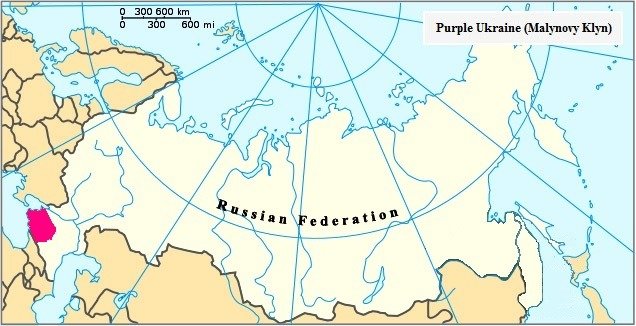
Initially, “wedges” were called settlements of Ukrainians in different regions. In the Ukrainian tradition, a “wedge” was a piece of land, and later – an area where Ukrainians lived outside of Greater Ukraine. There were four such “wedges” in total – the Green Wedge or Zakitayshchina, the Amur region, Sakhalin, the Amur region and other regions of the Far East, the Yellow Wedge, the area of settlement of Ukrainians in the Lower Volga region, the Gray Wedge, the Ukrainians of Southwestern Siberia and South Kazakhstan and the Kuban region – Raspberry Wedge. The map clearly shows that the territory covers the regions of the Krasnodar Territory, part of the Rostov region, Adygea, Stavropol and Karachay-Cherkessia.
In all cases, the “wedges” played a civilizing role in every region where Ukrainians appeared. Thrift, diligence, exceptional endurance and survival, a positive attitude played a role in the development of each region. Unlike immigrants from other regions of the Russian Empire, Ukrainians maintained peaceful relations with other peoples of the regions where they moved. Conflicts occurred only when the Moscow authorities and their local satraps pushed these peoples head-to-head. Naturally, it is the Ukrainian component – and a part of the Kuban nation can undoubtedly be considered not only the descendants of the Cossacks, who once founded the first 40 kurens in the Kuban, but the descendants of Ukrainian peasants who moved by the middle of the 19th century and, for example, Ukrainians who moved to the region, for example, until the end of the 80s, all this is one process that stretched for three centuries – it played a crucial role in the events of the period of independence of the Kuban Territory in 1918-1920. It is for this reason that Muscovy has done and continues to do everything to erase all the facets that distinguish the inhabitant of the Kuban from the Muscovite and, in particular, to destroy all the remnants of Ukrainian culture, as if it did not exist.
So, Raspberry Klin can be called not only a colorful cultural corner of Eastern Europe, occupied by Muscovy, but also the base, the basics of our statehood along with the states of the Circassians, which from time to time arose before the genocide of the Circassians in 1864 on the lands inhabited by the Circassian peoples . Raspberry Wedge took the baton.
Who wants to know more about the Crimson Wedge, we sincerely recommend the book of the same name by Dmitry Bily, a Ukrainian historian of Kuban origin. And, when in 2019 the question arose of what the movement would be called, Dmitry Dorovskikh had the idea to name the revived movement for Kuban independence that way. From this point of view, in a broader sense, we consider Raspberry Klin to be the base and platform of our statehood, which embodies the idea of a state under a common flag – a country in which representatives of all the peoples of the region will live freely, comfortably and freely, freed from Moscow rule.
As one wise man said: “A nation that chooses bread between bread and will eventually loses everything, including bread; a nation that chooses will eventually gets bread grown with its own hands.”






