

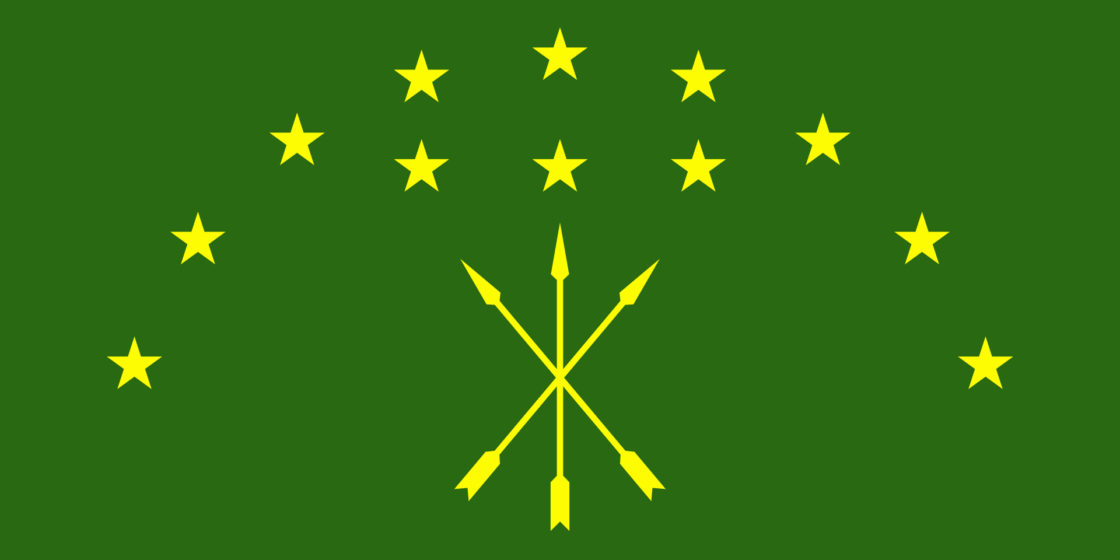
— Good afternoon, Beslan. Thank you for taking the time to speak with me.
— Good afternoon. I will be happy to answer your questions.
— Recently, the topic of the Circassian movement has been appearing more and more frequently in the Ukrainian information field, in particular in connection with reports of the detention of activists in Turkey. Can you clarify what exactly happened?
— As far as I know, we are talking about the detention of Baglar Selchuk, my ideological opponent, but at the same time, oddly enough, an ally in a common cause. We both represent the Circassian national liberation movement. The reason for the detention, as far as I understand, was his publications on the Kurdish issue, which caused a certain reaction in Turkey.
— Do we understand correctly that this is related to recent events — in particular, the Kurdistan Workers’ Party’s statement on self-dissolution?
— Exactly. It caused a positive reaction among many Circassians. We have historically sympathised with the Kurdish people – we respect their courage. But at the same time, we have never supported violent methods of armed struggle. Turkey at one time became a refuge for thousands of our fellow tribesmen who escaped genocide.
— Did you mention the creation of the Kuban-Cherkessia Coordination Council?
— Yes, this is an association that we initiated for political dialogue with the population of the Kuban and other regions. It includes, for example, the “Raspberry Wedge” movement. We recognize that there are approximately 1 million Circassians in the Russian Federation, while the Krasnodar Territory alone has more than 8 million residents. Without their support, no referendum is possible. We must win the trust and support of those who live today on the ancient lands of Circassia.
— How do you feel about the idea of uniting all the peoples of the North Caucasus into a single coalition?
— I will say frankly: we have considered such an idea, but we consider it extremely difficult to implement. We have a different cultural, linguistic and institutional basis from the Chechens, Dagestanis, and Ingush. For example, Chechnya already has an established state-oriented thinking and language, and we still need to restore these institutions. In addition, if we were to create a joint parliament now, it simply would not be able to work effectively: the issues of the Circassians and the issues of the Chechens require separate consideration. We support the idea of a confederation — on the model of the EU or NATO — with common security and political coordination, but only after the formation of national institutions.
— Do you have contacts with other activists?
— Yes, we communicate. Last year, Zakayev clearly stated at a meeting of the International Circassian Council: first, the restoration of national authorities, then supranational coordination. And we completely agree with this.
— Let’s go back to the Selchuk case. A campaign has been launched against him on social media. How do you assess this?
— My position is this: the Russian information machine is probably behind these attacks. Propaganda Telegram channels, such as “Ridovka,” are known for their provocative content. They use Turkish speakers to incite xenophobia and discredit Circassians in Turkey. Selchuk was framed — his words were taken out of context and presented as offensive. At this very time, Turkey announced the supply of tens of thousands of drones to Ukraine — and it is obvious who benefits from inciting hostility between Circassians and Turkish society.
— To what extent, in your opinion, does the Circassian population within the Russian Federation support the idea of independence?
— At least half of them — consciously or intuitively. The problem lies in another field — many lack elementary historical knowledge. People do not know what the Caucasian War is; they have not read the original decrees on deportation. I did not realize the scale of the catastrophe until 2011, until I got acquainted with the decrees of Alexander I, Nicholas I and especially Alexander II (he was a particularly ardent supporter of the idea of the destruction of the local population — ed. note ), as well as generals Yermolov and Zass. Circassians were forced to forget their identity for decades.
— What is happening in Circassia in terms of economy and mobilisation?
— The region is in decline. Industry was destroyed back in the 1990s. People, especially in Kabarda, were left without land, without education, without prospects. This is what pushes young people into the army — they simply see no other way out. And this is our tragedy.
— How tangible is the international support for your movement?
— There is no political support for the national movement. Often, there is even opposition. The only country that has expressed support for the Circassians over the past 10 years is Ukraine, which recognized the genocide and the right to rehabilitation of the Circassians on their historical territory. Georgia supported it until 2016, but now there are practically no such mechanisms. Ukraine is the only state that has publicly recognised the genocide of the Circassians and expressed solidarity. We are open to dialogue, but we have not received any real invitations or projects. Europe and the USA are more focused on preserving the status quo — that is, a united Russia — and therefore treat us only as a factor of instability. It is difficult, but we continue the struggle.
— Thank you for the informative interview.






