

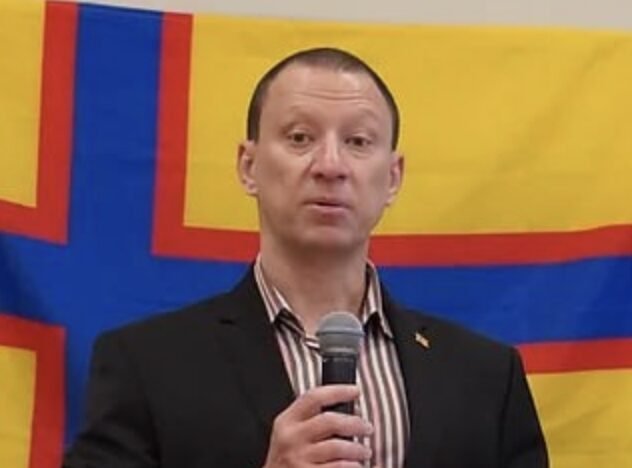
– Good afternoon, Mr. Denis, what do you see as the essence of the Russian Federation?
– Greetings to you and readers. Today, Russia, which is formally a federation, is a despotic authoritarian entity, which to a large extent can be called imperial. Unfortunately, it is precisely such a structure that has exhausted all possibilities for normal good-neighbourly coexistence and for ensuring prosperity and normal, including political, development for its citizens. This could still be tolerated if Russia, in its current form, did not pose a threat to everyone. And in general, it makes a serious contribution to pushing the planet towards World War III. Sorry for the pathos.
– Please tell us the history of the Free Ingria movement.
– Initially, it was more of a youth mainstream as a form of good-neighbourly confrontation — a confrontation between two cultures: the culture of everyday life and the communal life of St. Petersburg and the culture of everyday life and communal life of Moscow.
This idea is quite widespread — in general, up to 40% of young people aged 25–30 may sympathise with it. I emphasise that this is more of a folklore-youth idea.
If we are talking about an idea that implies a willingness to take physical or political action to fight for the independence of the region, then the numbers are less impressive – we assume that such people make up about 18%. But these numbers are based on indirect signs and may differ greatly from reality.
– How should the nations enslaved by Russia act to gain independence?
– Thank you, this is a difficult question. I believe that we must first convince the so-called international community that the idea of deconstructing the Russian Federation is not as terrible and destructive as it is being portrayed, including by Putin’s propagandists.
– And propagandists are working on this issue actively…
– Yes, they do it, by the way, quite successfully. The idea of deconstructing Russia must be constantly replicated; it must be critically examined. It must, in the process of consideration, reveal its weaknesses and be considered especially meticulously, perhaps smoothing out some sharp corners even at the theoretical stage. But the most important thing is that for this idea to be heard and accepted, it must be based not on a historical background, but on the picture of the future that we can offer the world community, which will correspond to the vision of the future of those powerful people of this world to whom we offer it, and which will provide these powerful people of the world with additional tangible benefits after the development of events that we propose. Understand me correctly, you can talk as much as you like at international forums about the fact that this or that nation has the right to its cultural identity, but certain actions must be taken.
– What do you think about the activities of the so-called Russian opposition?
– Regarding the Russian opposition, my scepticism is progressively growing. We can discuss this issue, but I believe that at the moment, the term “Russian opposition” does not exist and here is why. First, the opposition is a way of political struggle in its parliamentary version. Having usurped power, Putin destroyed this possibility, that is, now the actions of the so-called opposition look, let’s put it delicately, like cunning. Thus, we have questioned the term “opposition” in this context. Now let’s move on to the word “political”. At the moment, no organisation has directly declared “Our goal is the coming to power in Russia of the enemies of the Putin regime using any methods of political struggle”. Let me remind you that, as is known, there are five such methods – agitation, propaganda, sabotage, destruction and terror. So, none of the political wings of Russian opposition organisations claims to have real power in Russia. Therefore, the word “political” is inappropriate here.
– Thus, this is just an element of the media component, a show…
– I believe that today in the information field, there is a fairly extensive media activism, which quite successfully mimics the “political”. This activism takes the form of a left-democratic, left-globalist direction, is financed by organisations of a left-democratic nature and broadcasts narratives that are beneficial to them. Therefore, we can state that the Russian political opposition is a simulacrum that has the goal of transforming media capital into financial capital in an attempt to occupy at least a minor role in the media agenda and expects, after the departure from power of the current head of the Kremlin, for various reasons, to occupy advantageous positions in terms of establishing post-Sputnik Russia with the EU countries. Such is the realistic picture without embellishment.
– Thank you for the interesting interview, which was informative to hear from a respected person.
– Thank you.






