

— Good afternoon, Dmitry. Please tell us about the Congress of People’s Deputies of the Russian Federation. What is its purpose?
— Greetings, this is a kind of alternative parliament of the Russian Federation, which we see as a current and future representative body. It includes deputies who were elected in legitimate elections at one time. Although their mandates have already ended, we believe that they have residual legitimacy. After all, after the falsifications, changes to the Constitution and the destruction of competitive elections, all the current bodies of power of the Russian Federation — the president, the State Duma, local authorities — are illegitimate. Therefore, we are gathering to draft regulatory acts, concepts, and a vision of the future state system on the territory of the modern Russian Federation. This is necessary so that the people of this territory can live in peace, prosperity, and not pose a threat to their neighbours.
— One of the representatives of the Chechen anti-Kadyrov movement spoke at the Congress. How do you evaluate his speech?
— It was a thorough report on the history of Russian-Chechen relations. Not all delegates, perhaps, knew this topic so deeply, but for me, the situation was clear: Boris Yeltsin’s recognition of Chechnya’s independence and his signature under the peace agreements already speak enough about the Chechen people’s right to self-determination. We, as the Congress, definitely support the independence of the Chechen Republic. In my opinion, this does not require additional confirmations or referendums.
— How does your Congress differ from other initiatives – the Forum of Post-Russian Peoples or the League of Nations?
— We have somewhat different tasks. The Forum and the League of Nations bring together national liberation movements and republican initiatives. And we, first of all, create a model of a future state (or states) on the territory of the Russian Federation. At the same time, we fundamentally recognise the right to different opinions. Unlike the current “unanimity” in the Russian Federation or Belarus, we believe that pluralism and free discussion are the key to healthy politics.
— What do you see as the ideal transformation of the Russian Federation?
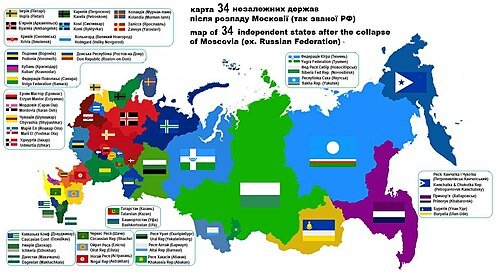
— In my opinion, the Russian Federation is not a federation — it is an empire. And the best way for it is transformation, disintegration into several independent states. How many exactly — life will show. It is important that each region mind its own business and not impose the “Russian world” on its neighbours. I do not believe in federations or confederations, but I am ready to work in such a model if the majority of delegates want it.
— How realistic is the development of national and regional movements within the Russian Federation?
— It is practically impossible to measure support now: sociology is banned, people are afraid to express the truth, and even on social networks, there is a risk of arrest. But I am sure that with the removal of the propaganda dictate and access to independent information, the independence movements will receive strong support in many regions — from Tatarstan to Ingria or Kaliningrad.
— What contacts do you have with the European Union?
— We are conducting a dialogue with many countries, most actively with Poland and the Baltic states, which understand the threat. They realise that the war against Ukraine is only the beginning. Unfortunately, Western countries that are further from the borders of the Russian Federation perceive the threat less acutely. The EU is not yet ready to support the idea of completely dismantling Russia, preferring the scenario of “evolutionary regime change” from within. The reason is obvious – fear of nuclear weapons. We are convinced that it is dangerous to leave everything in the hands of the Russian Federation.
— Thank you for the conversation.
— Thank you, we continue our work.
Author: Valentyn Demenko






