

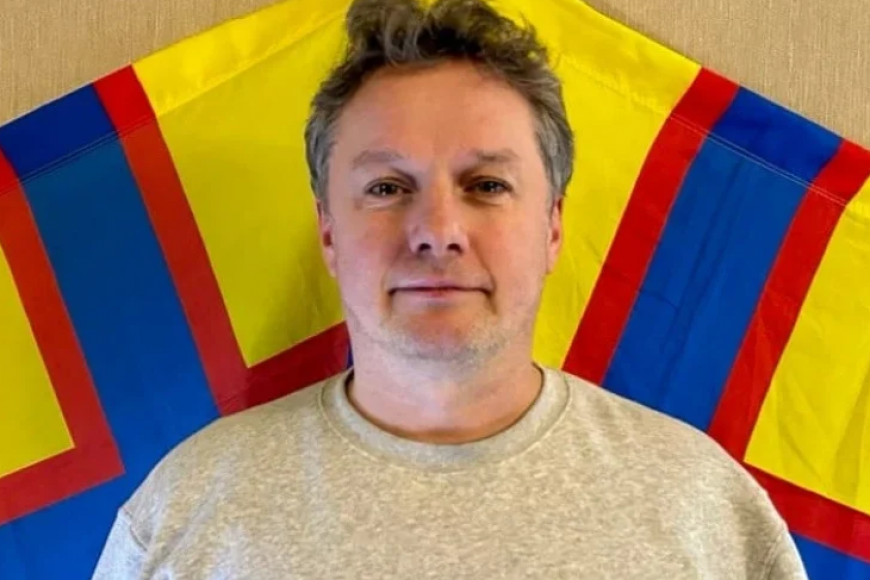
— Good afternoon, Maxim.
— Congratulations, Valentine.
— Do you think Russian special services are trying to infiltrate international Finno-Ugric initiatives to discredit activists?
— I think such attempts are possible. But I try not to become paranoid and not suspect everyone. We are not Stalin or Putin, so we see enemies everywhere. I know the people I work with, and I did not notice that they acted in favour of the special services. Of course, there are cases of pressure – relatives were scared, someone tried to discredit or seduce with money. But I did not meet any professional exiles.
— Can we talk about creating a common platform of resistance for various national movements within the Russian Federation — Karelians, Udmurts, Tatars, for example?
– This is absolutely real. Such coordination already exists. There are various platforms, including the Post-Russia forum, where I personally met activists from different regions. Ukrainians here provide tremendous assistance. The League of Free Nations is also an example. Some movements have governments in exile, while others are still based on the initiative of individual people.
— How do people in St. Petersburg and the Leningrad Region feel about Moscow? Is there growing dissatisfaction with the authorities?
— Anti-Moscow sentiments are historical. In St. Petersburg, they always believed that all troubles came from Moscow. But this does not always mean a desire for independence – rather, hostility. Any referendum with the question “Do you want to feed Moscow?” would give a predictable result. However, it is difficult to expect a mass protest: indifference is very high.
— How do you assess the level of support among residents of the Leningrad Region for the so-called SVO? Can we say that those working, let’s say, at budget-generating enterprises of the military-industrial complex are ardent Putinists?
– No, I don’t think so. We don’t have a single budget-setting enterprise, for example, in Nizhny Tagil. There is industry, but it is impossible to force everyone who works in the military-industrial complex to mentally support the war. Of course, people are being ideologically poisoned, but we can’t expect an open protest.
— How active are Russian cultural centres in Europe?
— Their influence has weakened significantly. In Riga, for example, they closed the “Moscow House,” and no one came out to protest. This is symbolic: Moscow considered itself Russia! For example, in Germany, such centres still operate, but they no longer have much significance.
— How do you assess the so-called Russian opposition?
— I don’t think they are directly controlled by someone from the FSB. Rather, they are internal imperialists: their aspirations boil down to building a “good” empire instead of a bad one. They avoid the topic of helping Ukraine, preferring to talk about political prisoners or the “need to stop the bloodshed.” They block debates about real, not fake, federalisation of Russia: “This is not the time, first we will defeat Putin, then we will discuss it.”
— Are there any coordination centres for the Finno-Ugric movement outside the Russian Federation?
— Yes, especially in Finland and Estonia. It is natural: free Finno-Ugric peoples live there, who help out of cultural solidarity. In Russia, the situation is very difficult because assimilation is proceeding at a rapid pace.
— The Fenno-Ugria organisation in Estonia — how independent is it?
— You need to look at people, not at signs. There is always someone who works on grants from the Leningrad Region and says that he is real, and we, the radicals, are supposedly doing harm. There is also the “Church of Ingria” with Bishop Laptev, a conciliatory person, like most official denominations in the Russian Federation.
-We believe in the victory of your movement. Thank you for a very comprehensive and interesting interview.
– Together to victory!






