

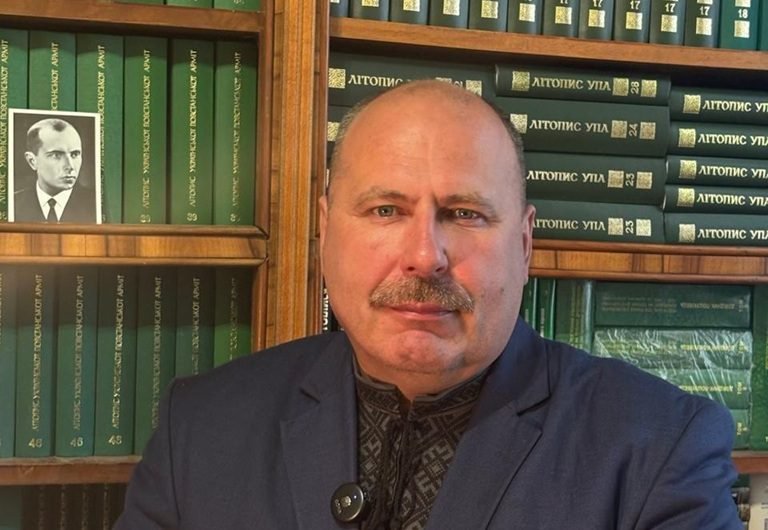
The KV discusses the directions, challenges, and prospects of dismantling the so-called Russian Federation and the emergence of national republics and regional states on its territory with Oleh Medunytsya, Head of the OUN (b) and People’s Deputy of Ukraine, 7th and 8th convocations of the Verkhovna Rada.
KV: Olezhe, let’s start with the Anti-Bolshevik Bloc of Nations, which is the precursor to the Anti-Imperialist Block of Nations, and how do you lead both the OUN (b) and the ABN?
Oleh Medunytsya: Last year, we held the World Congress of the OUN in Lithuania, where I was elected President. It often happened that the Head of the OUN Leadership was also the President of the OUN.
I would especially like to mention Yaroslav Stetsko (along with Stepan Bandera, the author of the Act of Restoration of the Ukrainian State of 30 June 1941, the Head of the OUN (b), the husband of Yaroslava Stetsko, KV ). It was under his leadership that the ABN became a powerful world anti-communist movement. He managed to stitch together various anti-communist movements into a single whole. His activities on our part were mainly advocacy – recognition by Ukrainians of the right and necessity to restore their state. Other ABN participants – Poles, Czechs, Hungarians, Bulgarians – mostly sought liberation from communist occupation and dictatorship.
Our founders spoke with Western leaders about the liberation of peoples from communist oppression and the need for the collapse of the USSR. There were people from the Baltics, Belarusians and Georgians. Among the Georgians, in particular, Levan Zurabishvili, the father of the 5th President of Georgia, Salome Zurabishvili, was present.
When the Soviet system – the Warsaw Bloc, the USSR – collapsed, many figures from the ABN effectively took the helm of their countries. Because of this, the conventional “Eastern European Axis” has an anti-Russian character, where communist movements are almost absent.
KV: You rightly pointed out that there are no communists in the countries of the so-called “former socialist camp.” But there is considerable Russian influence there.
Oleh Medunytsya: These are the consequences of the former influence of the USSR around the world – the formation of loyal regimes, loyal politicians. This goes back to the times of the “world revolution” and the internationals: when there was no soap in Soviet stores, toilet paper did not exist at all, and the Bolshevik regime in the Kremlin exported currency and gold in suitcases to support anti-democratic regimes friendly to it to destabilise the free world.
Comrade Putin did and is doing the same thing. Because the sign on the facade of the empire has changed, but the insides and essence have remained the same, Moscow milks the resources of enslaved nations and corrupts politicians in the West with the stolen wealth.
This demonstrates the vulnerability of democracies in the fight against authoritarian regimes when someone appears out of nowhere in a democratic system and begins to question the values and effectiveness of the democratic system.
KV: This story is over 100 years old. Because the Bolsheviks were democratically elected to the Duma of the All-Russian Empire, and the Nazis usurped power in Germany completely democratically.
Oleh Medunytsya: Yes. It is the same today. For example, Viktor Orban. Hungary has been in the EU for a long time and Orban was not an advocate (or agent) of Russia at the beginning. When Russia got involved in Ukraine, Orban took its side. Although, and this is important to remember, Ukraine is not home to the largest Hungarian minority – these minorities are larger in Romania and Slovakia.
And what is he grabbing hold of? For Russian hydrocarbons – for gas, for oil. Due to the low prices for Russian hydrocarbons, Orban’s government keeps tariffs low for the population in Hungary; that is, it is engaged in curious populism. At the same time, Orban and his closest entourage “light up” from the difference in prices, processing cheap Russian oil into gasoline and selling it on the European market at completely different prices. This is how super profits are formed, at the expense of which this pro-Russian force in Hungary maintains power.
On the other hand, Moscow is thus demonstrating to others: do you want to “light up” like Orban in Hungary, Fico in Slovakia, Benes in the Czech Republic, or famous German politicians? Be with us and you will be just as happy.
KV: This is classic bribery.
Oleh Medunytsya: This is a crazy scheme. Let me remind you how sanctions were imposed against the USSR for its invasion of Afghanistan, and at the same time, in the Italian parliament, communists supported cooperation with the Soviet empire – the Danieli company, for example, built a pipe factory in my native Sumy, contrary to the sanctions regime.
Or German Chancellor Willy Brandt, with whose active participation technological enterprises were built in the USSR, and later the Urengoy – Pomary – Uzhgorod gas pipeline was built so that the Soviet empire could pump its gas to Europe.
However, the Muscovites failed to completely buy the Germans, like the Hungarians. Despite Schröder with his salary and Merkel. This is how Germany’s democratic tradition made itself felt.
KV: If it were not for the explosion at Nord Stream, it’s unclear what would have happened. A month before Russia’s full-scale invasion of Ukraine, and I’m speaking from my own experience, the German establishment believed that Russian gas and Russian oil were just business. They didn’t understand at all that for the Russians, their hydrocarbons were weapons. But let’s get back to the ABN. Am I right that after the Warsaw Bloc and the USSR collapsed, the ABN fell into suspended animation?
Oleh Medunytsya: Yes, you are right. In the structure of the then ABN, the nations enslaved by Russia occupied a maximum of five percent. Moreover, in the first two years of Yeltsin’s presidency, Russia really looked like a federation. We slept through the time when the dismantling of the federal system of Russia began, strict centralisation was established, and local elections were cancelled.
We had a small surge associated with the first Chechen war. A Ukrainian-Chechen information centre was created, which provided information and a picture of the event, an alternative to that presented by the Russian and Ukrainian media. Even then, Ukrainian public opinion was on the side of Russia, and our government was on the side of Russia. Even through our military registration and enlistment offices, volunteers were recruited for the war in Chechnya, on the side of Russia.
We lost the information war then, although our nationalists were fighting on the side of Chechnya at the time, and we communicated with Dzhokhar Dudayev, who warned us that Ukraine would be next.
Even the annexation of Crimea and the war in Donetsk did not make us truly wake up. Only Russia’s full-scale war against Ukraine made us seriously take up the advocacy of dismantling the so-called Russian Federation and liberating the enslaved peoples.
Since the Bolsheviks formally no longer exist, the Anti-Bolshevik Bloc of Nations has turned into the Anti-Imperial Bloc of Nations, essentially the same ABN, whose goal is to liberate the enslaved nations of the so-called Russian Federation from the oppression of Moscow. One of our projects is the photo exhibition “Putin’s Real Prisoners. Political Prisoners of the Enslaved Nations,” which we present in the West, where most people know the hyped “Navalists.” And when the West learns that there are enslaved nations in the so-called Russian Federation, and their voices are not at all similar to the voices of “Russian liberals,” it surprises many.
Now it’s not just we who are engaged in this advocacy, but it is also coming from other political platforms.
KV: Which ones exactly?
Oleh Medunytsya: For example, the League of Free Nations , the Forum of Free Peoples of Post-Russia . The Verkhovna Rada has a TSK (a specialised committee) working on interaction with national movements of small and indigenous peoples of the Russian Federation.
Yes, a lot should have been done earlier. But even so, in three years, a lot has been achieved, especially outside Ukraine, in terms of convincing people that the collapse of the so-called Russian Federation is inevitable and that we should not fear it. Because in the West, they are still afraid of the dismantling of the remnants of the Russian Empire, just as they were afraid of the collapse of the USSR 30 years ago.
I often say and emphasise in my conversations with Western interlocutors: imagine if the USSR had not collapsed then, but had remained with industry, the military-industrial complex, Ukraine, and the Central Asian republics, what would have happened to you now?
KV: And what, imagine?
Oleh Medunytsya: They think about it, but they cannot imagine it. They are gradually realising that Putin did not just attack Ukraine itself; he is not just trying to revive the USSR, but he wants to restore the influence of the Soviet Union to its former scale. And that scares them.
Public opinion in the West is gradually changing. They are now more or less aware that Russia is not invincible, that it can fall apart from within.
The following argument works here: Russia uses all your internal contradictions against you – economic, political, social, sexual, issues of former colonies and any other. And what are you doing? Fending off sluggishly and almost not reacting? But you will eat yourself up like that. Therefore, you should work for the collapse of Russia.
We, Ukrainians, have no choice – we will either win or perish. You, Europeans, still have something to lose. And, in addition to building up your military potential, you must work with the enslaved peoples of the so-called Russian Federation – with the national liberation movements in exile, with those who are in Russia. You must launch projects on social networks, connect intelligence forces, to destroy the Russian Federation from within.
This is our manifesto with which we work in Western countries.
KV: If, as you say, they hear, then there is a dialogue. So there are counterarguments from Western colleagues. What are the typical counterarguments you hear?
Oleh Medunytsya: Traditionally, they are scared of the issue of nuclear weapons. But a larger counterargument is the borders of future independent republics and where the “Russians” who will end up in national republics go.
KV: About nuclear weapons – they’ve just got bored with it since the time of Bush Sr. and Clinton. Nothing will happen to those weapons, or whatever else the Muscovites have left. And what are our arguments against theirs about the future fate of the “Russians”?
Oleh Medunytsya: It’s very simple! There was the USSR – it collapsed. And what? Did someone kill or shoot Russians somewhere? No. Whoever wanted to leave the Baltic countries or the states of Central Asia, or the states of the Caucasus. And there are many places where a lot of Russians still live. And nothing terrible happened to them.
KV: I think that our Western partners, until the Russian Federation collapses, will not overcome these objections in themselves, just as they could not overcome them in the early 1990s, until the USSR collapsed. Therefore, the main work is still on us. What should we do, in addition to what we are already doing, to establish ties between, roughly speaking, Sokha and Germany, between Bashkortostan and France, between Chuvashia and Italy, between the Urals and Great Britain, and so on?
Oleh Medunytsya: The first thing we can and must do is become a world hub for the national liberation movements of the nations enslaved by Russia. So that here, in our country, there is state support for these movements. As, for example, the Lithuanians once helped us – the first Head of the OUN, Yevhen Konovalets, was a citizen of Lithuania, and Lithuania even helped the OUN with money.
This is how we must work with the liberation movements of the enslaved nations of Russia – nurture their leaders, educate their politicians, help create media, help their political prisoners in Russia, and their fellow citizens around the world. We must support their institutionality so that at “hour X,” these people will be able to lead the process and ideologically lead it.
And our Western partners should act in the same way.
KV: So, we should take on the functions of training, educating, and forming not only liberation movements, but also the state elites of future national republics – from the Baltic states to the Pacific Ocean?
Oleh Medunytsya: To be specific, we at the ABN have created the University of Free Nations, where we train their personnel. This is a basic three-month course, based on the results of which, students write papers on the topic “What should be the state of our people”. 70 people have already completed this course. Their organizations must be capable, not marginal, so that they produce good ideas, and that these ideas reach their compatriots.
It is important to understand here that this is a constant and persistent policy of the OUN. Because the ABN is one of our organisations. We have many organisations in our composition – sports, religious, and foreign nationals. We are trying to master the entire spectrum of experience of Ukrainian refugees who, after the Second World War, were scattered all over the world – and we are passing this experience on to the peoples enslaved by Russia.
KV: In the preparation of national elites for future state-building, there is a very important component – the military. Because when the collapse, destruction, or dismantling of the so-called Russian Federation begins, the issue of security will arise in the new republics. The remnants of the FSB, army, police, etc., will not go anywhere from there, and the new republics will have to do something about it. And, so that civil unrest or civil war does not begin there, we must now think through and prepare the power structures of the future republics. The best base for this is the Armed Forces of Ukraine. Where, not counting the RDK, LSR or Sibbat, because it is all about Russia, or Ichkerians – there is not a single national battalion. Why, and is it possible, in your opinion, to do something in this direction?
Oleh Medunytsya: Look at the experience of forming national armies in countries that lived for a very long time without their own state – Latvia, Lithuania, Poland, Romania, Ukraine.
The Sich Riflemen fought in the Austro-Hungarian army, and most Ukrainians in the Russian army. Within days of Ukraine gaining independence, these same people, who had been fighting against each other for years, united into a national army. This process took place in Poland, Latvia, and Lithuania. In my opinion, similar stories will unfold in the future republics in the post-Russian territories.
KV: I must note that, unlike Ukraine, Romania, Poland, the Baltic states, etc., the depth of Russification in the colonised republics of the so-called Russian Federation was still not so comprehensive.
Oleh Medunytsya: In eastern Ukraine, Russification was colossal – everyone graduated from the cadet corps, kissed the imperial flag. And this still did not prevent the creation of a national army.
We must support the institutionality of national liberation movements and their governments in exile, which regularly produce statements and appeals. This is how they create the ideological basis for the creation of states.
For example, today there are a lot of Tatars in the Moscow army, and a lot of military enterprises in Tatarstan. And suddenly, there is paralysis of the centre, which is unable to govern Tatarstan. National elites can and should decide on independence. And here you are – a Tatar who is no longer forced to fight for the empire. Who will you be for? In 90% of cases, you will be on the side of your national army.
KV: When this happens, we will mostly not be able to influence it. And we will not be able to influence the hypothetical future turmoil. God forbid that this turmoil does not happen. I am talking about preparing a base on our principles, like the University of Free Nations, but enlarged. This will also strengthen our capabilities in cooperation with the new republics and will protect us from hypothetical troubles from these republics. Because who knows how it will be.
Oleg Medunitsa: It won’t happen quickly anyway. How many people did you see in Ukraine in 1988, ready for an uprising and independence?
KV: We have very few in Sumy.
Oleh Medunytsya: So. Now we have to help build the skeletons of future nation-states, on which tendons and muscles will later grow. There are still many complexities ahead and it is currently unknown how exactly the Russian Federation will begin to collapse. Will it be a multidimensional economic crisis? Will it be a rebellion of the elites or unrest in Putin’s Kremlin entourage? Therefore, it is not worth thinking about everything down to the smallest detail right now.
Moreover, we are now talking about enslaved nations and have not talked about regional state projects, which can also exist, and which we are currently working on. There are activists, there are structures that speak about the independence of Ingria. Ingermanlanders – is there such a nation?
KV: There is, although it is very small due to the Muscovite ethnocide.
Oleh Medunytsya: Yes. But now it’s mostly St. Petersburg, the Russian Singapore.
KV: From the point of view of history and the Ingermanlander, there is no St. Petersburg, but there is Nyenschanz, who demolished the third Romanov and built a city in his own name in its place. The same story as with Odessa: there was the city of Khadzhibey, before that Kotsiubiyev, and Catherine built the port of Odessa – and now instead of Khadzhibey-Kotsiubiyev we have a post-imperial Odessa. But, despite this, I agree, because “Russian Singapore” is a cool location. In my opinion, the point of no return in the collapse of the so-called. RF will be the separation of Ingermanland.
Oleh Medunytsya (laughs): So we’re not talking about Kaliningrad anymore?
KV: In my opinion, Königsberg or Korolevets should eventually return to its native Lithuania.
Oleh Medunytsya: And the Uralsk Republic?
KV: I see it in reality. As well as the Siberian Federation. But there are more complex regions, for example, Pskov, Novgorod, or Severshchyna. And here the question is: on what to build independent republics, because these are completely Moscowized regions. How to work with them?
Oleh Medunytsya: Again, the question is about skeleton or protoskeletal structures. If such structures exist, if there is a minimum number of people who want to build their own state, and it doesn’t matter what they call it, everything will work out. If there are no such structures and people, nothing will work out. And on such lands, some new Moscow state will probably be rebooted, maybe even without the name Russia.
These are purely geopolitical and distant thoughts. As for specific activities here and now, we are talking about information work, work with their political prisoners, their military formations that are currently fighting here, and the University of Free Nations. From time to time, something new arises.
KV: In your opinion, should the TSK of the Verkhovna Rada, in cooperation with the national movements of small and indigenous nations of the Russian Federation, now create draft resolutions on the recognition of new national (and not only) republics and achieve their adoption by our parliament? This will significantly facilitate the further legitimisation of these republics in the world.
Oleg Medunitsa: That’s not a bad idea. But there are important nuances here that shouldn’t be discussed publicly right now.
KV: Is it possible to involve prisoners of war of the Russian Federation from among the enslaved nations in national liberation movements?
Oleh Medunytsya: It is extremely difficult because they are mostly devoid of national identity and went to fight solely for money. And an important component is fear for their relatives and friends who remained there.
Those who can join the national liberation struggle are either hiding from mobilisation or have fled Russia. This is a promising direction, but here we need to work all over the world, maintain systematic contact with them and not forget that they are migrant workers there.
In New York, for example, a Buryat came to our rally and said that there were almost 40,000 of them in Mongolia. And in Ulaanbaatar, the FSB officers grabbed him at a rally, broke his arm, and wanted to pack him up, but he barely escaped. He said that there were also many Buryats in South Korea.
This example is to help us understand that people who are ready to fight for their nation-states are scattered all over the world.
KV: And finally, say something optimistic and inspiring.
Oleh Medunytsya: The so-called Russian Federation, this remnant of the Russian Empire, will be destroyed!
Київвлада





