

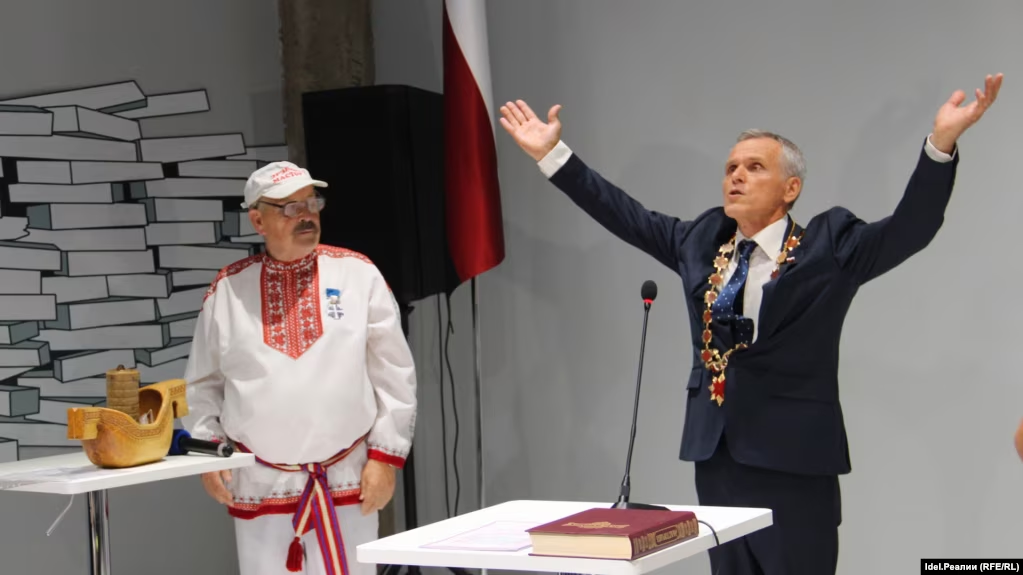
On the night of 21-22 August, a well-known activist of the Erzya national movement and honorary inyazor (elder) Pirguzh Kshumantsyan died in one of the hospitals in Mordovia. “Idel.Realii” studied the main facts of his biography and his role in the formation of Erzya organizations and the revival of traditions, and also talked about him with colleagues in the movement.
Erzyans and Mokshas are Finno-Ugric, indigenous nations of Mordovia and adjacent regions, their languages and cultures are similar but not identical.
Pirguzh Kshumantsyan is an Erzya name. Its first part is derived from the name of the activist’s native village – Tashto Kshumantsya in the Bolsheignatovsky district of Mordovia. According to Soviet documents, his name was Grigory Musalev. He was born in 1940 to an Erzya peasant family. His father soon went to the front, and in 1943 he died in battle near Kharkiv. His mother worked on a collective farm, raising three sons, of whom Pirguzh was the youngest.
After finishing school in the regional centre of Bolshoe Ignatovo, Pirguzh Kshumantsyan served in the army and entered the physics and mathematics department of the Mordovian Pedagogical Institute. After completing his studies, he stayed to work at the same educational institution as a mathematician-programmer.
In the late 1980s, Pirguzh Kshumancian became involved in national activism. Among his first initiatives was the revival of the annual Velen Ozks (literally “Village Prayer”) prayer in his native village of Tashto Kshumancian. This event, first held on his initiative, has been held annually on the second Saturday of July for 34 years now.
The most famous and popular Erzya event today, Rasken Ozks (People’s Prayer), was also revived with the participation of Kshumantsyan. The first such prayer took place in 1999. In 2004, both events received the official status of regional folklore festivals. In her article for Ethnographic Review, Saransk sociologist Olga Bogatova explained this decision as the “desire of the authorities to control such events.”
In addition to the revival of Erzya traditions, Pirguzh Kshumantsyan was involved in journalism and educational work. Since 1994, he participated in the publication and distribution of the newspaper “Erzyan Mastor” (“Country of Erzya”), brought literature in the Erzya language to different regions of the republic, and organized educational events in villages.
In addition, Kshumantsyan collaborated with activists of other Finno-Ugric peoples, representing the Erzya at international conferences in Finland and Estonia. He also participated in congresses of the Finno-Ugric nations of Russia, although in some years the authorities actively prevented this. Thus, in 2009, when the annual congress was held in Saransk, Kshumantsyan was detained and placed under arrest – allegedly for “obscene language” – for the duration of the event. While under arrest, the activist suffered a hypertensive crisis.
Erzya politician Syres Bolyaen, who personally knew Pirguzh Kshumantsyan and became his successor as inyazor, says that at first, the republican authorities supported the activist’s initiatives, but later tried to control them, and ultimately appropriated them: “Thousands of people in national dress and with Erzya flags came to the first prayers. Officials then actively participated in this, because they felt that they were still weak, and the national movement was broad. But when Putin’s era began, all our organizations, societies, circles, and ensembles gradually came under the control of officials. This also affected the newspaper “Erzyan Mastor”, which the authorities tried to close several times, and then actually carried out a raider seizure of it.”
— Kshumantsyan Pirguzh is a great man. Great in the sense that he had the mindset of a statesman. Not Russian, of course, but Erzya. He understood what to expect in the future, and could make strategic plans, focusing on the good of the entire nation. By 2019, he and other members of the Council of Elders realized that the authorities of Russia and Mordovia were preparing for the complete liquidation of the Erzya national movement. Then he came to the conclusion that the centre of our movement should be moved abroad — to where Russian security forces could not reach it. He believed that the next inyazor should not have Russian citizenship. I, a citizen of Ukraine, turned out to be such a person, — says Syres Bolyaen.
According to him, after this decision by Kshumantsyan, attacks on the last independent public institutions of the Erzya people in Russia intensified. Immediately after the election of the new inyazor, the newspaper “Erzyan Mastor” came under the control of pro-government authors. At the same time, the Foundation for the Rescue of the Erzya Language, which was founded by the scientist and writer Vidyaz Nuyan and headed by Kshumantsyan for many years, came under the control of the authorities.
After what the Erzya movement calls a “raider takeover,” the Erzya Language Rescue Fund was renamed the Erzya Ethnocultural Heritage Preservation and Development Fund. In 2019, both it and the Erzya Mastor newspaper were headed by former Mordovia State Television and Radio Broadcasting Company TV presenter Tatyana Larina.
— The militant wing of the Erzya national movement in the territory of the Russian Federation also stepped up its work. All this did not go unnoticed, and in the fall of 2023, two dozen Erzyas, in the best traditions of the NKVD, were pulled out of their beds and delivered to the Mordovian FSB department. Among them, along with 90-year-old Nuyan Vidyaz, was 83-year-old Pirguzh, — says Bolyaen.
– Kshumantsyan Pirguzh was one of the initiators of the awakening of the Erzya national movement. He was a purposeful and charismatic person, obsessed with the idea of fighting for the eradication of the imposed concept of a single people – “Mordvins” – and the restoration of the Erzya identity, – so believes another active participant in the Erzya national movement, a member of the Council of Elders and the son of the founder of the ensemble “Torama” Olo Yovlan ( Vitaly Romashkin ).
Erzyans and Mokshas: “Mordvinization Policy” and the Struggle for Identity
Among Kshumantsyan’s most important achievements, Yovlan names the revival of public prayers, as well as the restoration of the representative bodies of the Erzya people – the Council of Elders (Atyan ezem) and the institution of the people’s leader (inyazor).
— Despite the pressure and persecution from the authorities, Inyazor Pirguzh remained firm in his convictions until the end of his life. He publicly condemned the Russian Federation’s invasion of Ukraine and spoke out against the war. Before his death, he bequeathed to the Erzya movement to continue the struggle for the restoration of the independence of the Erzya Mastor state, — says Yovlan.
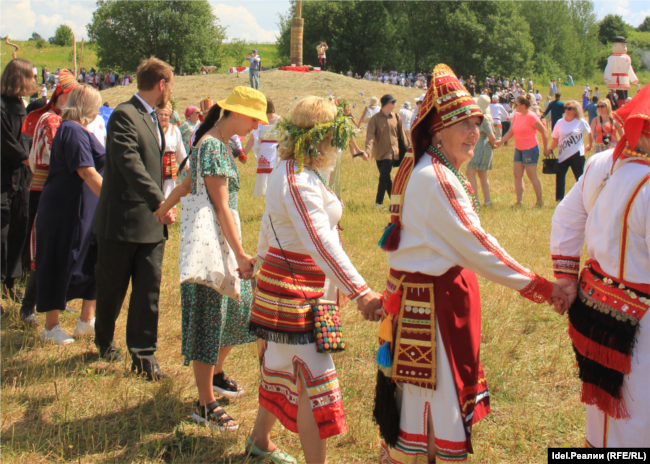
Pirguzh Kshumantsyan’s successor Syres Bolyaen also has fond memories of him: “He used to come to Kyiv, where the centre of the Erzya movement had effectively moved to. In our free time, we would go for walks. Once, we were walking along an underground passage, and he stopped by a group of guys who were singing Ukrainian songs. He stood next to them for a long time, about forty minutes. I didn’t dare disturb him, but then time was running out, and I said: “Inyazor, I’m sorry, we have to go.” He turned to me, and I saw tears in his eyes. I asked what had happened, and he said: “Will the time come when Erzya guys will sit down like this – without 100 grams, without a bottle – and just sing Erzya songs?” That’s the kind of person he was. I said then that this time would definitely come.”
- The Erzya are one of the indigenous people of the Volga region, speaking a language of the Finno-Ugric family. The exact number of Erzya is difficult to determine since Russian national policy groups them together with the Moksha under the common name “Mordva”. The Erzya and Moksha are related people, but their languages are not mutually intelligible, and there are significant differences between their cultures. Most independent activists from both nations deny the existence of “Mordva”.
- According to the 2021 census, 484 thousand representatives of the “Mordvins” live in Russia, of which 333 thousand live in Mordovia. Other regions that belong to the traditional settlement area of these peoples are the Samara, Penza, Orenburg, Ulyanovsk and Nizhny Novgorod regions, Bashkortostan and Tatarstan.






