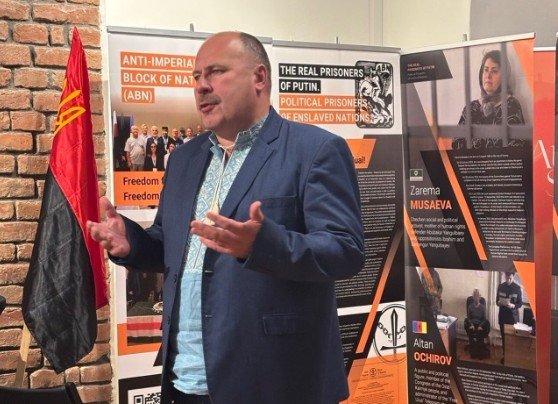

– In 1991, the Bolshevik “prison of the nations” collapsed. ABN leaders made a lot of efforts to destroy it. But did the ABN cease to operate after the collapse of the USSR?
– No, I did not stop. On the contrary, its activity intensified in the territory of the former USSR – in the newly independent states, whose freedom Moscow did not want to reconcile (and still does not tolerate!) As you know, ABN was founded at the Enslaved Nations Conference, which took place in November 1943 in the village of Buderazh in the Rivne region. It was attended by UPA Commander-in-Chief Roman Shukhevych, his comrades, as well as representatives of twelve nations whose lands were usurped by Moscow. All of them sought to free themselves from its yoke, as did Ukraine. It is natural that the Congress of Enslaved Peoples, which took place in April 1946 in Munich, was interpreted by the participants as a union of peoples for a joint struggle against Bolshevism (ABN). For forty years, it was headed by Yaroslav Stetsko, a leading figure of the OUN, and after his death in 1986, by Slava Stetsko, who had a lot of experience working in the ABN, both as a publisher of its printed organs, and in the field of cooperation with enslaved peoples – from Europe to Taiwan. The activities of ABN were welcomed by leading leaders of democratic states, such as Ronald Reagan, John Diefenbaker, Chiang Kai-Shek and many others. The world listened to the initiatives of ABN. Thus, at his suggestion, in 1959, the US Congress approved the resolution “Enslaved Peoples’ Week”, and in 1967, the World Anti-Communist League was founded in Taiwan, in the creation of which Yaroslav Stetsko played an important role.
The work of the ABN was very resonant, it was known everywhere in the world by all those who were involved in the high and noble ideals of Freedom. I think it deserves a wide media discourse (and even more). So now we will limit ourselves to brief memories of its activities abroad. In November 1992, the historic ABN Congress was held in Toronto (I had the honour of participating in it). Its delegates were in high spirits: after all, the evil empire along with its Bolshevism had been defeated and it decided to change the name of the Anti-Bolshevik Bloc of Nations to the Assembly of the Bloc of Nations of Europe and Asia for Freedom and Democracy. But a year later, at the Conference, which was already held in Kyiv on November 20-21, 1993, after listening to the speeches of delegates from Ichkeria, Tajikistan, Lithuania, Georgia, Ukraine, the participants realized: the renaming is premature, Moscow is not going to give up its aggressive policy so at the suggestion of Slava Stetsko, it returned the old name.
– With which enslaved nations that remained in the Russian Federation did the ABN maintain the closest ties?
– First of all, with those who defended their freedom at the cost of their own lives. After all, the Russian Federation is the heir to the USSR with all its imperial encroachments on the independence of peoples who declared themselves independent states. Those who remained part of the Russian Federation, but longed for freedom, succumbed to repression, brutal tyranny, and finally military invasion, as was the case in Ichkeria, Georgia, Moldova, Azerbaijan, and others. More than 14 delegations of newly established, but still under the Moscow yoke, countries participated in the 1993 ABN Conference in Kyiv. Their representatives joined the newly created ABN Committee, and also created the National ABN Committees. We actively cooperated with those who needed our support and help. First of all, it was the Chechen Republic of Ichkeria, against which, after its declaration of independence, Moscow started a war that had all the signs of genocide. It was in November 1994 that the ABN Conference was to be held in Grozny at the invitation of the President of the CHR, Dzhokhar Dudayev. At that time, Moscow began a “military operation”, or in fact, a war to destroy Ichkeria, using weapons of mass destruction, including cluster and depth charges. So, the Chairman of the Chechen Committee of the ABN, Mate Tsykhaseshvili, met in Grozny at this troubling time with a small delegation of the ABN, only myself, the head of the Ukrainian Committee of the ABN, a journalist, State Deputy Mykhailo Ratushnyi and Said Hasana Abumuslimova. Our group reached Grozny through Tbilisi, where we were detained for a day, then the road passed through Baku, where, thanks to the head of the Azerbaijan ABN Committee Elkhan Nuriev, we were given help and support to get round the Russian posts on the Dagestan border, to reach Khasavyurt. Next is the road to Grozny. At dawn on January 2, Mate and I were already walking the streets of the capital, which on the eve of the new year, 1995, was stormed by the Maikop division with the forces of newly recruited soldiers of the last, autumn draft, whom Grachev sent to certain death. Muscovites refused to take their remains, burned in tanks, from the streets, responding to the Chechens’ request: ” If they are interfering with you, you should remove them.” Chechens treated the wounded “Russians”, as they said, in accordance with the laws of war: they were given the same medical care as the defenders of Ichkeria, with whom they were in the neighboring premises. Vice President of Ichkeria Zelimkhan Yandarbiev organized a meeting with a captured Russian colonel, who spoke about the start of the “internal Russian conflict” in much the same way that Lavrov is currently “informing” the world about how “Ukraine attacked Russia.” The colonel explained how “they built a personnel squad to which they announced: Chechnya attacked Russia. Now let’s take Grozny. Then we’re on our way to Krym (Crimea).” I wondered what this had to do with Crimea? The colonel was surprised: “But how? The return of Crimea to Russia is the main asset for every soldier, the goal for which he serves in the Russian army.” Then I realized that war with Russia is inevitable. Returning to Lviv, I declared that Ukraine should not sign a “friendship” treaty with Russia, because it is a genocide-inflicting country. There were only a few people willing to support my initiative, but they were there.
– Which of the leading figures of the anti-imperialist movement made the biggest impression on you?
– The strongest impression was made by Slava Stetsko, who in June 1991 arrived in Lviv for the first time, after more than 45 years of living outside Ukraine. She took part in the celebration of the 50th anniversary of the restoration of the Ukrainian state, held a number of meetings and press conferences. Slava Stetsko dedicated one of them to ABN. Her story impressed me and even stunned me with the novelty of how, being far from the Motherland, one can fight for its freedom, in union with people who profess the same ideals. It is difficult to overestimate the anti-imperial activities of the ABN on a global scale, as well as the devoted service and achievements of its long-term leader, until his death in 1986, Yaroslav Stetsko. He is a character that needs a separate, lengthy discussion.
Now I will tell you about the tireless activist from Denmark, Peter Balytskyi, with whom I had the good fortune to communicate for many years. He created and headed the powerful structure of the ABN in Denmark, involving both Ukrainians of the diaspora and representatives of other nations enslaved by the USSR. The organizational abilities of Balytskyi were admirable. Not a single world event in Denmark went unnoticed by ABN. Balytsky organized pickets and demonstrations, called on the world not only to declare commitment to the ideals of freedom, but also to support it with concrete actions. A number of countries, in particular the Baltic countries, did not remain indifferent to his appeals. He was admired for his devotion to Ukraine, for which he worked tirelessly until the last days of his life.
What about the people devoted to the ideals of freedom who worked in the Georgian ABN Committee! It was chaired by a member of the Parliament of Georgia, Viktor Domukhovskyi, and Georghii Gulbani, also a member of the Parliament, was elected to the International Committee of the ABN. They worked in difficult circumstances when pro-Russian forces staged a coup in Georgia, and President Zviad Gamsakhurdia and the parliament moved to Ichkeria. The Georgians were waiting for the return of Zviad, (by the way, an ardent supporter of ABN), and he and his comrades went to Tbilisi. Every day they crossed one or two districts, people greeted them joyfully, and the security forces refused to resist them. Then Shevarnadze turned to Moscow for “help”. It did not refuse. The Moscow beast, finding itself in Georgia, mocked its people. They tortured them while shouting: “You wanted freedom, here’s your freedom, get it!” They beat him, and beat him… Zviad died on the night of January 1, 1994.
On Shevarnadze’s orders, Viktor Domukhovskyi was abducted even earlier and locked up in a pre-trial isolation detention centre. Shevarnadze could not forget the “interrogation” that Viktor arranged for him, as the head of the parliamentary committee, to investigate the crimes of the occupying Bolshevik authorities against the Georgian people. This was back when Shevarnadze was not the last figure in Moscow. The magazine “Svoboda Narodiv” – the “Abeeniv” (“Freedom for Nations” – the “ABN”) edition, which I edited – wrote about how Georgian patriots were treated behind bars. Despite the prison tyranny, thanks to Victor’s brave wife, I managed to interview Domukhovsky, who was still in the pre-trial isolation detention centre. His trial lasted over a year. Apparently, it was not easy to find “guilt” to sentence him to 14 years of imprisonment. When he was released (prematurely!) from prison, he called and consulted, because he could not live a day without serving his native Georgia. He was again persecuted and provoked. When the arrest was already becoming inevitable, he managed to avoid it by leaving with his family for Poland.
– Is Ukraine capable of becoming a centre of consolidation and support for peoples enslaved by Russia?
– Ukrainians are capable of both consolidating and supporting nations who, like us, cherish the ideals of Freedom. Today, our independence is defended together with us by Georgians, Chechens, Belarusians, Azerbaijanis, and representatives of other glorious nations. They will forever remain our brothers and, of course, “we will stand guard for freedom” [sentence from the UPA leaflet – Editor.] at a time of trouble in their homeland alongside them. Now it is extremely important to convey the truth about the worst enemy of humanity, the Putin empire, through the mass media. It poisoned the world with unheard-of lies so much that in some places people believe in the unworldly nonsense spread by its followers like “Ukrainians? There are no such people, it was invented by Austria and the Nazis (or Lenin).” There is no need to talk about those who live in Russia. They are not ashamed to repeat the nonsense even in conversations with their relatives in Ukraine. I talk to Ukrainians displaced from Donetsk region, who tell of the horrors and lies that they had to hear from their “relatives in Moscow”. We must be very careful in communicating with our like-minded people who live in the Russian Federation or in the lands occupied by it. They can be physically destroyed, poisoned as “Nazi agents”. There are many obstacles to consolidation. But they can and must be overcome.
– How effective can ABN be in the format of the Anti-Imperial Bloc of Nations at the current stage? What is more difficult: to raise enslaved peoples to fight against the evil empire or to convince the West that the collapse of the Russian Federation is a guarantee of security for Ukraine and the entire civilized world?
– In part, we have already talked about it. The vast majority of peoples aspire to free themselves from imperial slavery. However, the effective activity of ABN in Ukraine also depends on who will really “control” it. I remember the Minister of Internal Affairs Kravchenko, who hunted Caucasians, especially Chechens, like a madman. He even encouraged Moscow to look for “volunteers” in Ukraine for the war in Ichkeria as part of the “Russian world”. I hope that this will not happen to us, but something unexpected, willing to lick Putin’s slipper, may slip out. So the ABN should work, to cleanse the minds of those who are covered in pro-Russian sludge with rust. You ask what is more difficult: to raise up the nations or to convince the West… I think most Western countries understand that after the collapse of the Russian Federation, the threat of war would disappear for Ukraine as well, and life would become more peaceful for the whole world. But a new problem would arise for them, they say, how many new states would appear, and even nuclear ones could increase. Remember how and who dissuaded Ukrainians from Independence, making sure that they did not have more trouble. Nowadays, it would be better to remind the free world more often about the high ideals they declare, and ask whether it is time to put them into practice.
Oleh Vitvitskyi – an interview