
1. So, Oleksandr Bolokhoev won the immigration court case and was granted political asylum in the United States. Please share the latest news on this case…
Answer: This was one of the most difficult periods for our movement, as the risk of deportation was very high. Alexander was caught in an ICE raid in Oklahoma (he was working as a truck driver). Essentially, he was detained for not looking American, and this has become common practice under the current administration. Oklahoma is considered one of the most conservative states, where winning a case is extremely difficult. On top of that, his judge was immediately replaced and a new one was appointed, a former military prosecutor.
Fortunately, the judge was later replaced due to the trial being postponed, but it was a tense time for the Tusgaar team. There were two final hearings, each lasting four hours, and the prosecutor was determined to deport him. Alexander had to endure cross-examination, where any word or inaccuracy could have immediately resulted in a dismissal and the case being closed. We were lucky with our lawyer; we prepared well. Over 1,000 pages of evidence, photos, videos, letters of support, and a petition—Tusgaar’s team organized it all. When the second final hearing concluded, the judge announced she would issue a written decision.
We knew the state was Republican, and the judges and prosecutors were likely to be as well, and that a written decision most often meant a refusal. We were mentally preparing for an appeal. But the judge issued a 22-page decision, so thoroughly reasoned that our lawyer said it would be difficult to appeal. It was a clear victory. Nevertheless, we still had to wait another month for the prosecutor’s appeal. If the prosecutor had simply submitted a blank form, which often happens, everything would have started over and the case could have been lost. But this time, luck was on our side.
2. Is this a precedent for all political emigrants?
Answer: For our community, this is a precedent. Strictly speaking, a precedent is something that changes the law, and this isn’t Alexander’s case, legally speaking, but for our community, for our mentality, it’s definitely a precedent, since in Russia, for example, this would be impossible. In Russia, people are so accustomed to lawlessness that they don’t even hope. In the US, there is a system of checks and balances, and therefore, the outcome of a case depends on many factors.
3. Who helped fight for Oleksandr? Was there support from Ukrainians, from their public organisations, such as the ABN?
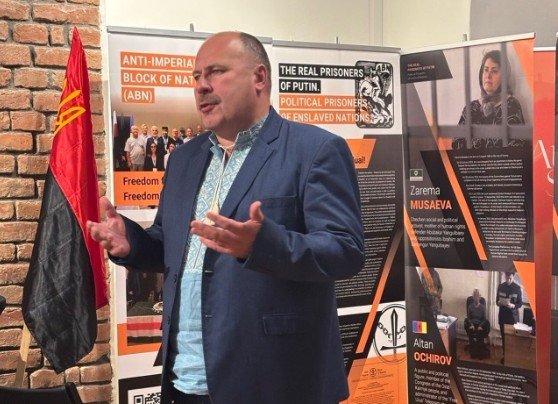
Answer: 3. We received help from virtually everyone we contacted. I’d like to thank ABN, Oleg Medunitsa, and Walter Zaryckyj, who actively supported us as we worked together to find possible solutions. On 7 December, we spoke at a conference in Chicago. Given how many soldiers from Buryatia are fighting in Ukraine, it was important for us to explain the reasons for Russia’s violent policies. Our people are essentially being exterminated, so we must conduct educational activities, especially among the Buryads themselves.
4. Will there be any changes in the work of the Buryat national liberation movement after such an event?
Answer: We hope that with our combined efforts, our movement will grow and develop. We look forward to collaborating with other international organisations and movements, and we wish everyone success in the national liberation struggle! We’ll need it.
Marina Khankhalaeva is the leader of the Buryatia independence movement “Tusgaar Buryaad Mongolia.”