

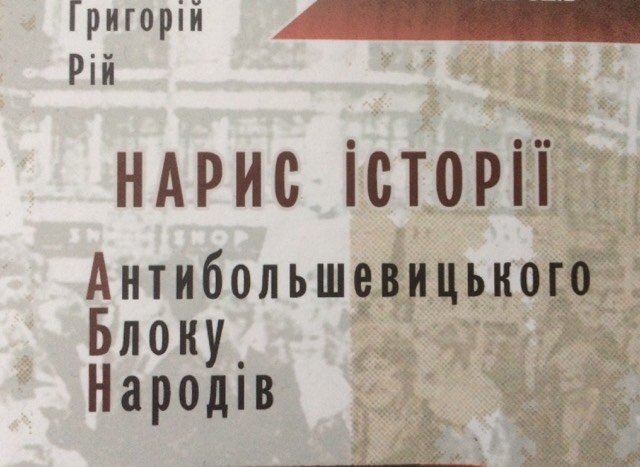
This is exactly what Hryhoriy Riy’s monograph “Essay on the History of the Anti-Bolshevik Bloc of Peoples” is, recently published in Kyiv by the publishing house “Ukrainian Publishing House”. It is one of the few studies that open the veil of the unknown and rich history of the post-war Ukrainian nationalist movement in emigration. And what can we say about the even larger mass of the political history of Ukrainians, scattered by a merciless fate in the worlds, which is inexorably sinking into the abyss of time along with the gradual disappearance of public and political institutions and individuals, each of which is a separate microcosm and a grateful topic for scientific research.
Perhaps ungrateful for that specific type of business that sometimes flourishes so wildly on selected topics of national memory. However, it is extremely important for her, because national memory is a collection of thousands and millions of human destinies, lives and hearts that lived, suffered, fought and created daily great and small feats in the rhythm of one great idea – the liberation of the nation, the building of one’s own state and its preservation through the ages. And they all deserve to take their rightful place in the recesses of her piggy bank.
Banderas emigration like a whirlwind broke into the foreign life of Ukrainians. Formed mainly on the basis of regional youth nationalist structures, OUN (b) had almost no representation outside of Ukraine until the beginning of the Second World War. However, after its end and in the conditions of the continuation of the national liberation struggle against the renewed Soviet occupation, it delegates abroad organized groups of its leading membership and raiding units of the UPA to inform the Western world about the fact of this struggle and to organize appropriate support for it.
In addition, those leading and rank-and-file members of the Bander movement, who proclaimed the restoration of Ukrainian statehood in Lviv on June 30, 1941, resisted the Nazi regime and became its victims, leave German prisons and concentration camps and remain in exile. Together, they create an extensive organizational network and system of public institutions abroad, which soon begin to dominate the public and political life of Ukrainians there.
By the way, it was no less diverse than in Ukraine. Along with the old emigrant organizations, there were also those that moved their structures abroad under the influence of the excesses of the Second World War and the totalitarian policies of the Soviet and Nazi regimes. And also those who started their activities already here. It is natural that they competed with each other and, as is usually the case, fought together against the leader of public sympathies – the Foreign Parts of the OUN, which from 1968 were transformed into a complete OUN of Bandera.
In this context, the characteristics given to the OUN (b) by the well-known liberal Ukrainian historian I. Lysiak-Rudnytskyi are indicative in this context. On the one hand, he did not skimp on sharp and fairly brutal epithets, which is generally uncharacteristic of his academic style, and on the other hand, he admitted that the OUN (b) dominated Ukrainian political life in exile1. It is characteristic that both he and other political opponents accused the Bander movement of totalitarianism. However, when Stepan Bandera, shortly before his tragic death, proposed a detailed project of the Ukrainian Overseas National Liberation Center (UZNVC), the creation of which was envisaged by holding general democratic elections among Ukrainian citizens in emigration, the “democratic” opponents rejected it under all sorts of pretexts2.
A comprehensive history of the OUN and OUN (b) of the emigration period has not been written to this day. At one time, the author, researching the figure of the ideologist and Leader Stepan Lenkavskyi, partially depicted it as an inseparable organizational background of his life and activity3. And how many more such figures, sacrificial and worthy of our respect, remain unknown to the Ukrainian public!? And how rich and equally unknown is the organizational history itself: the development of the organizational network, the provocations of the Soviet special services and the twists and turns of intra-organizational discussions caused by them, the organization of assistance to the underground national liberation struggle in Ukraine, the system of secret communications with the Krai, courier groups to Ukraine, the invisible front of the confrontation between the Security Council of the OUN and the NKVD-KGB, relations with the intelligence agencies of Western countries, pro-Ukrainian lobbying activities among Western government and military circles, mutual political struggle of Ukrainian emigration circles, deployment of subsidiary public structures in various countries of the world, development world coordination Ukrainian centers, etc.
In his monograph, Hryhoriy Rii opened only one of the pages of this rich history, worthy not only of the attention of scientists, but also of the pen of many writers of the historical-adventure genre.
The history of the ABN is inseparable from the history of the OUN (b). She was the initiator of the creation of ABN and the promoter of its development. And therefore, the international activity of the Anti-Bolshevik Bloc demonstrates the main principles, approaches and priorities of the foreign policy of the OUN (b) itself. However, this does not mean at all that ABN was just a subdivision of the organizational structure of the OUN (b). Similarly, as well as the fact that the UPA, although it was also created at the initiative of the OUN (b), fought not for its narrow organizational interests, but for the liberation and interests of the entire Ukrainian nation.
After all, the OUN (b) itself has always declared its supra-party and national character. The doctrine of nationalism in its interpretation and program execution had a meta-ideological character. That is, the idea of national liberation and building one’s own state acted as the core unifying factor that helped to mobilize various political forces for its implementation, regardless of the particularities of their worldview and current political confrontation. It was on the basis of such approaches that the Ukrainian state government was created after the proclamation of the Act of Restoration of Ukrainian Statehood on June 30, 1941 in Lviv.
The book is interesting to read. The author managed to reveal the genealogy of the ABN, to delve not only into its political, but also into its worldview and philosophical background, to show its activity in the context of post-war international politics and world anti-communism, and the diversity of anti-communism itself.
An excursion into the history of cooperation with foreign special services and their efforts to influence the policy of ABN and OUN (b) will arouse considerable interest in the reader. For this purpose, a separate section “American and British intelligence” is allocated in the monograph.
The national composition of the ABN should arouse the same interest. Based on archival documents, the author provides a list of its members: “Finns, Estonians, Latvians, Lithuanians, Belarusians, Poles, Slovaks, Czechs, Magyars, Serbs, Croats, Slovenians, Albanians, Bulgarians, Romanians, Ukrainians, Cossacks of the Don and other Cossack lands, Kalmyks, North Caucasian peoples, Georgians, Armenians, Azerbaijanis, Turkestans (Turkmen, Uzbeks, Tajiks, Kazakhs, Kyrgyz, Karakalpaks), peoples of the so-called RSFSR, Tatars, Bashkirs, Mongolians and other peoples of Siberia and the Far East”. In addition, he gives a detailed description of those organizations that represented them in the ABN.
The book is enriched by an equally diverse source base, which includes the works of German, Finnish, British, American, Canadian, etc. researchers of ABN and anti-communism, recently published secret materials of the American special services. This is important for the modern Ukrainian reader in order to pull him out of the captivity of uncritical self-indulgence and self-limitation with the latest worldview “iron curtain”.
Revealing the concept of ABN, the author naturally touches on the issue of the ethno-national policy of the OUN and comes to the correct conclusion that it was based on the principles of adequacy – Ukrainian nationalists treated other nations and ethnic minorities in Ukraine in the same way as they treated their goal of liberating the nation from colonial enslavement and to build their own national state. “Cooperation with other national movements in the OUN was considered from the very beginning in the context of their attitude to the goals of the Ukrainian movement,” the author notes.
In turn, during the processing of the archives, we managed to come across the interesting thoughts of Yaroslav Stetsk, whose life and activities also await a conscientious and systematic researcher, but who is already in sufficient relief, as the head of the ABN, present in the work of Hryhoriy Roy. Thus, in his capacity as the Leader of the OUN (b), in his instructions to persons authorized to conduct negotiations with Israeli circles sympathetic to the Ukrainian cause, he instructed: “We are for the State of Israel, if the Jews are for the USSD”4.
The author’s authentic use of the terminology brought to Ukraine by the Russian-Bolshevik regime, as well as the equally authentic spelling of the names of its leading figures: “Soviet Union”, “USSR”, “Soviet”, “Andrei Zhdanov”, etc., are original and worthy of praise. Such authenticity emphasizes the occupation-colonial, and therefore foreign, character of this regime. Other Ukrainian scientists, especially the younger generation of researchers, and especially in the field of nationalism studies, should take this approach as an example.
Is the entire multifaceted history of ABN reflected in the monograph of the young researcher? Obviously not. Researchers will come tomorrow with a much deeper analysis of certain pages and even individual facts of its history. But it will be tomorrow… And today the author of the “Essay on the history of ABN” is the first!
Oleksandr Sych,
doctor of political sciences
1 Лисяк-Рудницький І. Історичні есе: у 2 т. Т. 2. К.: «Основи», 1994. С. 437-456.
2 Див.: Бандера С. Перспективи української революції. К.: Наш формат, 2021. С. 487-511.
3 Див.: Сич О. Степан Ленкавський: життєвий шлях на тлі історії ОУН. Івано-Франківськ: Лілея-НВ, 1999. 160 с.
4 Стецько Я. Вказівки на розмову з представниками прихильних Україні ізраїльських кіл. Архівна збірка ОУН в Нью Йорку. 3 арк.
Український погляд






