

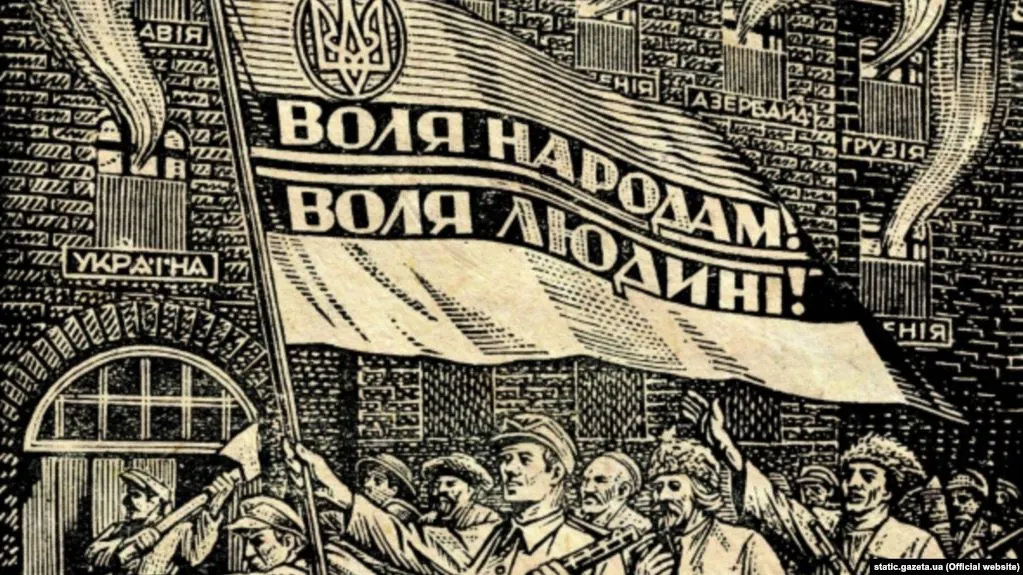
Ukraine is restoring its own geopolitical concept of supporting the nations enslaved by Moscow, which must be implemented by the Ukrainian executive authorities. Thus, this policy should become fully-fledged: representatives of the enslaved nations with weapons in their hands fight for Ukrainian victory over the aggressor and their own freedom and independence, the Ukrainian parliament provides legislative support for the initiatives that need to be regulated, and the executive authorities are engaged in the direct implementation of this policy.
When formulating policy, it is necessary to take into account the experience of previous generations, in particular the 20th century. In general, the question that modern Putin’s Russia is by its very nature an imperial formation is no longer controversial. If this thesis was still discussed after the war in Georgia in 2008 and the annexation of Crimea in 2014, then after the full-scale invasion on February 24, all hopes for a democratic Russia were dashed. It is believed that it was in the 20th century that mankind overcame imperialism by establishing the key principle – the right of nations to self-determination. In the example of Putin’s Russia, we can see how the imperial centres are not completely destroyed and can recover over time, along with the desire to increase their influence on the former territorial possessions. Therefore, the experience of the struggle of enslaved nations against Russian imperialism is important for contemporaries.
A peculiarly Ukrainian idea of the 20th century is the concept of the struggle of enslaved nations, which was formed in the environment of the Organization of Ukrainian Nationalists (OUN) in the 1930s and was de-facto implemented after the Second World War. In April 1946, the Anti-Bolshevik Bloc of Nations (ABN), a non-governmental organization uniting representatives of emigrant communities from Eastern Europe and Central Asia, was formed in Munich. Several key practices from the history of the ABN should be taken into account when forming a modern policy towards enslaved nations.
Experience one: the role of the subject. Ukraine is now defending its internationally recognized borders and trying to regain control over the lost territories as an independent European state. In the mid-1940s, the initiators of the creation of ABN only dreamed of such a state of affairs. It was precisely the joint struggle together with other Eastern European and Central Asian national movements that was supposed to ensure the creation of independent states and thus rebuild the existing political map of the Eurasian continent at that time. “We fought and are fighting not for the change or revision of these or other treatises, but for the basic reconstruction of the map of Europe and post-Soviet Asia, with the revolution of the foreign political order” ((Z[ynovii]. K[arbovych]. Two concepts. /Anti-Bolshevik Block of Nations and “Mezhymorya”/. Liberation politics, 1946), – wrote, in one of the articles, the head of ABN Yaroslav Stetsko.
The role of the target, or the centre of gravity for all enslaved peoples, was to ensure the presence of an armed underground movement in post-Soviet Ukraine – the Ukrainian Insurgent Army (UPA). The idea of creating a united structure for representatives of enslaved nations appeared in the UPA in 1943, when among its fighters were enough non-Ukrainians who needed organizational registration.
Now Ukraine, as once again an independent state, has many units in its armed forces made up of representatives of other nations, including sub-Russian ones. It is known about the armed formations in the Ukrainian army of Chechens (battalion named after Dzhokhar Dudayev, battalion named after Sheikh Mansur and others), Tatars and nations of Turkic-speaking groups (battalion “Turan”), Erzyans (the leader of the Erzyan nation Oleksandr Bolkin (Syres Bolyaen), Karelians and others, including Russians. The loudest event with their participation was sabotage along the line of the Ukrainian-Russian state border in the Bryansk region in early March 2023, for which fighters of the “Russian Volunteer Corps” assumed responsibility. Also, the “Freedom of Russia” legion was created as part of the Armed Forces of Ukraine.
The modern role of the subject must be ensured by the fact that the Ukrainian state grants the right to all those who have the desire to fight against the Russians, and especially to opposition-minded representatives of the nations of the modern Russian Federation.
Experience two: a mutually beneficial format of cooperation. For Ukraine, the desired result is victory in the war, crossing the boundary of its borders and securing them from future threats, while for the representatives of the Russian Federation nations – the overthrow of Putin’s regime and the creation of independent states (Tatarstan, Ichkeria, Ingushetia, Idel-Ural, etc.). It is necessary to guarantee that, in the long term, assistance to the nations enslaved by Moscow will not end with a Ukrainian victory.
On the one hand, cooperation with emigrant groups should be as wide as possible, Ukraine is a platform for all those who want to fight for their right to self-determination, and on the other hand, we need to beware of the appearance of internal disputes that can bring the whole idea to a dead end.
Conceptually, the ABN included in its composition all and even representatives of different political groups of one national movement, which should, according to the leaders of the bloc, reduce contradictions between representatives of different groups and currents and ensure the inclusion of the widest possible circle of representatives of peoples enslaved by Moscow. As a result, this led to the appearance of internal disputes, and in 1954 it even led to an internal split, when some members of the ABN left the structure. This process was not without agency influences, which successfully played and used the ambitions of some leaders of national groups.
The Ukrainian state should focus on those émigré communities of nations enslaved by Moscow that have direct contact with and support from representatives of the national armed forces of the Armed Forces of Ukraine.
Experience three: it is necessary to reject disputes regarding the forms of spatial organization after the disintegration of the Russian Federation. I mean here that Ukraine will not propose any forms of geopolitical associations for post-imperial Russian territories. The defining condition for now is the observance of the principle of the right of nations to self-determination and the observance of the ethnographic principle when forming the borders of newly formed states.
In November 1947, representatives of the ABN, the Melnyk International of Freedom and the Polish organization “Prometheus” united in the Anti-Bolshevik League of Nations’ Liberation. The structure did not last long, never fully functioning precisely because of internal conceptual disputes. “Prometheism” is a strategy that arose at the beginning of the 20th century in the midst of the Polish national movement and especially developed during the period of existence of independent Poland in the 1920s and 30s. In fact, the Poles tried to weaken the enemy and secure their own borders by supporting the nations enslaved by the Bolsheviks in their struggle. The name comes from the ancient Greek god Prometheus, who gave fire to humans by stealing it from the Olympian gods. The future geopolitical concept after the success of the “Prometheus” strategy was to become the doctrine of “Mizhmor” (Medisees), where Poland took the main role.
It was precisely the disputes over this future doctrine that undermined the foundations of the unification. Stetsko believed that “Intermarium” is not a concept of struggle, but only a formula for the future structure, the structure of the forces of non-existent states, which is territorially very narrow today, because it does not take into account all the enslaved peoples of the USSR. It is a Polish national concept…” (Z[ynovii]. K[arbovych]. Two concepts. /Anti-Bolshevik Block of Nations and “Mezhymorya”/. Liberation politics, 1946).
It is also important to note that the key slogan of the ABN became “The will of the nations, the will of the people”, which meant the equality and democracy of all participants in the common struggle of the enslaved nations. It directly contradicted the strategy of “Prometheus”, where the “fire of freedom for the enslaved nations” was to be “carried” exclusively by Poland.
I give this example here not as a criticism of the modern cooperation between Ukrainians and Poles. Undoubtedly, Ukraine should cooperate with all states that share and support our struggle against Russia. Rather, this is an example of how disputes about the future geopolitical arrangement can become a stumbling block for the formation of a fully-fledged association pursuing essentially the same goal.
The most important experience from the history of ABN is patience and readiness to act at the right moment. The Secret Report to the US National Security Council of 1950 No. 68 predicted that in order to win the Cold War, the US had to promote the emergence of “the nations of Russia attitudes that could help to change the current behaviour of the Soviets, and create conditions for the revival of the national life of groups that demonstrate the ability and determination to achieve national independence and keep it…” (p. 62). This idea received its final embodiment 40 years later, when the USSR collapsed.
Therefore, now there is no need to make predictions about when and how Putin’s Russia will collapse, but to take planned actions to shake its foundations and support the aspirations of enslaved nations for independence. Ukrainian policy regarding interaction with the national movements of small and indigenous nations of the Russian Federation should be based on the fact that, through our own armed forces, we provide the opportunity for everyone to oppose the Russians in Ukraine and thus fight for their own freedom, we do not seek geopolitical hegemony in the arrangement of a disintegrated Russia, and we guarantee long-term support to representatives of enslaved nations. Given the history and experience of the ABN, it is already worth determining one’s attitude towards the Russian nation-state, which will encompass Russian ethnographic territories, which can also become another source for discussions.
Hryhoriy Riy, historian, researcher of modern history of Ukraine and the Cold War, author of a book on the history of the Anti-Bolshevik Bloc of Nations
Note: for a quick information search please subscribe to our Telegram channel “Freedom for Nations!” https://t.me/ABN_Freedom_for_Nations
Also, read the Facebook materials of the ABN page and the group
Our site: https://abn.org.uaen/






