

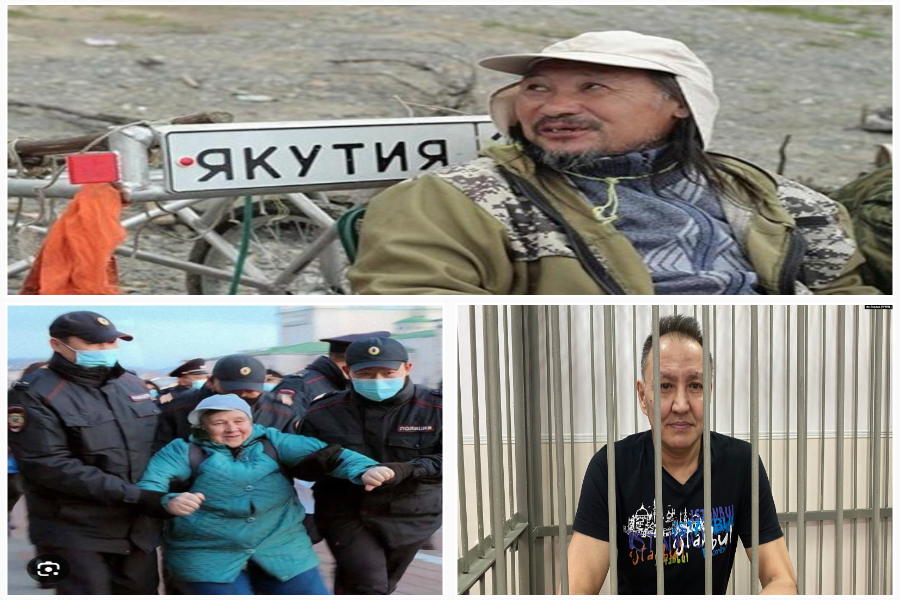
Freedom for nations – freedom for man! This universal, fundamental principle, based on the recognition of freedom as an indisputable value, is a determining factor of the fair democratic development of society. We are talking about individual freedom and collective freedom, according to which every people, every nation has the right to create its own state, and each person is able to perform actions that he considers necessary. This principle underlies the national liberation struggle of enslaved nations for freedom and the acquisition of statehood.
Nevertheless, for many centuries Russian rulers have always denied the right of enslaved nations to fight for their own independence and have cruelly dealt with their political opponents. This was the case during the time of the Muscovite Kingdom, the Russian Empire, during the period of the USSR and it remains so to this day. Vladimir Putin, like his predecessors — Yeltsin, Andropov, Stalin, Lenin and others, does not recognize the right to dissent and protest. The modern state and political entity, the Russian Federation, is ruled by an authoritarian regime. There is no real democracy, no freedom of speech and conscience, dissent is contested and opposition persecuted, while all dissenters are thrown into prison.
The trigger for the increase in political persecution was the full-scale invasion of Putin’s troops into Ukraine. The war became another tool for the Kremlin dictator to deal with opponents. Since February 2022, there has been a significant increase in the number of criminal cases in which speaking against military aggression in Ukraine is qualified as the main crime: public actions, individual pickets, posts on social networks or conversations in the kitchen.
According to the estimates of the independent human rights project “Support for political prisoners. Memorial”, which collects, studies and systematizes information about illegal criminal prosecutions from political motives on the territory of the Russian Federation, by the middle of 2024 the Kremlin’s general list of political prisoners consists of over a thousand people. Political prisoners in the modern Russian Federation are made up of various people. Among them are those who are persecuted for “political” articles of the Criminal Code, and are falsely accused of criminal, not political crimes. There are public and political activists who are persecuted for their activities, and there are those who get put behind bars for participating in a scientific exchange of information or reposting on a social network. Among the political prisoners, a large contingency consists of those who were persecuted because of their religious beliefs and views.
Some people became hostages, that is, deprived of their freedom because they refused to slander others or to influence their relatives and friends, or are accidental victims of the state’s repressive mechanism.
Among political prisoners, there are many steadfast fighters, whose courage in difficult conditions of captivity, and sometimes under torture, commands respect. Most of them are those who condemned the armed aggression of the Kremlin and supported Ukraine.
A special place in this list is occupied by representatives of national liberation movements of enslaved nations. These are activists from the North Caucasus (Chechnya, Ingushetia, Dagestan), Idel-Ural (Bashkortostan, Tatarstan, Chuvashia, Mari El), Far East (Sakha-Yakutia), Buryatia, Khakassia, Oirat-Kalmykia and other regions.
It is the latter who are Putin’s real political prisoners. After all, in addition to a demand to stop the war, they proclaim the idea of the right of their own nations to self-determination and freedom, i.e. separation from Russia. And this scares the Kremlin leader the most. Putin perfectly understands that after release, they would have every chance to lead the national liberation struggle of their people. That is why he does not offer them to the existing “lists for the exchange” of prisoners or captives, trying to destroy them morally and physically behind prison bars.
At the beginning of August 2024, the Anti-Imperial Bloc of Nations in its Address to the Leaders of the Western world and human rights defenders emphasized the need to fight for the liberation of political prisoners of the Kremlin, who are leaders and activists of national liberation movements of the enslaved nations. A list of the most bitter enemies and opponents of the Russian leader was formed, those who are persecuted or in prison. This, in the first instance are Zarema Musaeva, Altan Ochirov, Natalia Filonova, Aikhal Ammosov, Airat Dilmukhametov, Parvinakhan Abuzarova, Fail Alsynov, Alexander Gabyshev, Zarifa Sautiyeva, Mikhail Afanasyev, Azat Miftakhov, Ramilya Saitova, Rustam Fararitdinov and other political prisoners of the Kremlin.
The stories of their struggles, resistance and wanderings are different, but they are all united by what they suffered in the struggle for truth, justice and the right to freedom.
It is important that the civilized world knows these names and realizes the need to exert maximum efforts for their liberation, as well as for the liberation of their freedom-loving nations from under Moscow.






