

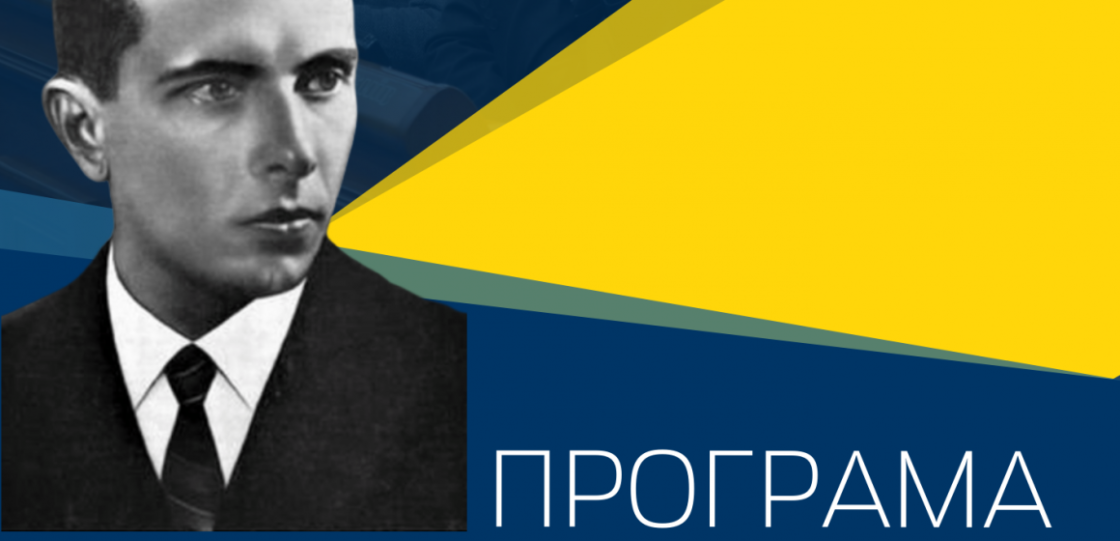
Today is the 115th anniversary of Stepan Bandera’s birthday.
This year also marks the 65th anniversary of his assassination as a result of an assassination attempt organized by the Soviet occupiers.
Why does Stepan Bandera still remain the main target of hatred of our enemies?
Why is his name still heard with hatred and fear on their lips?
At the final press conference from hell among the Ukrainian people, the devil from the Kremlin mentioned only the name of Stepan Bandera.
What are they so afraid of?
After all, he was killed a long time ago.
All the occupiers sentenced him to death, but he is “alive”.
Nurtures new people, followers of Bandera.
He instinctively became a guide for all free Ukrainians.
Or only for his impeccably biblical biography?
Or is it because, despite all attempts to kill him, he lives on? His campaign is alive.
Or is it because he taught Ukrainians never to bend on the way to victory?
We are all still in the grip of his biography. But for an idealist like Stepan Bandera, the idea is higher than life. And it is impossible to physically kill an idea.
He was a fantastic visionary. A brilliant analyst.
If we had carefully read his works, if we had learned from the experience of his predecessors, everything would have been a little different.
And this is how we learn lessons with blood.
And yet I want you to discover Bandera in a new way.
A few years ago, “Our Format” published a collection of his works “Perspectives of the Ukrainian Revolution”. Because they were never read not even by enemies, but sometimes even by supporters.
Today, I will present only a short selection of Stepan Bandera’s maxims regarding the Russian-Ukrainian war, which he predicted, and most importantly, explained in a reasoned and logical way how to achieve victory.
Therefore, think like a Banderite, act like a Banderite – and victory will surely come!
So, a short Bandera quote book.
 Russia, with its deep-rooted, and in the modern age, the most inflamed invasive imperialism, will rush at Ukraine in every situation, in every condition, with all its forces, with all its ferocity, in order to keep it as part of its empire or to enslave it anew. Both the liberation and the defence of Ukraine’s independence can basically rely only on Ukraine’s own forces, its own struggle and constant readiness for self-defense.We also need to have as many and the best allies as possible in our liberation struggle, and above all real ones. And Ukraine can have them. But only when she herself will fight and when she herself will be strong.”
(A word to Ukrainian revolutionary nationalists)
“Our allies are first of all those nations who were in the captivity of Russian-Bolshevik imperialism and are fighting against it for their own life and freedom and are sympathetic to the independence and unity of Ukraine.”(A word to Ukrainian revolutionary nationalists).
“The struggle for the state independence of Ukraine is a struggle against Russia, not only against Bolshevism but against every invasive imperialism inherent in the Russian people… If Bolshevism is replaced by another form of Russian imperialism tomorrow, it will also first of all turn with all its might against the independence of Ukraine, to its enslavement…”(“Ukrainian National Revolution, not only anti-regime resistance”)
“For us, the question can only be this way: should we continue the unceasing struggle for the freedom and life of the nation against Moscow imperialism, enslavement and extermination, or, perhaps, succumb to it and go unhindered to the death of the nation, to the return of the people in the heat of the further growth of Moscow imperialism?”(Another illusion of peace)
“When one of the two sides is waging a war, then there is already a war, whether the other side wants it or not. (…) The war was going on and is still going on because it is being waged by Moscow all the time. There is no choice between war and peace. The only question is: in what forms, in what sizes, when, and where are the individual stages played out, shades of that permanent war of Moscow?(Another illusion of peace)
“Ukraine, taking into account its geopolitical location, can only gain and maintain its independence by its own forces, by its own struggle. At the same time, it will carry out an important mission of wider significance for other nations as well, implementing and defending the universal slogan: “Freedom for the nations, freedom for the people!”.“There is only one Russia—imperialist, and it will be so until Russian imperialism is thoroughly destroyed, and the Russian people are not cured of it through the knowledge that their imperialism brings them the greatest harm—sacrifices, suffering, and downfall.”(The Third World War and the liberation struggle).
“The struggle will not stop until the full realization of our goal, which is a complete break between Ukraine and Moscow, the rebuilding of the Independent Unified Ukrainian State, the collapse of the USSR and the construction of independent national states in post-Soviet Europe and Asia, the complete defeat of Russian imperialism and the creation around Russia a closed system of states within its own borders, such that it could no longer engage in imperialist aggression.”(Ukrainian national revolution, not only anti-regime resistance)
“In order not to provoke an all-out military reaction of the West, Moscow will probably use tactics of concealment and reduction of their scope and severity in igniting military conflicts. Such tactics correspond to the strategy of gradual imperialist expansion and conquests of Moscow. It has many possibilities in its application. A typical example of such tactics is that Moscow does not officially engage in the war provoked by it, but only conducts it indirectly, through the hands of its satellites or the so-called “volunteers”. Moscow’s direct, overt participation in the war can be masked by supposedly “humane” motives for armed intervention.The latest weapons also impose on large, regular armies the need to get closer to guerrilla tactics than to positional warfare. In particular, it will be necessary to avoid large concentrations of troops, operating with fairly independent military units. New wars that will be fought under the sign of thermonuclear weapons, even if only under the threat of their use, cannot have front lines of the old type. They will be characterized by abrupt and very mobile, but extremely deep fronts. The border between the front and rear zones will often be blurred, only at long distances, in depth, will the differences between them be noticeable. This applies to the grouping of military forces and combat operations themselves.
(“THE QUESTION OF ATOMIC WAR AND THE LIBERATING REVOLUTION”)
“The Western nations face the same inevitable fate as we do, to fight with Moscow in defence of their independent existence. Only with us, this completely clear situation appears in the most acute, direct form, and with them, it is not so clear, not so sharp.”(Another illusion of peace)
“The Bolsheviks are desperately trying to turn forced tactical concessions into a successful means of further expansionist policy…(“Moscow’s constant strategy”)
“…this is no peace, but only the passive attitude of the Western states to the Bolshevik war against the whole world, against the freedom of nations and the human being. Such a “peace” is an indulgence in the Bolsheviks’ constant offensive in various forms and various shades.”(Another illusion of peace).
“We have already noted that the current moral-political and military state of the West and the balance of power do not give reason to hope that the Western states will take the initiative in the further development of the international situation. In particular, in the issue of the war with the USSR, it is difficult for them to get out of the blind spot and manage to take decisive steps. This requires significant changes. Even when the Western powers are drawn into a military conflict by the Soviets, they will try to limit it to the smallest possible dimensions. This applies not only to the territorial scope and severity but also to the intended outcome of the war. The Western states will first of all try to end every military conflict with a compromise with Moscow, if it is possible, without too painful losses.(“THE QUESTION OF ATOMIC WAR AND THE LIBERATING REVOLUTION”).
“” “If, for example, Ukraine were to break away from the Russian Empire, and Kazakhstan or the nations of the Caucasus remained part of this empire, it would be tantamount to the fact that the sovereignty of the Ukrainian nation and state is in great danger from Moscow’s imperialism.”(Front of Enslaved Nations)
“Western peoples do not have a true idea and true assessment of the actual situation in the territories occupied by Moscow. … In the West, they see only Russia. Some do not know at all or know very little about the fact that it conquered many nations with military aggression and violently dominates them, who have not reconciled and will never reconcile with that enslavement. Others, although they know something about the multinational composition of today’s USSR, still have in mind almost exclusively the Russian people as the only relevant factor. The nations enslaved by Russia are mostly interpreted in the West not as fully-fledged and self-aware nations competing for their independent life, but as ethnic tribes that are only passive objects in the hands of Moscow.”(Third World War and liberation struggle).
“All this would be impossible if the Western world did not accept and spread the illusion that the Russian nation and Bolshevik imperialism are two separate things, that the Russian people are not the bearer, but only the victim of the latter.”(Third World War and liberation struggle).
On the occasion of the 115th anniversary of the birth of Stepan Bandera, the Ukrainian Studies of Strategic Studies traditionally organizes 11 Bandera Readings: Liquidation of the Russian Empire .
Comment, share and don’t forget to support Bander Readings! Of course, if you have already donated to the Ukrainian army.
PayPal: yuriy.syrotyuk@svoboda.org.ua Yuriy Syrotyuk






