

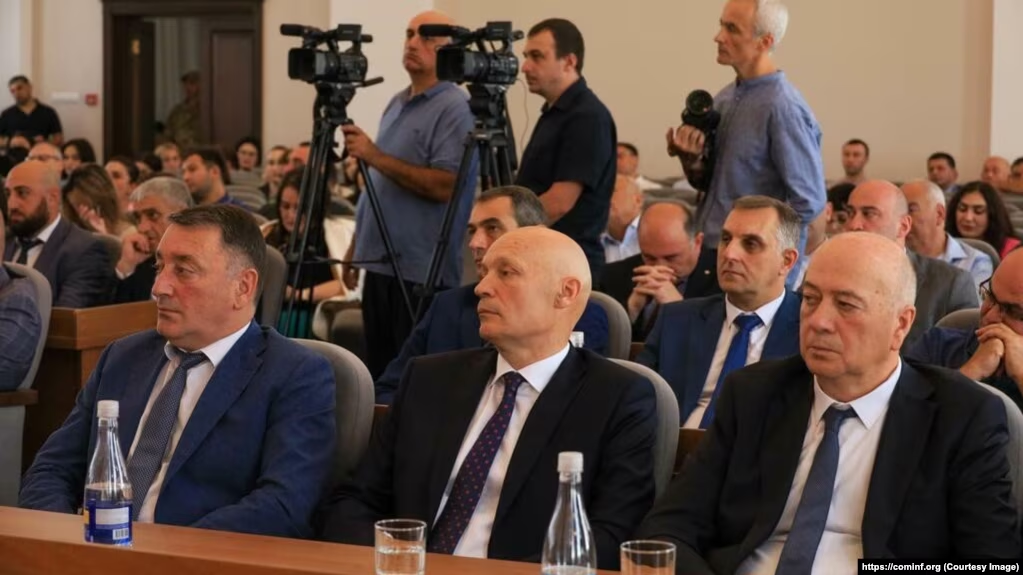
The first session of the newly elected parliament of South Ossetia did not immediately attract attention. At first, public attention was limited to information about the decisions made – the chairman and three vice-speakers were elected. But later it suddenly became clear that the local television company’s report was much more informative than the dry summaries of the event: facial expressions and the tone of the speeches indicated that the participants in the event clearly did not feel like winners of the people’s trust contest.
The first session was opened by the Chairman of the Central Election Commission Emilia Gagieva. Nothing was inspiring about her speech:
“Thank you to the voters for not standing aside, coming to the polling stations and voting. This again confirms the desire to form a strong, prosperous rule of law state. I would like to express special gratitude to international observers from Russia, Turkey, Abkhazia, Hungary and, of course, to our colleagues from the Central Election Commission of Russia and Abkhazia, who took the time and once again showed high professionalism and objectivity. Thanks to all members of precinct and district election commissions, and executive authorities, on whom depended the coordinated work of preparing and conducting elections to the parliament of the eighth convocation. We hope that the new parliament will work for the benefit of all the people of South Ossetia. I am confident that only with the participation of all political forces and active interaction with the population can the prosperity of South Ossetia be achieved.”
No congratulations on the election, no word about the legitimacy of the polls. As a rule, a member of the Central Election Commission is not expected to express his views on the republic’s prospects, but first of all to declare, as an official responsible for organizing and conducting the election process, that the elections were held without violations that could affect the expression of the will of South Ossetian voters. In other words, they were expecting confirmation from her that the people’s delegates had gathered in the hall and not comrades whose right to be there was questionable.
The expression of hope that the parliament will work for the benefit of the people of South Ossetia – isn’t it a slap in the face to those present? No “we are confident” or “does not raise doubts”, but “we hope…”. As if, despite everything, hope dies last…
“These elections showed the extent of the fall of the republic”
Emilia Radikovna coined words without a shadow of solemnity. She did not look into the hall; in those moments when she turned away from the text, her indifferent gaze wandered along the walls over the heads of those gathered. The way she carried herself gave the impression that the chairman of the Electoral Commission considered it inappropriate for her to be in this room. Still, she did not sign the final protocol of the elections, indicating in her dissenting opinion that the vote count was adjusted to the desired result.
Other participants in the event also showed no signs of high spirits. The president looked gloomy. Alan Gagloev spoke in Ossetian, even though the Russian ambassador to South Ossetia, Murat Kulakhmetov, was present in the hall. This is also a sign that the speaker’s words are for domestic consumption, and not for the general public.
Gagloev’s statement that all participants in the election campaign were of equal status clearly did not elicit approval from the audience. In another situation, the deputies would have greeted his words with applause, as another success of the young democracy. But not this time.
Murat Kulakhmetov also did not look like a participant in the ceremonial event. Even the deputy from the Leningorsky district Zaza Driyaev, who showed the most impressive result in the majoritarian elections – two hundred more voters voted for him than live in the district, did not show any signs of optimism.
The celebration was clearly spoiled by the demarche of United Ossetia, which did not show up to parliament in protest against the unfair elections. But that was not all. The session, or at least the part of it that was edited in by television, seemed to sense the inferiority of what was happening. As if it had suddenly become clear that the crown was plastic, that the courtiers were mummers, that the kingdom was not real. No one understood what to do about it. There is no cure for illegitimacy.
Dividing briefcases until the end of the fight
According to insiders, before the session, Alan Margiev tried to persuade Atsamaz Bibilov to come to the parliamentary session, but he refused. The reason is clear: to take part in the session after all the statements about unfair elections would mean losing face.
“United Ossetia” will, of course, return to parliament, but first it will go through all the courts and force the Prosecutor General’s Office to express its opinion on the violations established during the elections. The decisions of the courts are predictable, as can be judged by the Supreme Court not allowing three parties to participate in the elections, without a single clear argument for refusal. But “United Ossetia” will leave no stone unturned in the legitimacy of the executive and judicial branches, after which it will return to parliament with approximately the following words: “We do not consider you a legally elected legislative assembly, but we have obligations to voters that we cannot ignore. We are obliged to protect their interests.”
Another observation from local speakers is the false start of the technology that Gagloev used in the parliamentary elections instead of saving it for the much more significant presidential campaign. He played his trump card ahead of time. The success of the technology was largely due to two things. First, no one expected such a scale from Alan Eduardovich (the disappearing ink alone is worth it). Secondly, no one took “Nykhas” seriously. The main contenders, the People’s Party and United Ossetia, were focused on each other, while little attention was paid to the “party of decent people”.
The presidential elections will be different, opponents will not allow such tricks anymore. This is the main mistake of the winners.
The text contains toponyms and terminology used in the self-proclaimed republics of Abkhazia and South Ossetia
We do not disclose the names of the authors of this publication due to the threat of criminal prosecution under the law on undesirable organizations in Russia
Эхо Кавказа





