

On March 17 in Russia, a farce called “the election of the President of the country” was supposed to legitimize Putin’s reign, providing him with an unprecedentedly high result and voter turnout. And to witness stability in the country. This is in contrast to Ukraine, where President Zelenskyi’s term of office expires in May, and martial law does not allow for another election.
In a country where democratic and competitive elections have not been held for a long time, in the conditions of military aggression against Ukraine, “sovereign elections” should, according to the Kremlin’s idea, have a referendum character and legitimize the government’s decision with an alleged popular expression of will. At the same time, this is also a way to smear Russian society with collective responsibility for the aggression against Ukraine and the Cold War with the West. Something like the meeting of the Soviet Union of the Russian Federation on February 21, 2022, when Putin forced the members of the Soviet Union to take collective responsibility for the crime under a live recording.
In the conditions of complete cleansing of the political space, absence of free media and any civil liberties, and total control over the situation in the country, the task would seem simple. Exceed Putin’s support for the 2018 presidential election and voter turnout. At that time, Putin received 76.69% of the vote, compared to 67.54%.
Support should now reach 90%.
To create the appearance of political competition before the elections, they decided to admit three more candidates – representatives of parliamentary parties, who will generally repeat Putin’s rhetoric, simultaneously taking votes from each other. Such candidates were Zhirinovsky’s non-charismatic replacement from the LDPR, Leonid Slutskyi, the CPRF candidate, 75-year-old Nikolai Kharitonov, a member of the State Duma and a convenient sparring partner who promised not to criticize Putin. Vladislav Davankov, the vice-speaker of the State Duma from the “New People” party, is also registered and is supposed to testify to the alleged rejuvenation of the Russian gerontocracy, which has been ruling the country unchanged for more than a quarter of a century.
For at least minimal legitimacy of the elections in the eyes of democratic states, Putin needed a candidate with liberal views, a kind of “whipping boy” who would propose ideas unacceptable to society, say general privatization and liberalization, recognition of the rights of sexual minorities, and so on. Grigoriy Yavlinskyi and Ksenia Sobchak applied for this position in the last elections. Since they refused, Boris Nadezhdin, a TV freak, former deputy of the State Duma, who was a frequent participant in popular talk shows on Russian television, changed his party affiliation several times, without a powerful party behind him, should have become such a candidate for whipping and spreading unpopular theses.
But something went wrong. As in the case of Prigozhin’s march in the summer of 2023, when it turned out that the system is so fragile that from the Ukrainian border to Moscow, no one could stop the armed gang of Putin’s former cook, who was also welcomed by the population; and now the intention to run for office in the elections of a candidate who directly condemns Putin for the so-called SVO unexpectedly received the effect of a snowball that is uncontrollably rushing across the country in the direction of the Kremlin and can have devastating consequences for the regime of “sovereign democracy”, where there is no sovereignty of the people, no democracy, never was. It was believed that Nadezhdin, who does not have an extensive network and at the last moment received the support of the little-known Civic Initiative party, the party from which, with the agreement of the Kremlin, Ksenia Sobchak ran in 2018, would withdraw from the race at the moment of collecting signatures. But unexpectedly, the opportunity to have a legitimate candidate with an openly anti-war and anti-Putin agenda in the elections pushed the entire non-parliamentary opposition to call for support for Boris Nadezhdin. F or a candidate who, according to the Kremlin’s calculations, would not even be able to pass the signature collection sieve, huge queues of citizens lined up all over Russia, who, despite the bad weather and frost, waited for hours to vote for the opposition candidate.
The closed polls of the Kremlin immediately proved that the anti-war candidate who comes in second place at the start of the race, gaining already about 10% of the votes, can take the entire anti-war electorate, the number of which is growing rapidly.
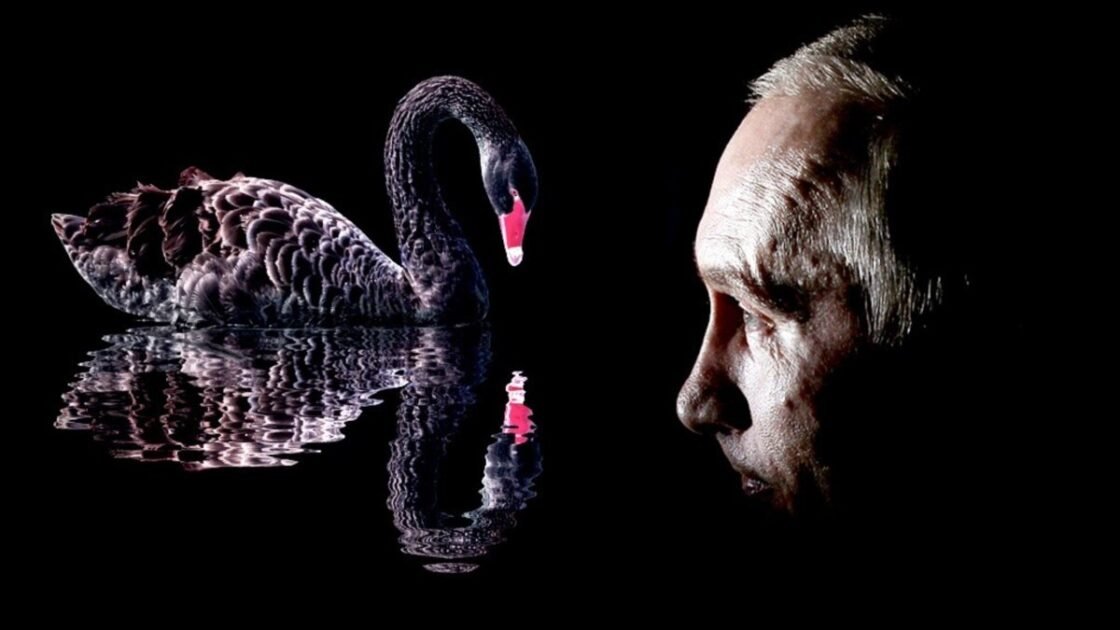
Therefore, a black swan flew into the iron-and-concrete system of the theatrical production of elections, which proved how fragile, inflexible and non-competitive the current system and its actors are.
Now the system has no choice but to leave Nadezhdin and the anti-war rhetoric behind the legitimate elections. The CEC has already announced that the candidate, who unexpectedly became one of the favorites in the race, lost 15% of the collected signatures, and therefore he will be denied registration. However, this pyrrhic victory will have further consequences. Society will see that Putin is afraid of the slightest competition and that his “100% support” is a drawn straw house. A society that cannot legitimately speak out against the war and Putin’s policies will become even more alienated.
Acting actors will also receive the signal. “Akyela” is weak, toxic and can drag everyone down.
Deprived of a voice, enslaved nations will try to use the weakness of the system to radicalize their struggle.
Until it has tangible results in the fields. Protests are impossible in Russia, the monopolized information field will grind Nadezhdin to dust, and he, in turn, will rather play along with the system than challenge it. But the sediment will remain. And the legitimacy of the elections has finally been put to the test.
Bread has already been taken away from society, now it has been deprived of spectacle.
Russia faced the problem of a lack of experience in electoral competition, and therefore a legitimate transfer of power. Eternal Putin, who has ruled the country for the last 25 years (Russians were born, grew up and married under him), cannot challenge old age. In the country, there is simply no idea and practice of transferring power (except for the well-known feint, when the temporary president of Russia was “pound” Medvedev), there is no possibility to influence the correction of the course of power through elections, hopes for changes are buried by war, crisis and aging gerontocrats.
The falsification of elections in the occupied territories, not recognized by the world community, will not add, but will undermine Putin’s legitimacy abroad.
The build-up of social and national tension will sooner or later lead to a blind riot, always “pointless and merciless” in Russian conditions. Part of the elite also understands this. And so the presidential election, which was supposed to be a symbol of the unity of the people and support for Putin’s policy, has already turned into a miserable fiasco.
The black swans are rushing towards Putin with their keys, and it is only a matter of time when and in what way the country will be torn apart.







