

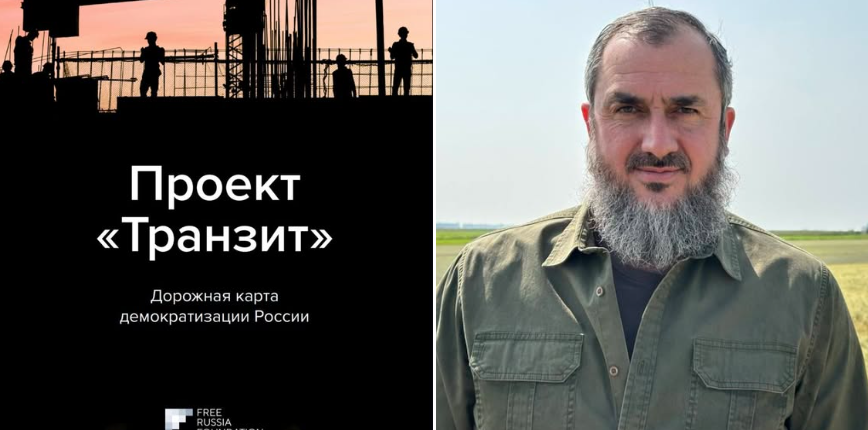
The roadmap for Russia’s democratisation was published by the Free Russia Foundation, which finances many anti-Putin oppositionists, known as “good Russians.” Navalny, I. Yashin, and V. Kara-Murza, who collaborate with the Free Russia Foundation, remained silent, adapting in Europe, yet their position remains unchanged, preserving Russia’s imperial foundations under a democratic banner.
Therefore, I was not at all surprised by the text of the roadmap from the Free Russia Foundation for a “democratised Russia”: “The ethnic model of federalism is based on the recognition of special rights of national minorities, which inevitably leads to the restriction or even oppression of the interests of the majority. However, such an approach may be a reasonable price for minimising the centrifugal pressure on the state from ethnic regions. … The ethnic model is the price that will have to be paid to preserve the integrity of the country.”
This is the height of cynicism. The “poor” Russian majority is making a “sacrifice” to the world community, paying the price of an “ethnic model of federalism” and calling it the democratisation of Russia. And the people asked whether they needed this form of federalism? The answer is obvious – no. Otherwise, they would not have set the goal of “minimising centrifugal pressure on the state from ethnic regions.”
Besides, who said that the proposed “special rights” of national minorities will be respected? Who will force Russia to respect them while preserving its imperial power? The Russian Federation under Yeltsin also signed a federal agreement with national regions, which “guaranteed” their rights, and never respected them for a single day. The communists formally created a Union, which was never a union, and “guaranteed” rights. It has always been this way in Russia. Do they want to pull this old trick again?
The main thing is that the roadmap of the so-called democratised Russia does not consider any other options. However, the enslaved peoples do not want to have any form of federation with Russia, neither ethnic nor any other. And what then? Again, the old proven imperial method – forcible inclusion in an “ethnic” federation? And where is democracy then in this new federation? This proves that democracy in Russia, while preserving its integrity, is impossible: it will be able to keep the conquered peoples and its territories under real democracy, and not its imitation.
The “good Russians” have convinced themselves that the world is not ready to accept the collapse of Russia, and extrapolate this desire of theirs to the enslaved peoples as a firm and unwavering decision of the collective West. But is this so? Today, this is not the case. Alternative options are being considered. Russia, by preserving and exploiting the conquered ethnic regions that provide it with the lion’s share of useful resources, has carried, carries and will carry a real threat to the stability of world geostrategy.
In early May, I compiled my analysis of the future of the post-Russian geospace and sent it to the President and Secretary General of PACE, as well as to other international bodies. I offer it to your attention.
* * *
The Russian threat to the European Union and world order, the need to prepare for the peaceful decolonisation of Russia
Introduction
Russia’s modern borders, inherited from the Soviet Union and the Russian Empire, create a unique geopolitical situation in which the country cannot help but be a constant potential threat to all of Russia’s neighbours on its perimeter, including the European Union (EU). In this analysis, we will examine the reasons why Russia will always pose a threat to its neighbours and the EU, and the need for Russia’s decolonisation as a way to address this problem.
1. The ideology of great power in Russia has historical roots
Russian statehood initially emerged as an aggressive military formation and throughout its historical development has waged aggressive wars of aggression and expansionist policies. The ideology of great power and national superiority over the rest of the world has been rooted in the consciousness of society and politics of the country over the centuries of Russia’s imperial history. It implies a desire to restore influence in the post-Soviet space and beyond. This ideology leads to an aggressive foreign policy aimed at expanding Russia’s influence, which contradicts the interests of neighbouring countries and the EU, threatens the security of the region and can lead to conflicts.
Imperial Identity:
Russia has long been an empire, and many Russians continue to see themselves as heirs to a great power. This creates a mentality that justifies aggressive actions against neighbours.
Geopolitical rivalry: Russia’s desire to restore its influence in the post-Soviet space creates conflicts with neighbouring states that seek integration with the EU and NATO.
2. Threats to the European Union
Russia, possessing significant resources through the colonial exploitation of national republics under the pretext of protecting a huge country, will always maintain a large army. Russia, with a powerful army that periodically goes to war, and a political establishment with an invariably militaristic ideology, will always be a threat to the stability and security of Europe.
Military operations:
The wars in Chechnya, Georgia, Syria, and Ukraine, and the military presence in Central African countries, demonstrate Russia’s willingness to use force to achieve its goals. These actions undermine the foundations of international law and could lead to an escalation of conflicts.
Hybrid wars:
The use of cyberattacks, disinformation and economic pressure creates instability in EU countries, which can undermine the unity and security of the Union.
Destabilisation of public order in EU countries:
The use of emigrants and agents of influence to destabilise public order, the bribery of politicians at various levels and journalists of well-known European media outlets as another manifestation of Russia’s aggressive policy towards neighbouring countries is also an existential threat to the stability of the EU.
3. The need for decolonisation of Russia
Decolonisation of Russia implies a review of its internal structure and relations with regions that were historically part of the empire. This could reduce the level of aggression and create a more stable political environment.
Self-determination of peoples:
Supporting the rights of self-determination of national republics, such as Chechnya, which have historically sought independence and fought for it, dismantling them by national republics can reduce the tension in the internal political field of modern Russia and reduce its external aggression.
Democratisation:
The elimination of authoritarian regimes and the transition to more democratic forms of government may lead to a decrease in militaristic sentiment.
4. Fears that the Russian opposition instils in the international community to preserve the imperial format of the Russian state
To keep Russia within its imperial borders, the anti-Putin opposition exploits in international institutions the thesis about the unforeseen consequences of the threat of Chinese expansion and the spread of Russian nuclear weapons during the collapse of Russia. The same myth existed before the collapse of the USSR. However, given global political changes, there is a possibility that new states in the Far East, Siberia, the Volga region and the North Caucasus will find themselves under the protection of leading powers.
Nuclear arsenal management:
In the event of the collapse of Russia, the governments of the new countries themselves will have an interest in ensuring that nuclear stockpiles are in a safe state for their nations under the supervision of international regulatory authorities.
Protectorate of leading powers:
New states formed on Russian territory can seek protection from the US and EU and transfer nuclear weapons to them or return them to Russia, which will ensure their security and reduce the likelihood of conflict.
China’s expansion:
Under the protectorate of the world’s leading powers, China will not be able to expand into the new states that emerged during the collapse of Russia. There is also no threat of China’s influence expanding into new states that, wary of its expansion, will prefer political and economic relations with the West and its allies, Japan, South Korea, and Taiwan.
Conflicts of interest:
By adhering to international agreements, China will be able to become one of the protector states in the region. Otherwise, it will be isolated from influencing the newly created states in the post-Russian space. China’s open expansion threatens it with consequences. Otherwise, Taiwan, as well as economically underdeveloped Mongolia with its vast territories and small population, would have long been absorbed by China.
5. Updating Russia’s facade will not remove its threat to peace and the EU.
In the event of a hypothetical coming to power of the current anti-Putin opposition, the world will receive a new version of Russia on the old, age-old imperial principles under a democratic banner. The Russian opposition continues to think within the framework of the imperial paradigm. The set of arguments does not characterise it as a democratic opposition. It looks like a group competing with the Putin regime, intending to change the political elite while preserving the imperial basis with a new, outwardly decent facade of the state.
The problem is not only with Putin himself, but also with the electorate, whose imperial demand he has satisfied with his authoritarian rule. Whoever, whatever party, succeeds Putin, they will have to reckon with a chauvinistic population. So we need a truly democratic opposition, ready to fundamentally change the foundations of Russia and accept the disintegration of Russia into national republics.
Democracy is a priori impossible in Russia, with the desire to preserve imperial conquests: What to do with the right of peoples to self-determination? The army, and the Chechens who resist, will be taken outside the law, will be given new labels and will commit another genocide?
Russia’s size is the basis of its imperial ideology: Holding on to conquered territories and enslaved peoples will prolong Russian imperial ambitions. In turn, these ambitions hinder democracy and create a platform for authoritarianism. The resources of the national republics will continue to be ruthlessly exploited for military needs, and the population will be recruited for new wars.
Conclusion
The issue of the security of the EU, as well as other regions and countries, in the context of Russia’s existence within its modern borders, requires careful analysis.
Undoubtedly, Russia in its modern borders, which fuels the great-power consciousness of the population and generates an aggressive foreign policy of the country’s leadership, is a constant threat to neighbouring states and the European Union. But Russia is a colossus with feet of clay. Given the centrifugal processes in the national republics, the disintegration of Russia is natural and inevitable. It is only a matter of time and whether it will be peaceful and measured or bloody and chaotic. It also depends on the political will of international institutions. Decolonisation of Russia and support for the self-determination of peoples can be important steps towards reducing this threat.
It should be noted that the collapse of the Soviet Union prevented the spread of nuclear weapons, and this experience may be useful in the future. In the event of the collapse of Russia, the international community is likely to be able to develop effective control mechanisms to prevent the spread of nuclear arsenals. This could include international agreements and protocols aimed at the safe handling of nuclear materials.
Fears of China’s growing influence over the newly formed states of the Far East, Siberia, and the Urals are exaggerated. Neighbouring states are usually cautious and seek to strengthen their positions, relying on the support of states such as the United States and other Western countries. This cooperation could become the basis for creating a new security order in the region that would promote stability and prosperity.
If the collapse of the USSR into 15 countries did not lead to chaos in world geopolitics, the collapse of Russia into 25 republics poses even less of a threat of chaos.
Thus, in the event of Russia’s collapse, new states can not only avoid the threat from China or other countries hostile to the democratic world, but also create effective mechanisms to ensure their security and independence. It is important to remember that international relations are dynamic, and countries can adapt to new challenges, finding ways to cooperate and protect their interests.
The role of Chechnya in modern Russian history cannot be underestimated. Chechnya has become an important element in the formation of the Putin regime, as it was during the two Chechen wars that Vladimir Putin was able to consolidate his power, portray himself as the defender of the state, and secure support from nationalists. The Chechen war has become a symbol of the brutality and repression that the regime uses to suppress dissent and national movements.
Therefore, it would be humane and legally legitimate for international institutions and parliaments of European countries, paying tribute to justice, to follow the initiative of the Verkhovna Rada of Ukraine and recognise the Chechen Republic of Ichkeria as a country temporarily occupied by Russia, as well as to recognize the genocide of the Chechen people.
On the other hand, Chechnya could play a key role in the possible collapse of the Putin regime. The Chechen people, who have experienced a lot of suffering and hardship, at the turn of the 20th and 21st centuries became a catalyst for other peoples of Russia who are striving for independence. In the event of a weakening of the central power in Moscow, the Chechen people, who have fought for freedom for centuries and have consistently fought for it to this day, may once again try to realise their eternal desire for independence, which will lead to a domino effect.
Thus, the threat posed by Russia to the European Union is caused not only by great-power ideology and imperial ambitions, but also by internal contradictions that could lead to the destabilisation of a vast geopolitical space if the inevitable process of imperial disintegration is not controlled.
Dzhambulat Suleimanov,
Leader of the Chechen national liberation movement “United Force”, graduate of the University of Free Nations






