The “Yamal to its Descendants!” association used to openly speak out against violations by extractive companies and took part in the adoption of a resolution on the state status of the Yamalo-Nenets Autonomous Okrug. Today, its representatives send “humanitarian aid” to Russian troops in Ukraine, sign numerous funding agreements with fuel and energy companies, and speak at the UN about Russia’s achievements in supporting Indigenous peoples. We trace the path “Yamal to its Descendants!” has taken, how the organization became closely intertwined with the regional authorities, and why its critics accuse it of becoming a “political pacifier.”
‘Social agenda’ and development
The non-governmental organization “Yamal to its Descendants!” (Yamal – potomkam!) was founded in 1989, during a wave of rising self-awareness and aspirations toward self-governance among the Indigenous peoples of the USSR. According to its founding documents, the association’s stated purpose is to protect the rights and socio-political interests of the Indigenous peoples of the Yamalo-Nenets Autonomous Okrug (YNAO) and to help address their problems. Under its charter, “Yamal to its Descendants!” “serves as the authorized representative of the Indigenous minority peoples of the North of the YNAO” and operates on the principle of transparency. The organization has offices in Salekhard, Noyabrsk, and Novy Urengoy, and branches in the Priuralsky, Nadymsky, Shuryshkarsky, Tazovsky, Purovsky, and Krasnoselkupsky districts of the YNAO.
The resolution adopted at each of the organization’s congresses opens with the same formula: “We, the delegates… representing the Indigenous minority peoples of the North of the Yamalo-Nenets Autonomous Okrug, numbering 49,820 people (of whom 18,787 lead a traditional way of life and are engaged in traditional economic activities – reindeer herding, fishing, hunting, and the gathering of wild plants)…” – followed by appeals to government bodies and local self-government authorities.
In its early years, protecting the tundra and the rights of Indigenous residents in the face of industrial development became one of the core areas of activity for “Yamal to its Descendants!” Sergei Kharyuchi, the association’s first president, recounted that the organization’s creation coincided with a strong environmental movement on Yamal, and that in its first years activists carried out numerous inspection raids: “That was when industry operators first started paying attention to us. They agreed to our demands and followed the recommendations we set out.” This work continued through the 2000s and 2010s.
For instance, in 2004 “Yamal to its Descendants!” alleged that Lukoil had unlawfully seized land for two quarries. In 2007, together with the Tazovsky district administration, “Yamal to its Descendants!” conducted inspections of inter-settlement territories to check for environmental violations by fuel and energy companies and submitted materials to federal authorities to hold offenders accountable. In the early 2010s, the association raised concerns about a Transneft subsidiary building the Zapolyarye–Purpe pipeline. “Yamal to its Descendants!” gathered signatures demanding a change to its route.
The association also prepared recommendations for local self-government bodies and fuel and energy companies on minimizing harm to Indigenous peoples and the environment, took part in discussions of the development plan for the Semakovskoye gas field in the Nadymsky and Tazovsky districts, participated in EIA hearings, and organized public reception points, including in the tundra, to gather the views of tundra residents on various projects.
Related: How EIA hearings are structured and how major infrastructure projects affect Indigenous lives
Over time, this side of the association’s work became less visible. This happened against a broader backdrop of shrinking space for independent civic activity and increasing state control. But another likely factor was a conflict of interest arising from the association’s funding by fuel and energy companies.
From at least the mid-2000s onward, the association and its district branches received support from Novatek. RN-Purneftegaz, it is claimed, has “supported the association as a whole, and also provided targeted financial assistance to its branches” throughout the entire existence of its Purovsky branch. In addition, “Yamal to its Descendants!” appeared in Lukoil’s 2007–2008 report among the company’s social investment and charity beneficiaries. In 2018, the association signed an agreement with Gazpromneft-Yamal to support “Yamal to its Descendants!” social projects.
In the 2020s, reports of funding, as well as of bilateral and trilateral agreements involving companies, municipal authorities, and the association’s district branches, have become increasingly frequent. Such agreements have been signed with Severneftegazprom, , and the previously mentioned Gazpromneft-Yamal, Lukoil, and Novatek.
The industrial burden on Yamal
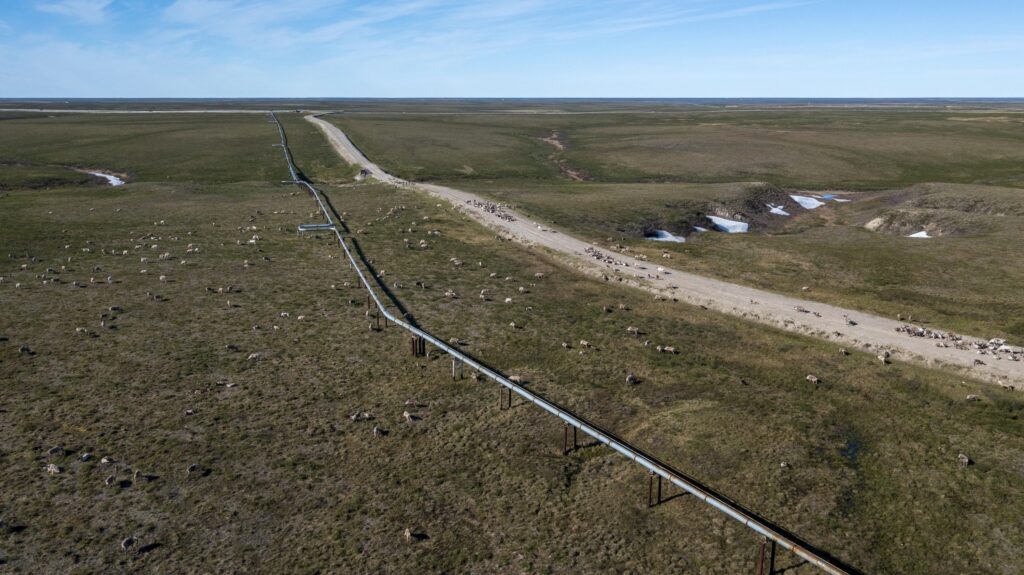
For decades, gas and infrastructure projects have been developing on Yamal, affecting the economy and land use of the peninsula’s Indigenous peoples, the Nenets, Khanty, and Selkup. Gas expansion has led to structural changes across the territory: it alters conditions for nomadic movement, access to tundra pastures, and wild reindeer migration routes, and affects fishing and culture as a whole. As the effects stem not so much from individual facilities but from the cumulative impact of long-term development, it becomes increasingly difficult for Indigenous communities to link specific harm to a particular project and to defend their rights.
Overlapping personnel
Financial ties to the fuel and energy sector were compounded by overlapping personnel. The Noyabrsk branch of the association was headed for about fifteen years by Sergei Moldanov, who worked at Noyabrskneftegaz. Alexander Nakhrachev, elected head of the “Yamal to its Descendants!” branch in 2020, also works at an oil and gas company. Association members avoid publicly discussing potential conflicts of interest and staff members’ administrative dependence on oil and gas companies; in some cases, working for a fuel and energy company is even presented as a positive example. Association members, for instance, attributed the easing of tensions between the Indigenous people and energy companies to Moldanov’s work: “It is largely thanks to him that the hatchet was buried between the Nenets and the oil workers: in the early 1990s, pickets on industrial access roads were not uncommon.”

The current head of “Yamal to its Descendants!” explains the organization’s shift in priorities as a response to changing demands from residents themselves: “Whereas environmental problems used to be the top priority, today people are more concerned with the social agenda.”
Today, the issues considered the legitimate sphere of work for associations embedded in the power vertical, including “Yamal to its Descendants!,” are social support, housing provision, education, and, to some extent, traditional economic activities. Within these areas, the organization works with government bodies on relevant issues. It also provides targeted assistance: for example, offering material support to people with special needs and low-income residents, arranging sanatorium treatment, organizing schoolchildren’s participation in folklore festivals, and other cultural and educational events.
What else does the association do?
Among the issues on which Indigenous politicians and associations embedded in the power vertical seek to engage with authorities and defend residents’ interests is the criminal prosecution of Indigenous people for poaching, a problem rooted in the difficulty of obtaining quotas and the strictness of relevant laws. “Yamal to its Descendants!” has advocated on behalf of Indigenous “poachers.” The association has called for ensuring that Indigenous children in boarding schools receive food consistent with their traditional diet.
A critical issue for the life of Indigenous peoples is improving the legislative framework protecting their rights. At present, Russian law falls short of international standards in this regard: for example, instead of the term “Indigenous peoples,” there is a narrower, specific term, “Indigenous minority peoples,” while free, prior and informed consent from Indigenous peoples to extractive activities on their lands is not legally required; instead, the law provides only for consultation. Regional specifics and the body of regional legislation also matter. In the YNAO, for instance, the “Law on Reindeer Husbandry in the YNAO” was adopted in 2016, a law unique within Russia. It legalized private reindeer-herding operations and introduced state support measures for private reindeer herders. The law had been in preparation since 2012 with the association’s participation.
The role of “Yamal to its Descendants!” in shaping Yamal’s legislative framework for preserving the traditional way of life was noted by Sergei Yamkin, chairman of the YNAO Legislative Assembly, whose sister went on to head one of the association’s branches.
This narrow specialization leaves no room for confrontation in cases of serious violations of Indigenous rights, for instance by extractive companies, and forces the association to operate within serious constraints, defending the rights and interests of Indigenous peoples primarily in situations that do not come into conflict with the interests of administrative elites and extractive companies.
Inconsistent representation
In 2021, Grigory Ledkov, a senator from the YNAO and a member of the United Russia party, was elected to a third term as president of RAIPON, the Russian Association of Indigenous Peoples of the North, Siberia and the Far East, an organization he came to lead after its co-optation by the state. According to Eduard Yaungad, head of “Yamal to its Descendants!,” it was his organization, which belongs to RAIPON’s umbrella structure, that nominated Ledkov for a new term.
The organization also maintained good relations with another United Russia senator, Alexander Novyukhov, who took over from Ledkov as RAIPON president in 2025. In 2017, when he was still a deputy in the Ugra regional legislature, Novyukhov stated: “‘Yamal to its Descendants!’ is our strategically important partner in resolving many issues. Today, it is the only public organization of Indigenous peoples in Yamal that has managed to build a constructive dialogue with government bodies at all levels and with fuel and energy companies.”
Related: On Novyukhov’s ties to extractive companies
This “constructive dialogue” is also evident in the close ties between “Yamal to its Descendants!” and the state. The organization’s first head, prominent northern politician Sergei Kharyuchi, served as chairman of the YNAO Legislative Assembly from 2000 to 2018. He is a member of United Russia, where he holds the position of deputy secretary of the Yamal branch responsible for Indigenous affairs.
The current president of “Yamal to its Descendants!,” Eduard Yaungad, is also a United Russia member. He combines his role at the association with work on the YNAO Legislative Assembly’s committee on agro-industrial development and Indigenous minority peoples’ affairs.

The connection to the region’s legislative assembly can also be traced at the level of “Yamal to its Descendants!” branches. In 2023, for example, the Salekhard branch was headed by Tatyana Serotetto, a cousin of YNAO Legislative Assembly speaker Sergei Yamkin and a member of the assembly’s staff. At the time, sources in regional media reported that her appointment at the association could serve as a springboard into a public political career. Later, in 2024, Yamkin appointed her head of the assembly’s administrative staff.
The ties between “Yamal to its Descendants!” and regional authorities are not limited to personal relationships among its leaders and members. The association has the right to nominate its representatives to councils of representatives of minority peoples attached to the heads of municipal formations, takes part in conducting elections by nominating its members as precinct election commission members with voting rights, and receives subsidies from the regional budget under the program “Preservation and Sustainable Development of the Indigenous Minority Peoples of the North in the YNAO.”
This position gave “Yamal to its Descendants!” direct access to government bodies and opportunities for legislative work. One result of this was the adoption of a reindeer breeding law unique to the region.
However, what once expanded the association’s ability to defend Indigenous interests may today constrain its decision-making, including on political matters, at a time when opportunities to protect Indigenous rights, always heavily dependent on officials’ goodwill given the flawed legal framework, are continuing to shrink. For example, as far back as 1991, association representatives took part in adopting a resolution on the state status of the YNAO, and in 2004 the association advocated for autonomy within the “matryoshka” structure of Tyumen Region, proposing that YNAO authorities merge with the Nenets and Dolgano-Nenets (Taymyr) Autonomous Okrugs in order to “preserve their political and economic independence from Tyumen and keep in their own budget the 15 billion rubles that would otherwise go to the federal budget.”
By 2014, however, the then-president of “Yamal to its Descendants!,” Edman Nerkagi, stated that the association “warmly supports the initiative of the Yamal parliament to abolish direct gubernatorial elections” in favor of a system in which governors are effectively appointed by the president, a shift that naturally limits the ability of Yamal residents, including Indigenous people, to directly influence the policies pursued by the authorities.
Political ‘pacifier’
Created to defend Indigenous rights at the political level, “Yamal to its Descendants!,” along with similar organizations, was gradually constrained in this role. But as Russia’s political landscape shifted, it became politicized once again, this time through its incorporation into the ruling structures.
For example, in 2012, amid large-scale protest actions across Russia, the then-president of “Yamal to its Descendants!”, Edman Nerkagi, attended rallies in support of Vladimir Putin. “The path our government and our autonomous okrug are on today is stable, and this needs to be understood and preserved,” Nerkagi said at the time.
In 2014, the Muravlenko branch of the association condemned the situation on its website and “supported law enforcement bodies in investigating information published online about poaching by the politician Navalny.” At the time, activists from the All-Russian Society for Nature Conservation had called for photos posted on the politician’s social media to be checked for illegal hunting. There is, however, no information in open sources of any connection between Navalny’s alleged hunting activity and the Yamal region.
Then, in January 2018, shortly before the presidential election and amid protests over Alexei Navalny’s exclusion from running as a candidate, “Yamal to its Descendants!” joined the ProRF project, an initiative launched by the Federal Agency for Ethnic Affairs to “strengthen national unity” and “raise the level of patriotism”.
Related: What the Federal Agency for Ethnic Affairs is doing and how it is connected to the security services
The association’s close ties to the state and its policies have repeatedly drawn criticism from local communities. In field notes from researchers, local experts said openly that the association is made up of people loyal to the authorities and that it “acts as a political pacifier, including in its relations with those developing the land.”
One of the most prominent critics of the association is Yeyko Serotetto, a well-known activist, reindeer-herder blogger, and member of the Communist Party, who has his own loyal following among local residents and runs the “Voice of the Tundra” group on the VK social media platform. Yeyko has repeatedly criticized “Yamal to its Descendants!” for inaction in defending the rights of his fellow residents and has himself faced pressure from the authorities.
In 2018 and 2021, Serotetto ran for a seat in the Yamal Legislative Assembly on a platform focused on providing housing for Indigenous peoples. He was not elected, but continues to help people by drafting appeals to government bodies, describing this work with the phrase: “this isn’t politics.” The issues the activist raises concern local residents directly: a shortage of pasture land, housing, and relations with regional authorities and the fuel and energy sector.

One of the projects Serotetto has opposed is Obsky LNG, controlled by Novatek. According to community activists, construction of this liquefied natural gas plant is contributing to the destruction of lichen by heavy machinery, while a waste disposal site is polluting the tundra. Khatyako Yezyngi, an advisor to the head of the Yamalsky district who led “Yamal to its Descendants!” in the 1990s, told local residents that “the land is federal, no one is obligated to listen to you.”
Among Yeyko’s supporters is well-known Nenets writer and former YNAO Legislative Assembly deputy Nina Yadne, who has criticized “Yamal to its Descendants!” in numerous publications, calling it “helpless, silent, and dependent.”
The current head of “Yamal to its Descendants!,” Eduard Yaungad, criticizes Yeyko Serotetto, arguing that “a reindeer herder should stay out of politics.” According to him, “someone cannot consider himself a genuine reindeer herder if he is staying in contact with foreign agents and speaking on behalf of Khodorkovsky and Navalny.”
Other officials have accused “Voice of the Tundra” activists of waging an information war, artificially manufacturing a point of tension, and engaging in propaganda. In 2024 Yeyko Serotetto published a collective appeal from residents of five YNAO districts, which was later submitted to the governor. The signatories complained about Indigenous representatives within government structures who, in their view, failed to defend their rights and did not help resolve specific problems. The association and its representatives were among those criticized.
Serotetto is not the only one; other members of the Communist Party have also criticized “Yamal to its Descendants!” for inaction, for example on the issue of inflated food and gasoline prices at Yamal trading posts (faktorias).
The association at war and at the UN
After Russia’s full-scale invasion of Ukraine, the consequences of the integration of “Yamal to its Descendants!” with Russian ruling structures, through personal ties and institutional activity, became more pronounced. This manifested, in particular, in the association’s participation in pro-war activities and in so-called “Indigenous diplomacy.”
In 2022, the association publicly backed RAIPON’s decision to endorse the so-called “Special military operation.” That same year, the movement held an extraordinary congress, at which amendments to the “Yamal to its Descendants!” charter were made to expand the organization’s powers in relations with the fuel and energy sector. Besides, a new board member was elected, Artur Lyrmin, a veteran of the Second Chechen War and former head of the association’s Tazovsky branch, who was set to oversee a potentially sensitive area, issues of cooperation with the oil and gas sector.
What was Lyrmin known for as head of the Tazovsky branch?
In 2013, Artur Lyrmin, representing the association’s Tazovsky branch, took part in public hearings on the environmental impact assessment for Yamal LNG’s Sabetta port construction project. According to the hearing minutes, he presented data from a survey of Tazovsky district residents, according to which the association had surveyed and informed 590 people about the project: of these, 392 people agreed with carrying out the works, 197 opposed it, and one abstained. The survey report summarizes the position of the nearly two hundred people who opposed the project in a single sentence: according to it, they were concerned about potential damage to the fish fauna of the Gulf of Ob and the resulting impact on traditional fishing.
Comments on the project documentation were recorded only from the YNAO administration’s department of natural resource regulation, while the views of Indigenous residents on the project’s implementation were effectively reduced to a simple “for or against” tally. This falls far short of a “free, prior and informed consent” procedure, and although the formal process was observed, “Yamal to its Descendants!” appears here to function more as part of the mechanism for formally rubber-stamping the project than as a structure defending the rights and voice of Indigenous people.
The following year Lyrmin left to fight in Ukraine, and in 2025 he was elected to the Tazovsky district legislature. Notably, another former head of the Tazovsky branch of “Yamal to its Descendants!”, Vitaly Satykov, is also fighting in Ukraine.
In 2023, the head of “Yamal to its Descendants!,” Eduard Yaungad, published a letter from an association member, described as “one of the commanders of the Russian Armed Forces with the call sign ‘Sever’ on the Krasny Lyman front,” thanking the association for its support, letters, and “humanitarian” shipments from “children back home.” According to media reports citing organization members, its activists “collected humanitarian aid during the Special military operation.” Yaungad has repeatedly reported on such shipments, which have included Starlink satellite systems, and has personally visited “the zone of the special operation.”
After 2022, representatives of “Yamal to its Descendants!”, including Eduard Yaungad himself, have repeatedly spoken at UN events on Indigenous issues. In this context, it is significant that at one of the few international venues where Russia remains represented to the same extent as before the full-scale invasion of Ukraine, the speakers on human rights issues are administratively dependent representatives of the association, some of whom simultaneously hold positions as officials or deputies from the ruling party.

In 2022, Eduard Yaungad gave a presentation on the everyday lives and living conditions of Indigenous peoples at the 21st session of the UN Permanent Forum on Indigenous Issues in New York. There, he spoke about the “modern regulatory and legal framework” for the sustainable development of Indigenous peoples on Yamal, citing 58 forms of support for nomadic herders and 14 state programs, payments, and cultural preservation initiatives. According to Yaungad, “[the culture of the Indigenous minority peoples of the North] is Russia’s national heritage. It is precisely this principle that underlies the regional policy for protecting the rights and interests of Yamal’s Indigenous peoples.”
He also stated that “this year the problem of the politicization of the international treaty process on Indigenous issues has become particularly acute,” called for objectivity in representing Indigenous peoples’ interests at the level of international cooperation, and warned against “viewing things one-sidedly,” “based only on statements made by people who have not lived in the Russian Federation for a long time, yet still allow themselves to speak on behalf of Russia’s Indigenous peoples.”
In 2023, at the UN forum’s subsequent 22nd session, Yaungad said in an interview that the purpose of his trip was “to convey to the international community information about the life of Indigenous peoples on the territory of the Russian Federation,” as well as to talk about “the impact of sanctions against Russia on the livelihoods of the Indigenous population.”
Related: How the protection of Indigenous rights works in Russia
At the 24th session of the UN forum in New York in 2025, Yaungad “the experience of Yamal reindeer herders,” “spoke about the support measures that regional authorities and major Yamal companies provide to reindeer herders,” and complained about “one-sided information or false claims about the real state of affairs” in Russia.
This presentation format, with its emphasis on showcasing “success stories” and its omission of systemic problems, can be seen as an element of “Indigenous diplomacy” and one of the few remaining channels for advancing Russian state interests on international platforms. But beyond that, this approach runs counter to the purpose and mandate of the UN Permanent Forum on Indigenous Issues.
The forum is conceived as a venue for discussing the challenges Indigenous peoples currently face and for developing recommendations to states and UN bodies on how to address them. When the emphasis instead falls on presenting a positive image of the situation, it narrows the space for substantive dialogue and the exchange of practices aimed at resolving these problems.
This approach also runs counter to the logic of the United Nations Declaration on the Rights of Indigenous Peoples, which proceeds from an acknowledgment of these problems and the need to address them, including, for example, upholding the principle of free, prior and informed consent for projects affecting Indigenous peoples, a principle that Russia fails to observe even at the declarative level, since it is not enshrined in law. As a result, Russia’s participation in this format does less to advance the forum’s stated goals and protect the rights of Russia’s Indigenous peoples than it does to delegitimize statements by Russian Indigenous people living in exile.
Арктика сьогодні