

At the very beginning, the civilizational and ethnocultural incompatibility of the Russian autocratic-bureaucratic empire and the entire way of life of the Caucasian highlanders, with their remnants of military democracy, tribal structures, and customary law (adat), was revealed.
Islam played far from the first role here, because it had not yet had time to take root in the local /runt, because, for example, the Chechens accepted Islam quite late – at the end of the 18th century. Therefore, even today in these societies, Sharia is forced to wage a not always successful struggle against adat. The incompatibility of the two cultural worlds became most acutely expressed at the beginning of the 19th century, when the highlanders, pressed against the main Caucasian ridge, had nowhere to retreat. Many Russian poets paid tribute to the Caucasian War: Pushkin, Lermontov, Bestuzhev, Marlinskyi, etc. Pushkin spoke with unusual emotion about the bloody punitive expedition of Field Marshal Kotlyarevsky (among others, our countryman):
“Your course, like a black plague, destroyed and destroyed the tribe,” which made another Russian poet Vyazemsky remark: “The word of the poet should not turn into glorifying carnage.” Active hostilities with minor interruptions continued for almost 50 years. The Eastern Caucasus stopped resistance in 50tho years of the 19th century, Western — in the 60s. As always, the Russians justified this expansion with geopolitical interests: the need to ensure direct communication with Transcaucasia, the approaches of Turkey, etc. But the Highlanders did not deeply care about St. Petersburg’s interests. When a Russian general told an old mountaineer that the Turkish sultan had ceded this region to Russia, he pointed to a flock of birds on a tree and replied: “I cede these birds to you. Take them if you can.”
Up until 1917, the opposition to Russia in the North Caucasus took place in the form of the so-called movement of abreks, people who did not recognize the laws of the empire and its power. On horseback and with a gun, they established justice themselves, ignoring Russian courts and orders.
After 1917, the mountaineers mass and armed themselves against the empire. General Denikin has to keep almost half of his army in the south, against the rebellious Caucasian auls.
The empire knew only one logic – the logic of unrestrained territorial expansion. In 1900, in a memorandum on the state of the army and its needs, the Minister of War of Russia, Adjutant General Kuropatkin, reported to the sovereign about the country’s huge territorial gains over two centuries of its history, and anxiously asked whether it was worth expanding further, or whether it was time to stop ? But he asked in vain, because in 1905 the war with Japan began for the right to annex Manchuria and call it “Yellow Russia”. Although, for the sake of justice, it should be noted that sometimes common sense and instinctive caution were enough. When, at the beginning of the 20th century, one brave lieutenant colonel, chasing an “illegal armed formation” in the territory of Russian Turkestan, according to modern terminology, invaded Afghanistan, captured two northern provinces and sent a dispatch to St. Petersburg, demanding that he be given 3-4 reinforcement regiments in order to the whole of Afghanistan was annexed to the empire – a telegram from the sovereign to the command of the Turkestan district arrived from the capital. It was very concise and consisted of three words: “The fool will be returned immediately.”
Unfortunately, in 1979, there was no powerful person in Moscow who would be able to issue such an order, and the imperial legions invaded Afghanistan, contrary to the warning of the great “conqueror of the universe”, Timur Tamerlan: “Afghanistan is a beehive where there is very little honey , but there are too many ferocious bees.”
Ruslan Aushev, lieutenant general of the Russian army, president of Ingushetia and Hero of the Soviet Union (for Afghanistan) said about the latest events in the North Caucasus: “I have not yet heard from the federal center any reasonable opinion about the Chechen problem. And if they want to fight in Chechnya, let them fight. But they remember that the uprising against the Bolsheviks began here in 1926, and the last rebel was killed in the mountains in 1976!”
Today, the republics of the North Caucasus have an extremely difficult socio-economic situation: unemployment (almost 90 percent of those able to work do not have a job), corruption of pro-Moscow government structures, lack of any prospects for the majority of the population. The so-called transfers – monetary aid from the federal center are regularly stolen by local tsars, and this is a kind of compensation for their loyalty to Moscow.
In this context, it is worth looking at the events in Dagestan: in the villages of Karamakh and Chabanmakh (the centers of Wahhabism), the standard of living was higher than the average in the republic due to both their own work outside Dagestan (freight transportation on their own trucks) and the absence of social stratification between by the government and the population, because Wahhabism requires each member of the Muslim community “umma” to take care not only of himself, but also of the entire community. Against the background of the fantastically corrupt Dagestan party-economic elite (which has not undergone noticeable changes since the time of K. Chernenko), such Muslim “communism” was an extremely irritating factor. It is impossible to solve this problem by force of arms, even by destroying these villages. And here Moscow falls into a trap – what to do? Violence will not improve the situation in Dagestan, giving money (even if it were in the center) is supposed to be necessary, but there are no guarantees that it will reach the majority of the population through the local leadership. Because the soil for new explosions in Dagestan, the socio-political soil (corrupt government despised by the people), economic (poverty and unemployment), ideological (the attractiveness of Wahhabi “communism” with its slogans of equality, brotherhood and justice for all believers) remains. The old Communist elite, the ethno-political clans of the Avars, Dargins, Lezgins, Laks and Kumyks, having divided the trade in wool, cattle, fish, and border contraband, drive around in Mercedes. And what about the majority? For the majority – Wahhabism.
Official Moscow understands this, but what can you do… Try to recruit these old, proven cadres, and they will organize such a “national-liberation” movement… We can only wait to see who will win: the party-hospital activist will defeat the Wahhabis or the Wahhabis will defeat the party-hospital activist…
Similar processes, sometimes faster and sometimes slower, are taking place in other regions of the North Caucasus. Ingushetia did not allow to close its border for Chechen refugees, which means that the widely publicized sanitary border against Chechnya will have a big hole.
The very acute Ossetian-Ingush conflict has not yet been resolved. When the Ingush were deported in 1944, the so-called Prigorodny district from the Grozny region, which arose on the site of the abolished Chechen-Ingush republic, was transferred to Ossetia. The Ingush public demands its return, but it is even technically difficult to do so, because over the years it has become an organic part of the Ossetian capital city of Vladikavkaz. In the early 1990s, armed clashes between the Ingush and Ossetians already took place, in which units of the Russian army took part on the side of the Ossetians. Hundreds of people died. Even today, it is not clear how, even in principle, this situation can be resolved.
The conflict between the Karachays and the Circassians in the Karachay-Cherkess Republic is potentially dangerous, where, despite the indignation of the Circassians, a native of Karachay, the former commander-in-chief of the Russian ground forces, army general Volodymyr Magomedovich Semyonov, was elected president (he was dismissed during the hostilities in Chechnya, probably due to family circumstances – a Chechen wife). In the mountainous part of the republic, in Karachay, according to the Russian press, training camps of Islamic rebels have been recorded.
Karachay is the most backward, poor and unorganized part of the autonomy. Among other things, among the 14 persons arrested by the federal authorities who are suspected of committing terrorist acts in Moscow, Volgodonsk and Buynaksk, 13 are residents of Karachay-Cherkessia. In the mountainous, Balkar part of Kabardino-Balkaria, the situation is approximately the same, there is also its own general, national leader, former deputy commander of the Transcaucasian Military District, Sufiyan Beppaev.
In the Republic of Adygea, the process of slow but steady displacement of the Russian population continues.
In Stavropol Region and Northern Dagestan, the ideas of Wahhabism are clearly attracting the Nogai Turks, who, according to the Russian mass media, even formed a Wahhabi regiment. All these phenomena cause confusion, panic and hysterical reactions in the circles of the Russian political elite, a strange mixture of fear, aggression, helplessness and imperial supremacy. In the Russian political analysis concerning the North Caucasus, one can notice a blatant ignorance of the real situation, and a purely Moscow messianic limitation in understanding the national issue in general, and the Caucasian issue in particular. Even during the first Chechen war (1994 — 1996), the famous analyst, expert on the Caucasus, academician of the Russian Academy of Sciences Serhiy Arutyunov tried to reach the Kremlin strategists, trying to explain to them first that the Chechen problem cannot be solved by military force, and then that a personal meeting between Yeltsin and Dudayev can radically improve the situation. Dudayev was killed, but the meeting he requested never took place. Today’s Aslan Maskhadov is not opposed to a meeting with Russian Prime Minister Putin, who, in the spirit of a Caucasian governor who does not recognize a wild abrek, refuses, motivating the refusal by the fact that, they say, Maskhadov does not control anyone in Chechnya. I would like to know whether V. Putin controls much in Russia, apart from the press, of course.
From individual statements of the “iron Vovik” (by analogy with the pupil of the same system “iron Shuryk” – Shelepin) it can be understood that the level of his energy significantly exceeds the level of understanding of problems. There are repeated attempts not to solve the Chechen problem, but to destroy it physically. But over all this, like the sword of Damocles, hangs the threatening question: “What’s next?”.
Let’s imagine that the federal forces took Grozny for the second time, installed the Russian tricolor on the presidential palace, created a puppet government and local authorities. They put a pledge in every village and… ensured themselves long years of guerrilla warfare, when they shoot from the most unexpected places, when mines suddenly appear, where they shouldn’t be, where moving on the roads becomes a matter of true heroism. And how many troops should be kept there – 50, 70, 100 thousand, and for how long? By the way, according to the reports of independent experts, the Dagestan campaign cost Russia 2 billion dollars… During this time, a lot of unforeseen things happened. In particular, to fight against the Wahhabis, the population of Dagestan was given weapons, it is no longer possible to take them away. Considering the very tense situation and the very complicated ethno-social structure of this republic, it is difficult to say where it will shoot, this weapon…
In addition, now there is a strong force of soldiers in these areas, and knowing that the Russian “soldiers are brave boys” are clearly not Roman legionnaires with their iron discipline (according to ancient historians, after the Roman camp collapsed in the apple orchard, there not a single apple was plucked, because it is not possible without the centurion’s permission) – then the attitude of the local population towards them can change significantly. Especially since many of these Russian boys have already undergone criminal education.
But the paradox is that no one has done as much to destabilize the Caucasus as Russian politicians. It is enough to mention the Russian adventures in Abkhazia, where the joint efforts of regular units of Russia and Jigits from the so-called Confederation of the Peoples of the Caucasus (mainly citizens of the Russian Federation) destroyed the Georgian government forces, and hundreds of thousands of Georgians were subjected to ethnic cleansing.
And really, where did Abkhazians, who number only 80,000, suddenly have airplanes, warships, etc.? It was there, in Abkhazia, that Shamil Basayev, Ruslan Gelayev and other Chechen field commanders gained their first military experience in interaction with the Russian military. But then it did not cause any indignation in Moscow.
Even the separatist South Ossetia (Shyda Kartli — Upper Kartli, as the Georgians call their territory) would never have been able to resist the official Tbilisi without the powerful support of Moscow and Vladikavkaz. And during the struggle of Eduard Shevardnadze against Zviad Gamsakhurdia, the marines of the Black Sea Fleet of Russia conducted combat operations against the Zviads in Western Georgia. During the Armenian-Azerbaijani war, Russia made multibillion-dollar deliveries of military equipment to Armenia.
Sooner or later, such shaking of the region, where ethnic explosives have been accumulated for ages, had to give results. The process was about to get out of control. What happened.
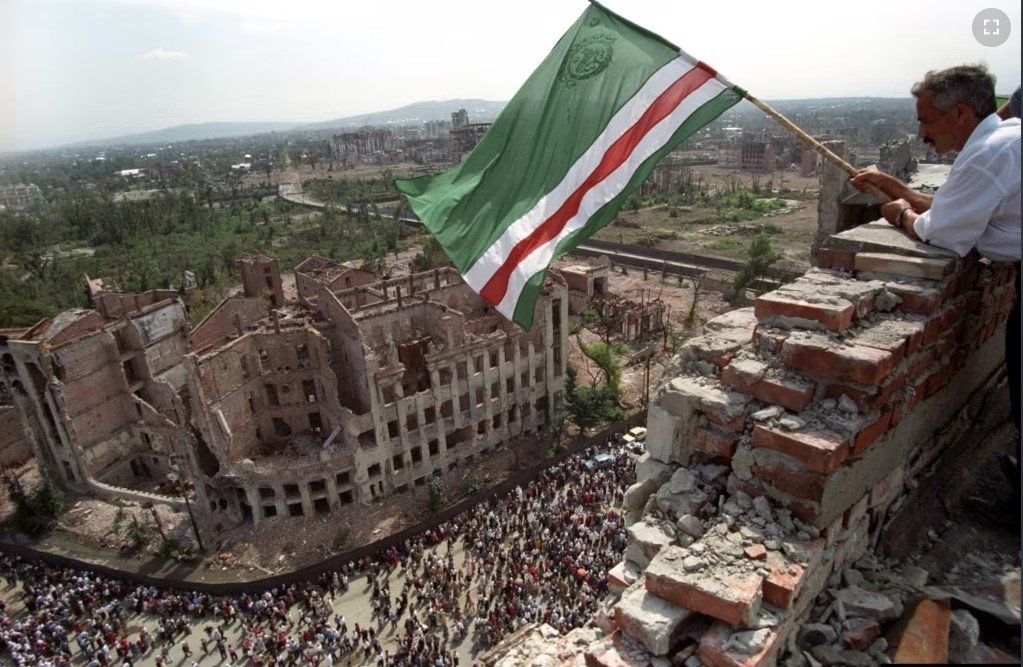
But the war in Chechnya had and continues to have the greatest destabilizing effect on the entire Caucasus. The Chechens, who found themselves in the sanitary border, have nowhere to retreat. That is why the vice-president of the republic Vakha Arsanov said: “We are ready to receive Russian troops. Welcome to hell.”
But there is no room for a retreat even for Russian Prime Minister V. Putin. For him, the road to the Kremlin passes through Grozny. However, today it is difficult to imagine all the consequences for Russian society of a new, quite possible defeat in the Caucasus. Then the boomerang will return. The impact of this “flying” device can be merciless…
Ihor LOSIV
http://Архів ОУН. - Бібліотека. - Газети.- Шлях Перемоги. - 1999. - 17 вересня. - С.4





